In His Father’s Footsteps: Ziad Qanou’s Endless Whirl and the Dream of a Global Stage
The sacred art of the Egyptian Tanoura through the rhythmic bond of a Sohag father and son preserving their Sufi-inspired heritage.
By Jehad Abdel-Rahim
Upon a modest rooftop overlooking the Upper Egyptian province of Sohag, a father and son bound their fates to a shared obsession long before they ever set foot on a public stage. Nourished by the rhythmic cadence of folk music and the meticulously practiced art of the spinning vortex, Ziad El-Sayed Qanou grew up in the shadow of his father, El-Sayed Qanou, a celebrated practitioner of the craft. Today, the younger Qanou carries that inherited flame, transforming what began years ago as an intimate family ritual into a grand ambition to represent Egypt on the international stage.
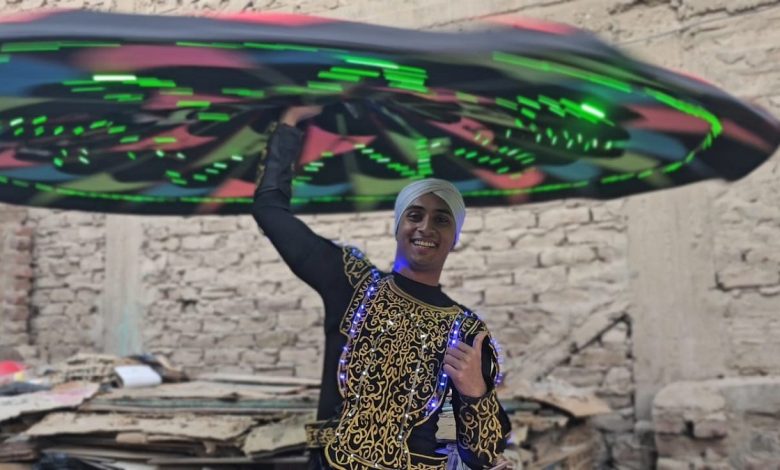
Despite the widespread ubiquity of the Tanoura (the traditional Egyptian folk dance characterized by heavy, multi-layered colorful skirts), audiences frequently conflate it with the broader Levant’s Mawlawiya (the Whirling Dervish order) since both practices anchor themselves in the art of the spin. Yet, the Egyptian Tanoura remains an inherently festive, theatrical folk art inspired by Sufi heritage. It distinguishes itself through vibrant colors, dramatic showmanship, and an active communion with the audience. Conversely, the Mawlawiya remains tethered to solemn spiritual rituals steeped in specific religious and symbolic meanings. Between this vibrant folk spectacle and that hallowed spiritual legacy, the father and son continue to preserve the Egyptian Tanoura, passing its secrets to a new generation.
The Father and the Son
“I inherited this craft from my father,” says Ziad El-Sayed Qanou, a high school senior and a renowned Tanoura performer in Sohag. “My education began on our rooftop when I was just five years old. It took long, arduous years of training before I could finally claim the stage alone. Now, my dream is to perform beyond the borders of Egypt.”
Standing steadfast behind Ziad is his father, El-Sayed Qanou, the pioneer who introduced the Tanoura to Sohag. The elder Qanou first encountered the traditional arts during school festivals and sports days in his preparatory years. He trained under the tutelage of instructor Gamal Abdel-Khaleq, who discovered his innate talent and ushered him into the ranks of the Sohag Palace of Culture as a young apprentice.
Thirty-Three Years of the Vortex
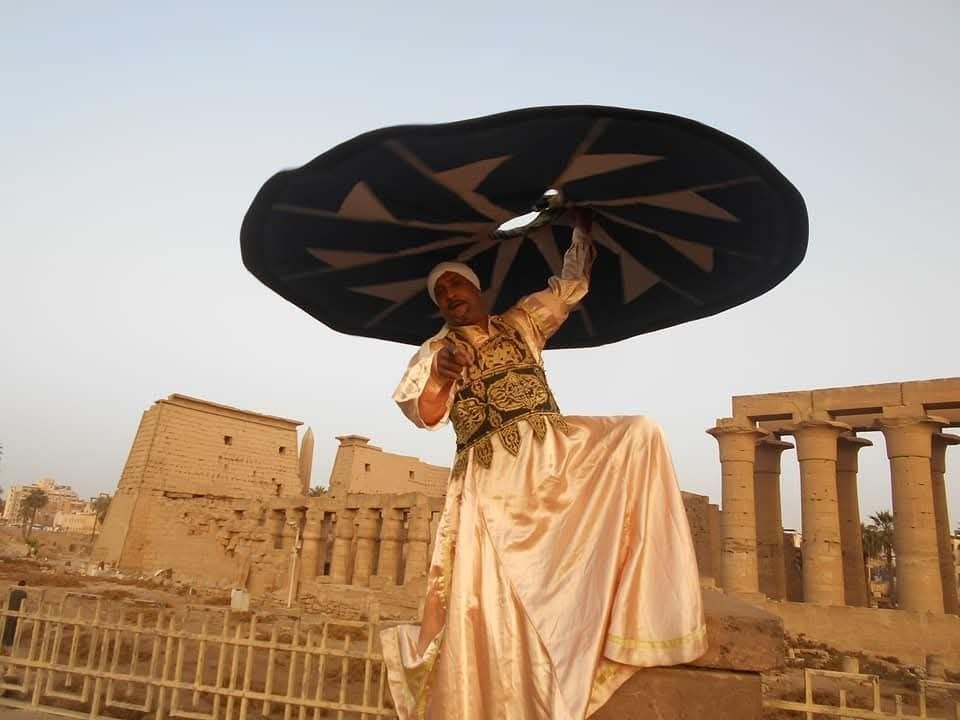
“I danced the Tanoura for nearly thirty-three years before retiring three years ago,” says El-Sayed Qanou, who has now passed his fiftieth year. “I joined the folk arts troupe at the Sohag Palace of Culture when I was fifteen. After years of mastering traditional folk choreography, my passion transformed into a profession that took me to festivals both across Egypt and abroad. Through constant travel and friction with diverse international troupes, I began searching for a distinctive artistic color to set me apart. The Tanoura caught my eye, and it was precisely what our province lacked.”
He continues: “At the time, we had no Tanoura instructors in Sohag. In fact, only one man, Mohamed Aya, practiced the art, and he performed exclusively outside the province. The local audience back then simply did not understand or absorb the art form. Thus, I became self-taught, using my work at the Palace of Culture to study visiting troupes.”
He adds: “I would interrogate the dancers about the secrets of their craft, asking how they maintained equilibrium amidst the spin. I learned what we call the axis of suspension, where one leg acts as a fixed anchor while the other drives the movement, precisely like a compass. I began practicing for just one single minute a day, gradually mastering the dizziness, day after day.”
The Son’s Ascent into the Spin
As the decades slipped by, El-Sayed Qanou did not keep the craft to himself; the passion transferred seamlessly to his son, who spent his childhood watching his father perform. The father recalls that his son was utterly captivated by the heavy skirts from infancy. When Ziad was five or six, his father tailored a miniature Tanoura to fit his small frame, omitting the heavy Seir (the leather weighted belt) so the child could move with ease and learn the basics.
The young boy would retreat to his room or scale the stairs to the rooftop, spinning for a mere five or ten seconds a day. Eventually, those tentative, childlike attempts blossomed into a source of livelihood and regional fame.
Despite Ziad’s early devotion to the dance, his father initially forbade him from turning it into a profession, insisting he first excel in his studies. Only later did he gradually impart the true orthodox techniques of the art. Ziad began donning the official heavy vestments, extending his practice sessions from five minutes to ten, and eventually achieving the zenith of endurance: two hours of continuous, uninterrupted spinning during major competitions.
The Love of the Dance
“I fell in love with the Tanoura as a boy, watching the performances at the Palace of Culture,” Ziad reflects. “I saw the reverence and respect the audience held for my father, and the pure joy he brought them. When I saw how captivated foreign spectators were when he performed abroad, I realized that he was speaking for the entirety of Egypt.”
On their rooftop, Ziad began mimicking videos of his father, scouring the internet for additional footage to deepen his understanding. By the time he was thirteen, he earned the title of best Tanoura dancer in his category, receiving accolades from both the Minister of Youth and Sports and the Alexandria Palace of Culture.
He continues: “I discovered that the Tanoura is not merely spinning and theatrical gestures; it is vastly deeper. As I spin, I feel myself purging all the negative energy trapped within me. That Sufi movement brings me closer to the Divine through silent supplication; I forget the world entirely. This realization only came after my father taught me the true spiritual foundation of the craft.” He adds with palpable pride: “I used to feel an immense joy performing under my father’s name, being requested by audiences solely because of his reputation. He handed me the banner, and he has stepped away from the stage.”
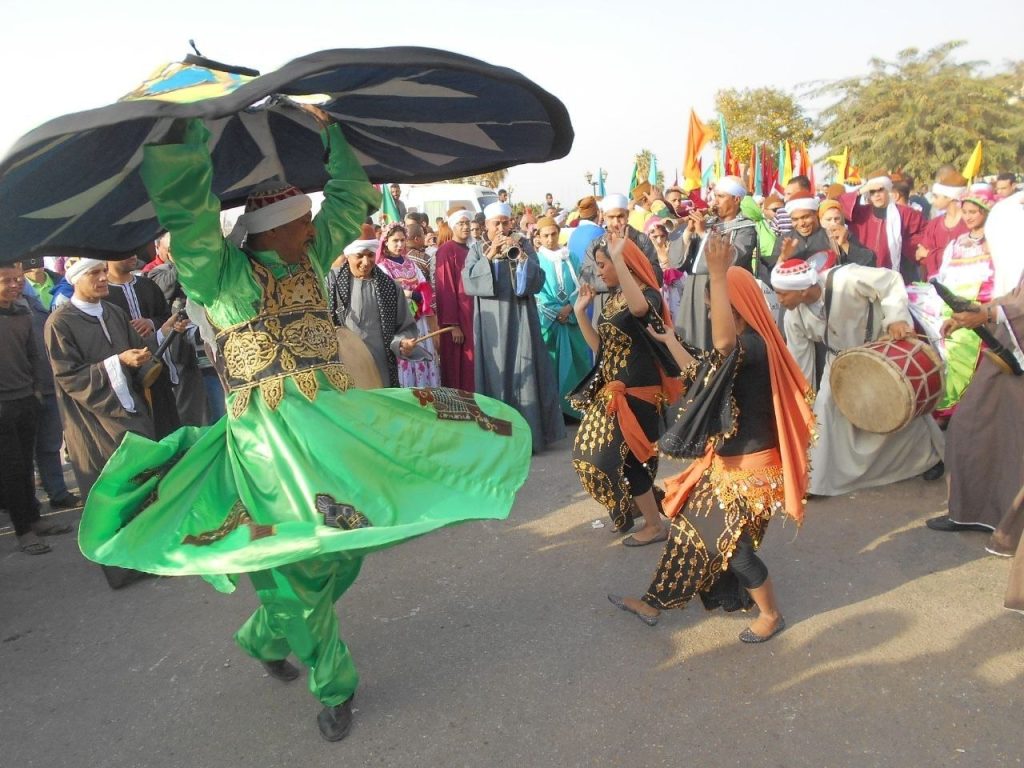
Honor and Heritage
El-Sayed Qanou, who currently earns his living as a civil servant in the Directorate of Health, emphasizes that his greatest achievement is not the fleeting whisper of fame, but the character of his son. “I taught him the old-school principles of honor and respect, how to carry himself among people, and how to revere his audience, even if he is performing for a single soul. When people praise his manners and credit his upbringing, I am filled with pride and contentment.”
Reflecting on the evolution of the dance in Egypt, the elder Qanou notes: “A profound shift has occurred between the past and the present. In the old days, the Tanoura cleaved closely to a austere Sufi minimalism; the attire consisted of nothing more than a simple Galabeya (a traditional loose-fitting robe) and a sash. Today, it has evolved into a theatrical spectacle tailored for weddings and celebrations, heavily reliant on dramatic lighting, kaleidoscopic colors, and garments adorned with sequins and phosphorescent materials.”
A Craft Without Age
Ziad believes that the Tanoura rejects the limitations of age, demanding instead absolute physical fitness and athletic discipline. He explains: “A dancer must treat his body with reverence, eating cleanly and cutting out fats to maintain agility. Smoking is out of the question. The Tanoura skirt itself can weigh up to twelve kilograms, demanding tremendous physical fortitude.”
Despite the demands of his art, Ziad clings tightly to his academic aspirations, striving for a seat in the Faculty of Computers and Artificial Intelligence, maintaining that the dance will always remain the passion closest to his soul. He concludes: “I dream of teaching my own children the Tanoura just as my father taught me, but I will not permit them to perform professionally until they have grown and completed their education.”
The Mawlawiya and the Tanoura: A Distant Kinship
Audiences frequently confuse the Mawlawiya and the Tanoura to the point where many consider them synonymous, yet the relationship between them is akin to genus and species, explains Dr. Massoud Shoman, a prominent researcher of folklore and cultural heritage.
Shoman expands: “The Mawlawiya is a historic Sufi order tracing back to its founder, Mawlana Jalal al-Din Rumi, its name derived from the honorific ‘Mawlana’ (Our Master) that preceded his name. The order gained renown through its founder’s call for spiritual cohesion, self-elevation, the renunciation of violence, and unity in the face of discord and chaos.”
“The Mawlawiya became the defining hallmark of this order, manifested in a dance built entirely upon the spin. These movements guide the human soul to ascend far above the impurities of the flesh, exiting the material world to soar into a state of ecstasy akin to Nirvana.”
“Accompanying the dance is the Nay (the traditional end-blown reed flute), which many consider the voice of nature itself, preparing the soul for its return to its celestial origin. The philosophy of the Mawlawiya expanded to encompass all races and creeds, where all partake in the dance in pursuit of spiritual transcendence.”
An Art Form Formed in Showmanship
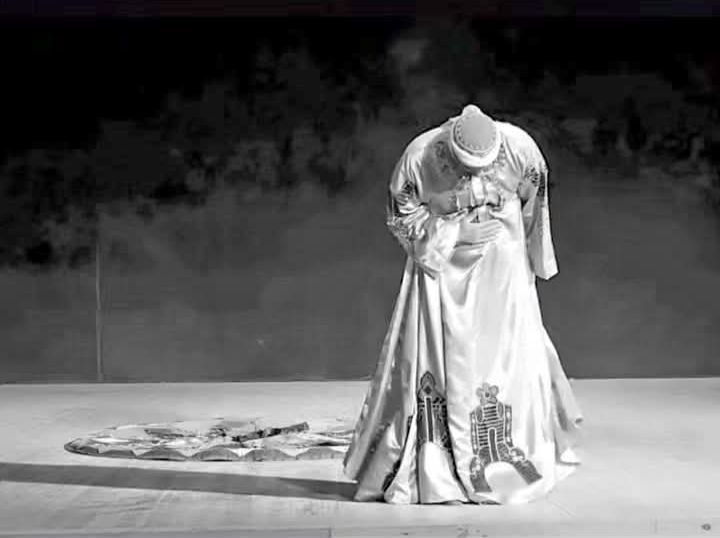
Shoman continues: “Within this context, the Tanoura emerges as a secular folk dance born from the womb of the Mawlawiya, mutating from a ritualistic, sacred dance concerned with divinity and heavenly ascension into a theatrical art form that merely touches upon the Sufi concept.”
“Despite the ubiquity of the Tanoura among almost all Egyptian folk troupes, it is not historically indigenous Egyptian folklore. Rather, Egyptian artists sought to internalize this dance, adapting it through the philosophy of the circle and the symbolism of completion, ecstasy, and arrival. The dancer revolves around the center of the universe, only to conclude at the exact point where his journey began.”
He concludes: “These dances represent a symbolic mimicry of the Earth revolving around the sun. Mortal man, molded from clay, spins around the light in a desperate quest to elevate his soul. Although the Tanoura did not originally sprout from Egyptian soil, the Egyptians displayed brilliant ingenuity in developing its forms, transforming it into a kinetic drama that mirrors the human journey from birth to death: man’s eternal struggle to elevate his spirit, shed the prison of the flesh, and achieve absolute completion through purity.”