The Silent Dialogue: Contemporary Dance Seeks a New Public in Alexandria’s Open Squares
Egypt’s ninth Contemporary Dance Night navigates the gap between artistic democratisation and the mystery of the moving body.
By Wafaa Amin
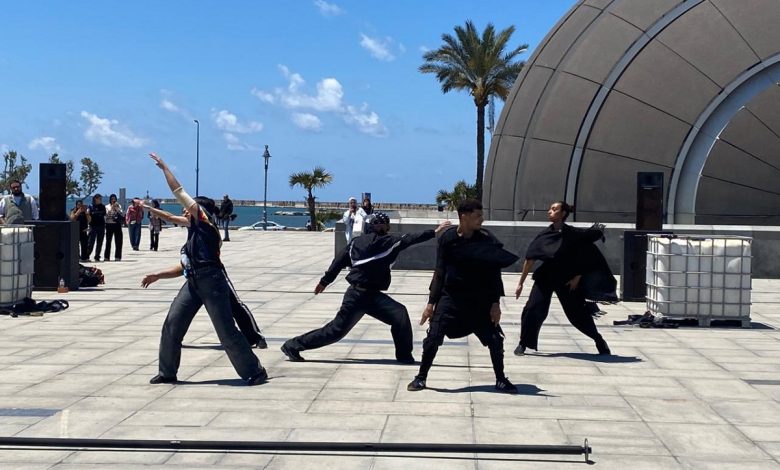
“I don’t understand a thing,” a spectator remarked during the “Contemporary Dance Night” festival at the Library of Alexandria’s open plaza. His companion replied by invoking a sentiment often attributed to Friedrich Nietzsche: “Those who were seen dancing were thought to be insane by those who could not hear the music.” It is a quote that perfectly distills the perceptual chasm between seeing and understanding; a gap that felt tangibly present in the plaza as the festival’s performances unfolded, drawing reactions that oscillated between deep admiration, sheer bewilderment, and outright rejection. Here, a vital question emerges: Does moving contemporary dance from the hallowed halls of the theater to the raw grit of the street bring it closer to the people, or does it merely shroud the art in further mystery, stripping it of its intended interiority?
The festival launched its proceedings in celebration of International Dance Day, which fell on April 29, beginning in Cairo before migrating to Alexandria on May 5 and 6, with its final curtain set for Menia. This ninth edition represents a deliberate attempt to liberate the medium from its traditional confines and thrust it into the public sphere, offering performances in open squares and streets, unburdened by barriers or tickets.
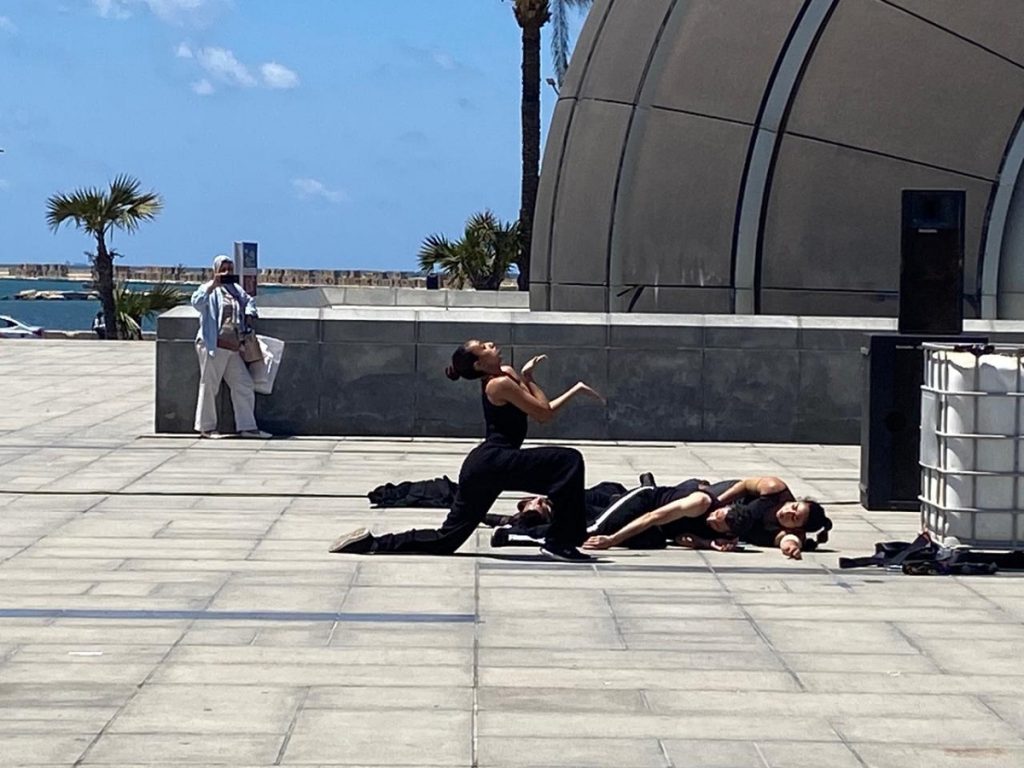
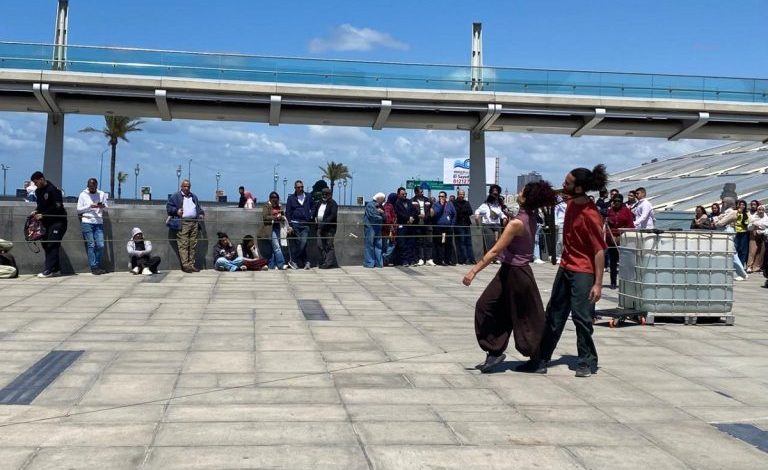
The answer to whether this transition succeeds may lie in the experience itself. In the first of the Alexandria showcases, Ahmed El-Gendy presented his work, A Point in the Middle. The piece explores the friction born when two souls collide; initially, they appear incapable of coexistence, but as the tension escalates, they strive to forge a shared language of proximity. The dancers’ movements felt like a continuous negotiation between dominance and surrender, between the urge to draw near and the impulse to recoil.
Regarding the street as a stage, El-Gendy believes that even a fleeting glance from a passerby might be enough to ignite a spark of interest. He notes that relocating art to the public domain “makes it accessible to everyone.” He further suggests that a divergence in audience interpretation is only natural, as the work does not dictate a singular truth so much as it flings wide the doors to a multitude of meanings.
This divergence of perspective was starkly evident in the crowd’s reactions. Some attendees engaged deeply, attempting to decode the choreography through their own personal lenses, while others remained mere observers, watching with a sense of startled curiosity at an experience that felt entirely foreign.
In another performance titled The Same Love, one participant confessed her initial hesitation about performing outside the theater’s controlled environment. She spoke of a lingering anxiety regarding the public’s temperament, yet that apprehension eventually transformed into a surge of adrenaline, despite the unpredictable nature of the responses.
As small crowds gathered, a fundamental dilemma surfaced: accessibility does not inherently guarantee comprehension. Is the mere presence of art in a public square sufficient? On one hand, taking these performances to the pavement is a leap toward the “democratization of art,” where it exists free of institutional gatekeeping. On the other hand, it risks becoming a transient spectacle; something the public passes by without a genuine attempt to read the subtext.
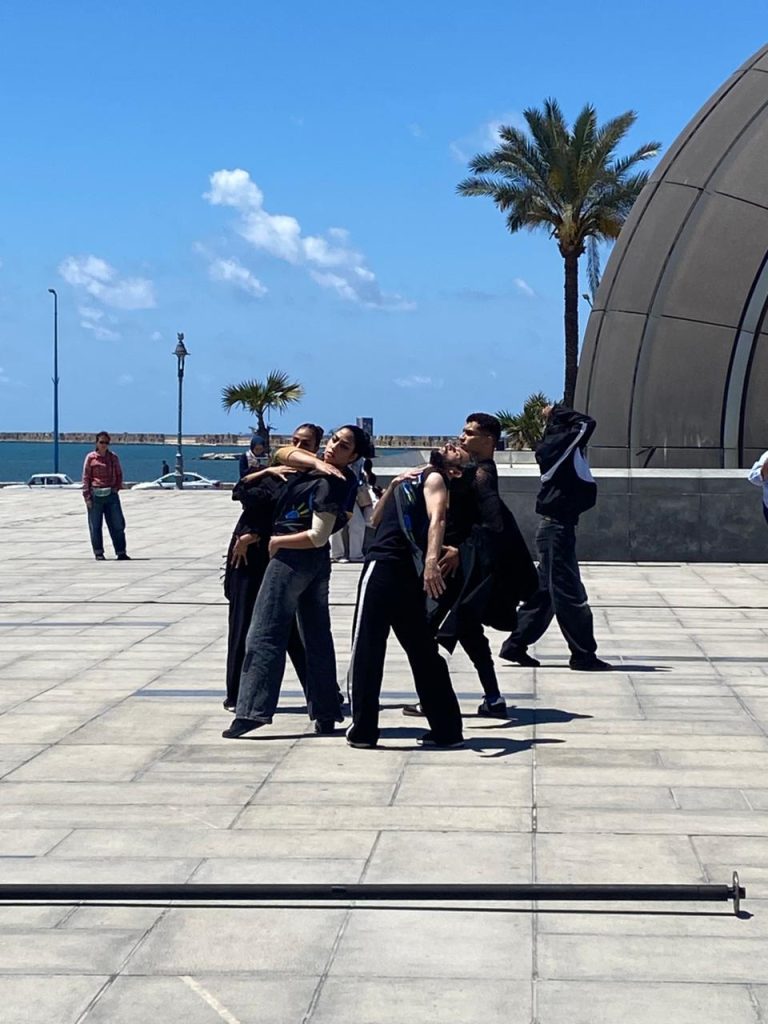
The Essence of the Contemporary: A Body Unbound
To seek an answer, one must first grasp the intrinsic nature of contemporary dance itself. As theater critic Mohie Ibrahim elucidated in a televised dialogue, contemporary dance functions as a fluid alchemy of diverse forms a synthesis of ballet, hip-hop, and folkloric dance. It offers an expansive territory for experimentation, anchored primarily in a philosophy of free physical expression. This medium favors horizontal movement and a visceral intimacy with the earth over rigid, vertical archetypes, transforming the body into a vessel for articulating complex philosophical or social inquiries.
While International Dance Day honors the legacy of Jean-Georges Noverre, the architect of ballet’s thematic foundations, contemporary dance emerged as a subsequent rebellion. It arrived as a movement designed to shatter established rules, seeking to liberate the human form from the pursuit of aesthetic perfection and reimagining the body as a tool for raw, individual truth. In Egypt, this contemporary art form began to crystallize at the dawn of the millennium, gaining professional momentum with the founding of the Cairo Contemporary Dance Center. This institution has been instrumental in cultivating a new vanguard of professional dancers and choreographers.
The Lexicon of Motion: Universal or Rooted?
With the participation of artists spanning the globe from Egypt and France to Spain, Switzerland, the United Kingdom, and the Netherlands a further question surfaces: does a universal language of the body truly exist? Or does contemporary dance remain, despite its experimental zenith, inextricably tethered to its local context?
There is no definitive resolution to be found, for contemporary dance thrives on the very act of contemplation. Between an audience striving for understanding and those content to simply observe, the experience is forged in the ephemeral moment of reception. Meaning is never static; it shifts and breathes according to the soul of the beholder.