The Tragedy of Azbakia and Imam Al-Shafi’i: How Architecture Rewrites Our History
Architectural revival of Egypt’s historic districts, exploring how urban heritage in Esna, Cairo, and Helwan serves as a vital anchor for community identity and sustainable economic development.
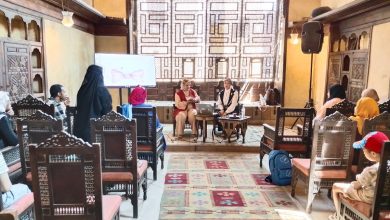
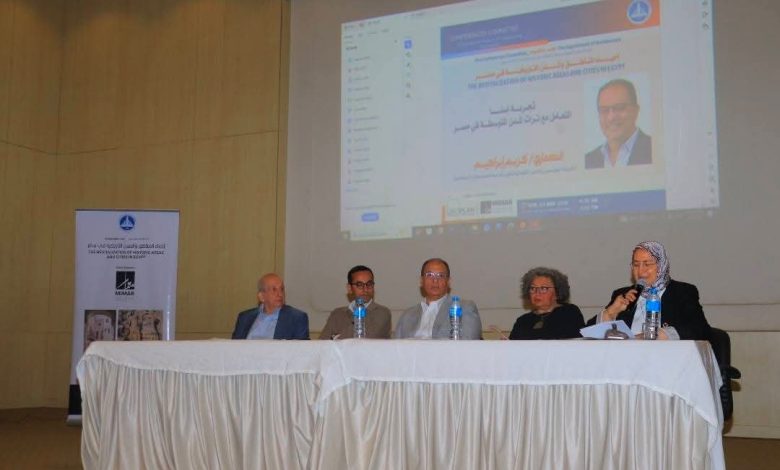
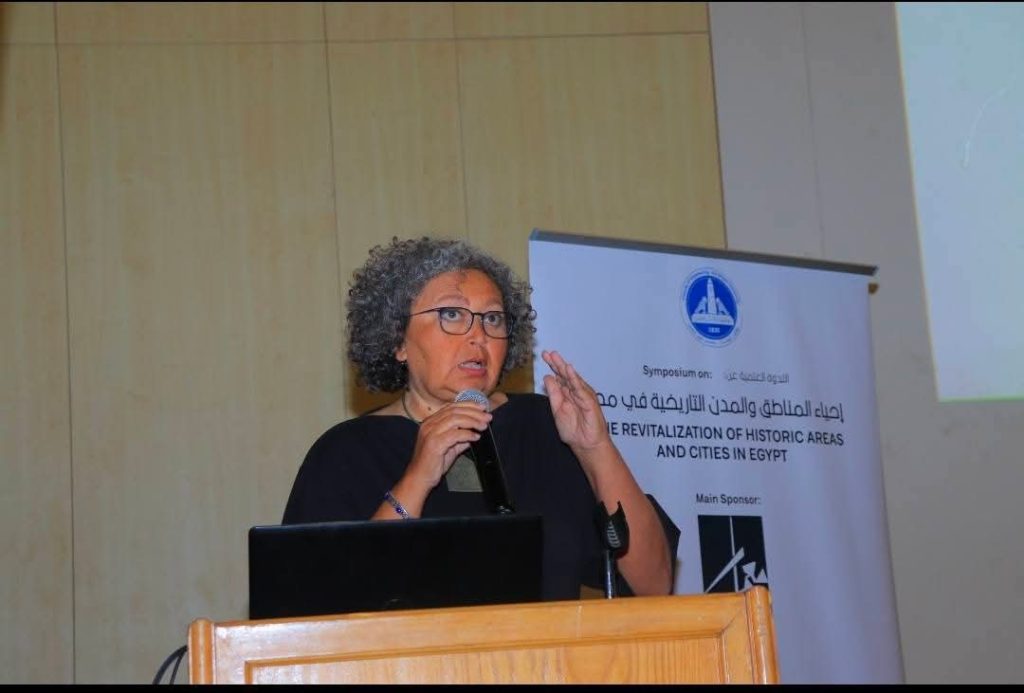
Last week, the Faculty of Engineering at Ain Shams University hosted a series of expansive academic seminars within the Department of Architecture. Supported by the technical expertise of the Aga Khan Program for Islamic Architecture and the Aga Khan Award for Architecture, the discussions interrogated the contemporary challenges and methodologies of reviving Egypt’s historic districts and urban centers.
The inaugural session, titled “Contemporary Experiences in the Revival of Historic Cities,” featured Architect Karim Ibrahim on the revitalization of Esna; Dr. Maher Stino, Professor of Architecture and Landscape Design, on the restoration of Cairo’s Azbakia Gardens; Architect Moaz Abu Zeid on the rehabilitation of the Capritage Gardens in Helwan; and Dr. May al-Ibrashy on the grassroots initiatives within Cairo’s Al-Khalifa district.
Layers of History
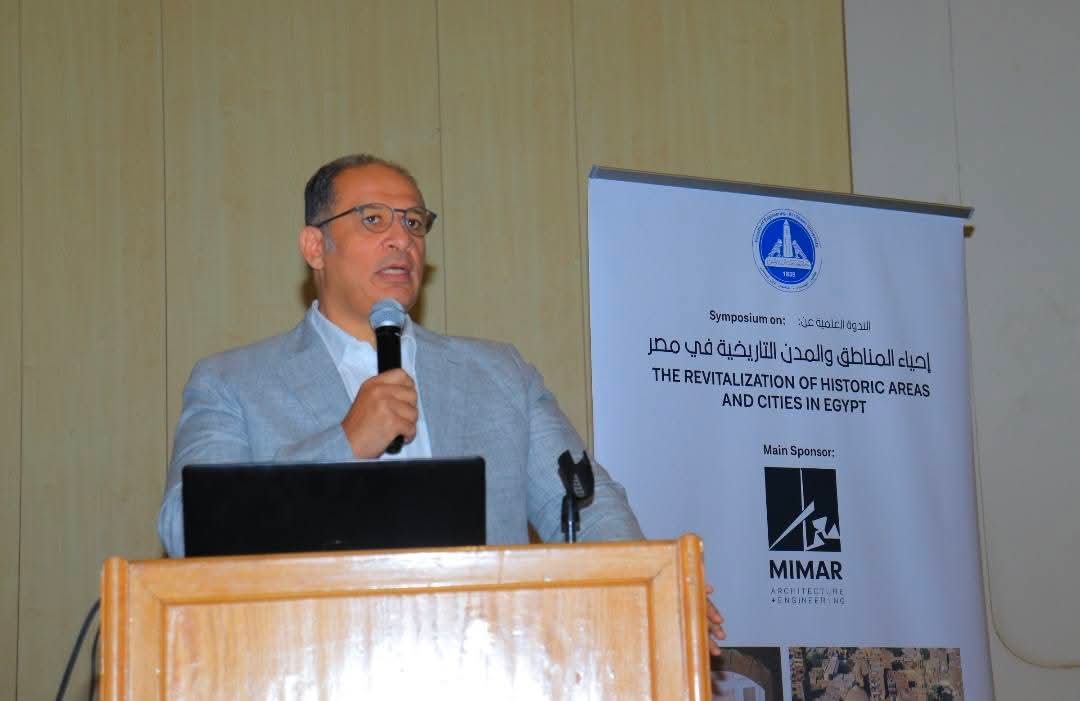
Architect Karim Ibrahim, Executive Director of Takween Integrated Community Development—the firm spearheading the rediscovery of Esna’s cultural assets began by outlining the project’s foundational philosophy. “The core idea stems from a question we posed in 2009 regarding the fate of Egypt’s small and medium-sized cities,” Ibrahim noted. “We sought a mechanism where heritage functions as a catalyst for socio-economic development. This progress demands two pillars: sustainability and inclusivity. The community must be an integral part of the process and a primary beneficiary of its returns, shifting away from the development models of the past.”
He continued: “Esna is an anomaly in its urban composition, compressing nearly every layer of Egyptian history into a mere 80 acres. It houses the Temple of Khnum, a Greco-Roman masterpiece; the eleventh-century Omari Minaret standing before it; and the eighteenth-century Wekalet al-Geddawy (an antique trading inn) adjacent to it. Interwoven among these are rich Coptic and modern heritages. We are looking at a profound accumulation of historical strata.
The Erosion of the Urban Fabric
Ibrahim warned against preservation methods that prioritize the isolation of monuments over the preservation of the living city. He cited the “evacuation” model used in Old Luxor, where a registered monument is preserved in a vacuum while the surrounding urban fabric is razed. “This creates a dilemma,” he argued. “When you strip away the surroundings, we are often left not knowing what to replace them with, leading to distorted, hollowed-out spaces.”
Instead, Ibrahim advocated for a model where the urban fabric is treated as the essential vessel for social and economic life. The goal, he stated, is to offer an integrated experience of urban living that fosters tourism while directly enriching the city’s own inhabitants.
The Decline of a City
Tracing Esna’s recent decline, Ibrahim explained that the city flourished as a vital commercial and agricultural hub from antiquity through the late 19th century. Following the 1973 war, the city’s economy became tethered to tourism.
The Esna Barrage, constructed in 1906, inadvertently aided this. Its limited capacity forced Nile cruisers to wait between eight and twelve hours to cross the lock, compelling tourists to disembark and explore the city.
“The shift occurred in 1997,” Ibrahim explained. “A new, nationally significant barrage was inaugurated, allowing ships to pass in a mere fifteen minutes. Consequently, tourist foot traffic plummeted.” By 2010, statistics revealed that of the 250 ships traversing the Nile between Luxor and Aswan weekly, only 13 stopped in Esna less than 5%. The economic pillars supporting the city’s interiority effectively collapsed.
Complex Calculations
The Esna revival project sought to address the “leakage” phenomenon in tourism economics. “In developing nations, the theory of rising tourism numbers is only a partial truth,” Ibrahim observed. “Often, the returns never reach the local community or even the state. If a tourist spends $100, up to $75 may never enter the local economy, flowing instead to international tour operators and airlines.”
While estimates of this leakage in Egypt vary some citing as high as 86%, others as low as 15% Ibrahim stressed that the real issue is the lack of precise mechanisms to track where wealth settles and how the community thrives from it.
Concepts of Cultural Tourism
The project shifted its focus toward a holistic definition of “Cultural Tourism,” encompassing local agriculture, foodways, and sustainability. “Cultural tourism is not anchored solely to the monument,” Ibrahim said, noting that this approach allowed the project to triple visitor numbers within three years, eventually reaching a fivefold increase the fastest growth for any Egyptian destination.
The initiative extended beyond the city limits into the rural “Al-Mata’ana” region, home to 19th-century royal rest houses used by the entourage of the monarchy in 1885 to oversee agricultural and irrigation projects. “We repurposed a royal rest house as a hotel and restaurant,” Ibrahim added. “It is a prime Nilotic site, capable of generating both income and movement. We have fully restored the structure and established the foundations for its reuse.”
Reviving Traditional Craft
“One of our most challenging sectors was food,” Ibrahim admitted. “Visitors to Esna struggled to find traditional meals reflecting the local soul. We organized a cooking competition for the women of Esna, documenting 25 heritage recipes previously unknown to us.”
The project also revived traditional industries, such as the local oil press, and developed products inspired by Esna’s heritage. Every aspect of the work relied on local labor, which required rigorous quality control. Approximately half a million bricks were reused in the restoration of historic homes, breathing life back into traditional masonry. To market the city, the team avoided stereotypical Pharaonic imagery, opting instead for a visual identity inspired by the calligraphy found on historic doorsteps.
The Azbakia Gardens
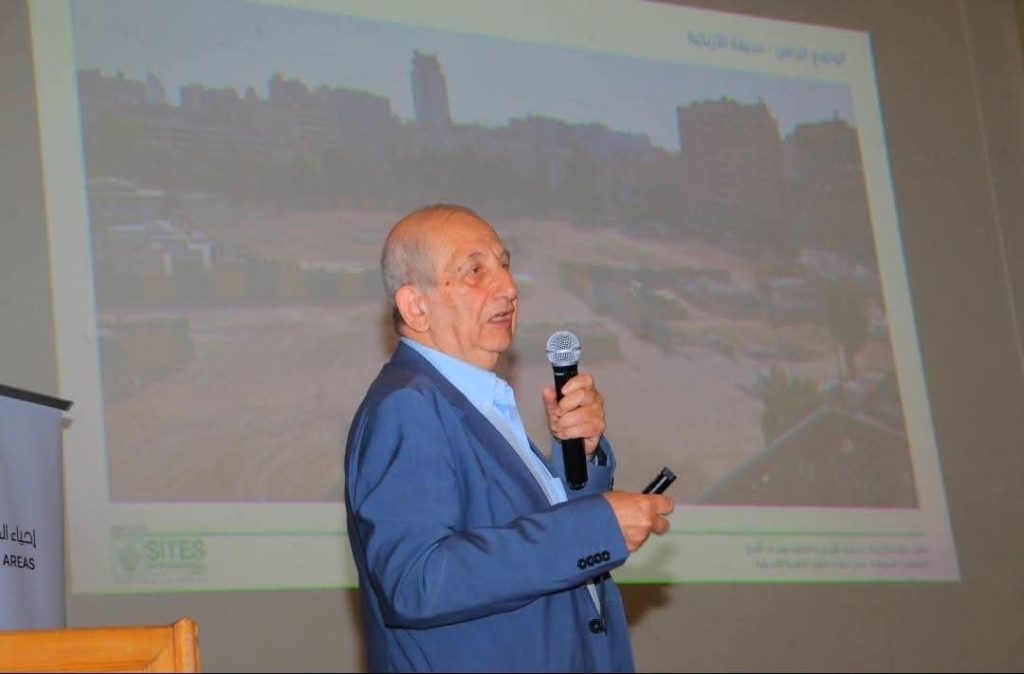
Dr. Maher Stino recounted the tragic transformation of the Azbakia Gardens. Once a 22-acre sanctuary defined by its Gabalaya (ornamental rock grotto), dense canopy, and intricate wooden pergolas, the gardens were a zenith of Cairene landscape design. “We worked to resurrect these elements using archival photography,” Stino said.
He lamented that the construction of the Cairo Metro proceeded with “zero regard” for the site’s historical sanctity. Ten acres were excised, historic trees uprooted, and haphazard ventilation shafts installed, scarring the landscape. Stino contrasted this with Chicago, where a major park was seamlessly integrated atop a massive underground garage.
The Destruction of the Periphery
“Tragically, everything surrounding the garden was decimated,” Stino continued. “The historic Opera House burned down and was replaced by a parking garage.”
He described the National Theater as a “shambles,” choked by ill-conceived additions that forced visitors through narrow rear entrances. With the Central Exchange building swallowing another five acres, the garden became a shadow of its former self. “When we surveyed the site, we found only two or three acres remaining—a neglected haunt for vagrants,” Stino said. The team realized that merely planting grass would be a waste of resources unless the entire district was reimagined.
Visionary Solutions
The Professor of Architecture and Landscape Design asserts: “Had I the authority, I would raze the central exchange building and the parking garage. In their place, I would establish a meticulously planned district featuring offices that harmonize with the city’s authentic architectural character, while providing 600 subterranean parking spaces, followed by the full reconstruction of the Old Opera House.”
He noted the potential for securing funding through an international subscription backed by the European Union, specifically Italy and France, with the aim of rebuilding the Azbakia Gardens and the Opera. This vision includes purging the surroundings of the National Theater of its architectural disfigurements and anchoring it to the garden via a grand urban plaza designed to breathe life and social interaction back into the area. He added that the project focused on resuscitating specific historical landmarks, such as the pergolas (shaded wooden walkways), the fountain, and the restaurant building. He clarified that the garden now features a new structure designed through the careful study of archival imagery. The historic pergolas and their intricate details were meticulously recreated based on vintage photographs, alongside the reconstruction of the Gabalaya (ornamental rock grotto) to mirror its original historical form.
Stino maintains that the site of the Azbakia Gardens remains a vital artery within the fabric of Cairo, serving as the essential link between Khedivial and Fatimid Cairo. “In the future, I hope we adopt a more comprehensive perspective toward this relationship,” he remarked, “one that encompasses Al-Azhar Street, Al-Muski, the Al-Muizz district, and Mohammed Ali Street.”
The Helwan Capritage
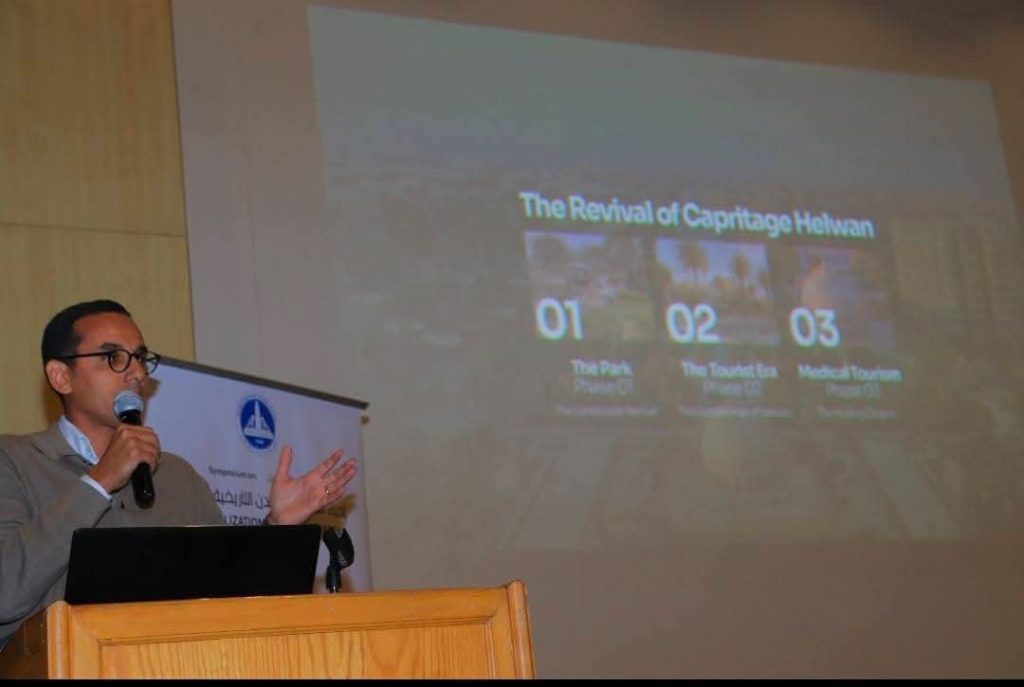
Architect Moaz Abu Zeid, overseeing the revival of the Helwan Capritage Gardens, explained how the project’s scope expanded from a single casino building to a comprehensive vision for Helwan’s heritage. The plan encompasses three axes: the garden as a starting point, a future tourism zone centered on the “Casino,” and a final phase dedicated to therapeutic tourism.
Consulting the Archive
Abu Zeid faced a data vacuum caused by decades of unauthorized modifications. “We relied on cinema,” he revealed. “The Casino appeared clearly in two classic films, allowing us to reconstruct collapsed elements. We also scoured Google Earth, archival maps, and vintage postcards.”
The project’s primary achievement thus far is the restoration of 50,000 square meters of greenery, including 2,000 new saplings and palms, while maintaining the original landscape fabric. Lighting was also prioritized to transform the once-dark grounds into a safe, luminous haven for the families of Helwan.
The Monument is Ours
Dr. May al-Ibrashy spoke on the “Athar Lina” initiative, which posits that historic sites must be welcoming to their local residents first, rather than being mere tourist enclaves.
“Our initiative began with heritage education for women and children,” she said. This evolved into heritage-based industries, providing economic agency to the community. Al-Ibrashy’s team has restored seven registered monuments and three historic buildings, always linking the physical restoration to vocational training for locals.
Among these was the “Al-Hasawati Dome” in the Imam Al-Shafi’i district. But while the dome was saved, Al-Ibrashy expressed profound grief over the widespread demolition currently ravaging its surroundings.
The Imam Al-Shafi’i District
“The demolition in the Imam Al-Shafi’i area began to facilitate a bridge connecting the eastern and western sectors of the cemetery,” Al-Ibrashy explained.
She noted that the most painful aspect was the irony of the “district upgrade” surrounding the Imam Al-Shafi’i shrine. This “upgrade” manifested as the wholesale leveling of the area to create a vast, hollow square.
“We launched a campaign to document the histories of the families buried or living around the Imam,” Al-Ibrashy said. “As we were archiving their legacies for permanent exhibitions within the necropolis, only one house remained standing. In that lone survivor, we held an exhibition to chronicle a family that had served the shrine of Imam Al-Shafi’i for generations.”