Upon the Crest of the Sea: The Calligraphers Who Paint Dreams and Lineage onto the Hull
The sacred artistry of Egypt’s maritime calligraphers transforms fishing vessels into floating canvases of faith and lineage. From protective prayers to the names of beloved grandchildren, discover how these vivid inscriptions anchor the souls of sailors against the unpredictable Mediterranean tides.
By Helmy Yassin
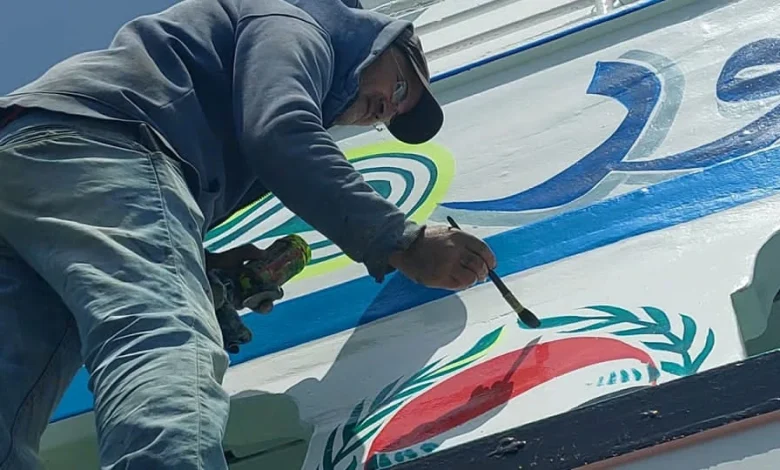
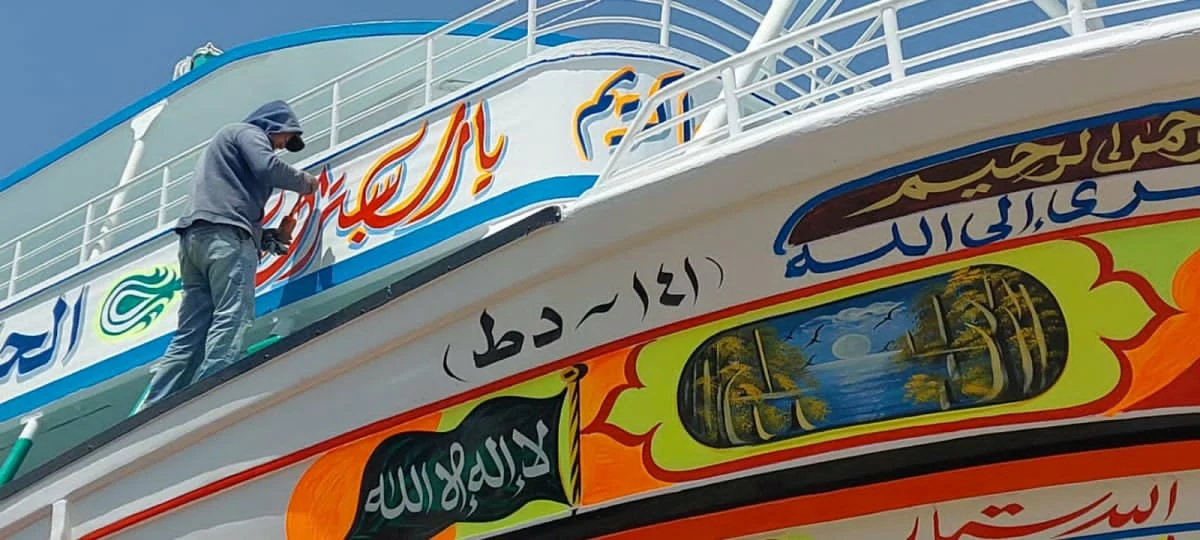
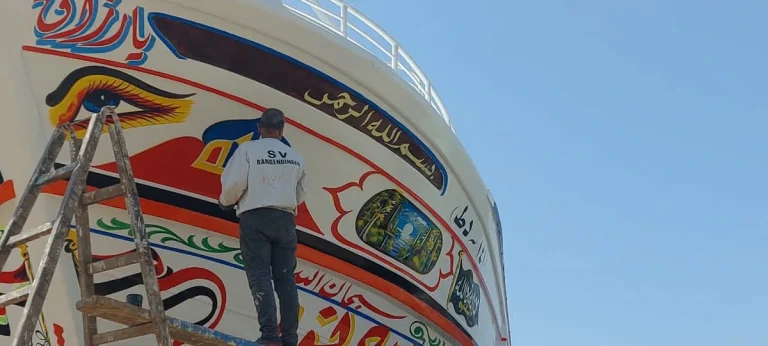
When one observes the vessels resting along the banks of the Nile, those bracing for the salt of the open sea, or the ferries plying the waters between Ezbet al-Burj and Ras al-Bar, a striking calligraphy reveals itself upon their hulls. These inscriptions are far more than mere ornament; they are vessels for a collective interiority, carrying the deep-seated beliefs, prayers, and motifs rendered by the calligraphers of the fishing fleet. By anchoring the boats’ names in bold, rhythmic Arabic script across their flanks, these artisans bestow a singular identity upon every craft, allowing each to hold its own amidst the hallowed, crowded theater of the harbor.
Sentinels of the Voyage
The calligrapher Medhat Taher Abdel Nour explains that his craft transcends the mere naming of a vessel. His work involves weaving Ad’iya (devotional supplications) and religious verses across the boat’s anatomy, from the prow to the gunwales. Fishermen remain steadfast in their devotion to these phrases, which carry themes of Hifz (divine protection) and Tawakkul (total reliance on God). They harbor a profound conviction that these words offer a sanctuary of serenity during the arduous journeys at sea, particularly when the weather turns fickle and the inherent perils of the labor intensify. Abdel Nour adds that he meticulously selects the style of calligraphy to suit the dimensions and contours of each boat, ensuring the letters remain sharp and legible from vast distances across the salt-heavy horizon.
Abdel Nour continues, noting that he utilizes specialized pigments engineered to withstand the corrosive bite of salt water and the relentless glare of the sun. This ensures the script endures the elements for prolonged cycles, though some fishermen request a periodic renewal of the ink to maintain the vessel’s dignity, particularly before the arrival of the primary fishing seasons. He further observes that the technique of inscribing upon timber differs fundamentally from that used on iron hulls, a distinction dictated by the chemical alchemy of the paints employed.
Inscribed Prayers: An Ancestral Legacy
In this context, Sameh al-Deebali, a fisherman holding a Bachelor of Arts who has served aboard various international ships, suggests that while the presence of prayers on these vessels is a legacy inherited from their forefathers, its true power lies not in the ink, but in the fisherman’s inner Yaqeen (unshakeable certainty) and seasoned expertise.
He clarifies that the sea does not negotiate with words, but rather responds to a fisherman’s readiness and his instinct for reading the shifting conditions of the deep. While the presence of these prayers provides a sense of solace and psychological harbor, especially during the Nawat (fierce seasonal storms), al-Deebali maintains that true survival is anchored in experience and a rigorous devotion to safety protocols. He notes that while some may lean heavily on the symbolic weight of these phrases, they remain, at their heart, an essential thread in the folk tapestry of the profession.
Folklore, Faith, and the Names of Progeny
Mohamed Mostafa Qashlan, a fisherman from Baltim currently working in Ezbet al-Burj, emphasizes that the naming of a boat is the prerogative of its owner, often rooted in the names of children or grandchildren. These are frequently coupled with sacred formulas such as Ala Barakat Allah (Upon the Blessing of God) or Tawakkalna ala Allah (In God we place our trust).
On vessels where ownership is shared, one partner might request the inscription of a son’s or grandson’s name, resulting in phrases like Mahrous bi-Idhn Allah (Protected by God’s Will), Salama bi-Khair (Safety in Abundance), Karim ya Nabi (Generous is the Prophet), or Muna min Allah (A Gift from God). Some names draw from the well of local heritage and folk identity. Qashlan adds that while boats carry the names of daughters, they rarely stand alone; they are almost always anchored to the father’s identity, such as Abu Sherihan (Father of Sherihan) or the hopeful Sabah al-Khair (Good Morning), ensuring the vessel remains a living extension of its owner’s lineage.
Furthermore, these inscriptions serve a vital psychological function during the turbulence of storms. A fisherman finds a quietude of spirit when he sees these sacred words surrounding him in the dark of a gale. In those moments of trial, they provide a measure of stillness, a tether that allows him to persevere against the sea.