
Guardians of the Fringe: Dr. Esraa Essam on the Living Heritage of Egypt’s Borderlands
Dr Esraa Essam delves into the sacred rituals, oral histories, and cultural resilience of the Amazigh of Siwa and the Beja of the Southeast, revealing the complex tapestry of identity that thrives at the nation’s jagged edges
At the very jagged edges of the map, within Egypt’s border communities, alternative narratives of the nation’s heritage begin to breathe. While mainstream efforts often fixate on material history monuments and artifacts as the primary anchors of identity, a new work redirects our gaze toward the human element and the marginalized collective. From the Siwa Oasis in the far west to the Halayeb and Shalateen triangles in the southeast, Dr. Esraa Essam, a researcher in urban geomorphology (the study of landforms and urban evolution), ventures into the private worlds of the Amazigh and the Beja. Her mission: to chronicle the minutiae of daily existence customs, rituals, sacred languages, and the communal table offering a portrait that feels less like a clinical study and more like a collective human biography of societies too often reduced to stereotypes or erased from the national prose.
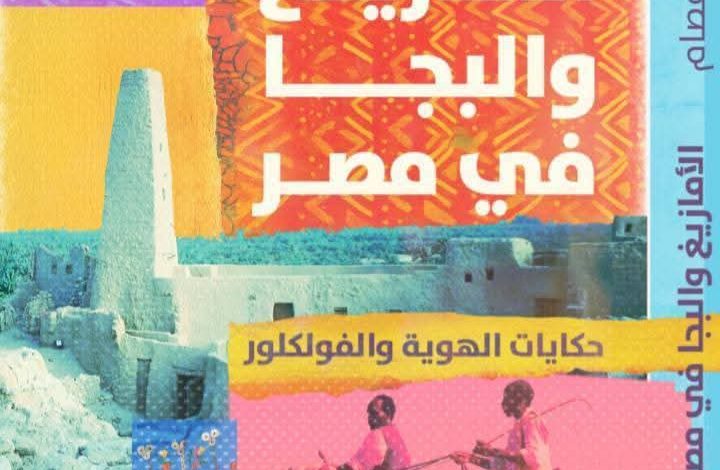
In this conversation, we sit with the author to retrace the journey of her book, The Amazigh and Beja in Egypt: Tales of Identity and Folklore, exploring her vision of cultural pluralism and what we might learn when we finally view Egypt from its periphery.
What compelled you to document Egypt’s cultural diversity through this volume, and why settle on the Amazigh and Beja specifically?
The primary catalyst was a haunting sense that there is “another Egypt” living alongside us, yet entirely shrouded from our view invisible within our dominant narratives. As a society, we often speak of Egyptian identity in a singular, monolithic tone, when the reality is far more intricate. My research pointed toward a composition of Egyptian humanity that has evolved through layers of time and decades of nuanced existence.
I chose the Amazigh and the Beja because they are quintessential desert archetypes. I wanted to approach desert communities as a geographical dissection of Egypt’s multifaceted identities, rather than categorizing them by ethnicity or population density. For me, a geographical framework felt more scientific, more neutral. These groups represent the concept of “trans-border identity,” illustrating how geography and anthropology allow border communities to be colored by neighboring cultures. Yet, they prompted a vital internal question: How does a group maintain its distinct interiority without severing its bond with the larger homeland?
How did this immersion reshape your perspective on the concept of minorities within Egyptian society?
Truthfully, my relationship with the term itself underwent a transformation. I began to handle it with a heightened caution, recognizing the sensitivity it carries for those I study. I noticed that many members of these communities find the term “minority” unsettling; it carries a sting of marginalization, an implication of diminished value.
Academically, by virtue of my specialization in geography, I view a “minority” purely as a numerical descriptor a matter of population distribution and density not a value judgment. I believe it is the responsibility of the researcher, particularly in the social sciences, to honor this human dimension and appreciate the reasons behind this rejection rather than dismissing it.
You have described identity as a “complex tapestry.” How did you see this manifest in the daily rhythms of Siwa and the border regions?
When I call identity a complex tapestry, I mean it is not woven from a single thread, race, or culture. It is composed of overlapping strata: language, custom, geography, and history. This is strikingly evident in Siwan society. The Amazigh language (Berber) is the language of the hearth and daily transactions, while Arabic is reserved for education and officialdom. It is the bridge to the outsider and the tool for social media, especially since the Siwan dialect is a spoken legacy rather than a written one.
The Siwan individual navigates these two circles with a fluid grace, feeling no contradiction or estrangement. Yet, I cannot deny that the community elders harbor a profound anxiety regarding the potential extinction of their local tongue under the weight of modernity and the tides of tourism. This complexity is not lived as a conflict, but as a state of resilient equilibrium.
Did you find a chasm between the public discourse on identity and what you witnessed on the ground?
Indisputably. In public discourse, identity is often presented as a simplified, closed vessel as if a human being could be reduced to a single, distilled belonging. This is a superficial conceit.
On the ground, identity is far less prone to sharp classification. I did not find an existential crisis of “who are we?” Instead, I found a multi-layered self. A person can be Amazigh or Bejawiya and, in the same breath, unequivocally Egyptian. One of the failings of public discourse is that it either amplifies difference as a threat or accepts it only under rigid conditions, often framing it within a landscape of confrontation.
Why does the discussion of ethnic diversity occasionally ignite such controversy or misunderstanding?
Because some perceive the celebration of ethnic diversity as an invitation to division or a casting of doubt upon national unity. In essence, however, it is an attempt to fathom the richness and plurality of our society. This reaction is also tethered to a habit of envisioning identity through a single lens and refusing any deviation from that norm.
People often conflate cultural diversity with political secession. The reality is that most nations, Egypt included, are formed from layers of identity that do not clash with national allegiance.
Do you believe that acknowledging cultural pluralism fortifies national identity, or does it invite legitimate fear?
I see it as an essential pillar of strength, not a threat provided the method of presentation is rooted in understanding. What I gathered through my direct engagement is that communities whose diversity is recognized are more balanced and possess a deeper sense of national belonging. Recognition grants the individual the dignity of full belonging without requiring the amputation of a part of their soul.
It is perhaps akin to the unconditional acceptance one finds in a profound friendship. The more we accept the “other” without condition or comparison, the more intimate and harmonious the bond becomes. This human harmony is a template that can, and should, be applied to entire societies.
How does one distinguish between national belonging and the diverse ethnic roots within it?
Distinction does not imply separation. It is about understanding the different tiers of the self. The difference between the two is the difference between the universal and the particular. National identity is the overarching canopy, while ethnic identity is the private interiority that rests beneath that shade.
National belonging is tied to the state, shared history, and the institutions that gather people into a single political entity. Ethnic identity, however, concerns the ancestral roots, the dialect, the folk memory, and the “rhythms of the day” that distinguish one group from another within the same homeland. It is a box within a larger, more expansive box.
Why is folklore the ultimate vessel for the collective memory of these communities?
Because folklore is the mold in which these societies cast their identity. It does not merely serve a decorative or entertainment function; it is a means of interpreting the world, the nation, and life itself across generations. A folk tale may carry an unwritten history; the work songs of Siwa reflect a visceral connection to the soil and the ancient codes of the farmer. These songs possess a philosophy of place more profound than any dry academic reference or official narrative.
Lifestyles may shift under the pressures of modernity, but folklore retains its capacity for resilience and inheritance. It is a living vessel, constantly renewing itself while reflecting how these small communities see themselves.
To what extent can local cuisine and its attendant rituals unveil a community’s soul?
To me, food is the most honest and human key to deciphering identity. When I begin studying a new society, the first thing I observe is how they prepare their bread. For instance, the Beja camel herders prepare their bread using only water and flour, baking it directly upon the hot sands. This reflects their nomadic nature their reliance on minimal resources and the necessity of speed.
The ingredients themselves speak volumes; they mirror local resources, agricultural patterns, and the dominant labor of the community, whether migratory or settled. Just as food tells us of the earth, it reflects the surrounding geography, the climate, and the natural landscape.
The role of food extends into the social fabric the sacred codes of hospitality, the rituals of preparation, and the specific dishes tethered to feasts in regions like Siwa and the Halayeb triangle.
All these elements reveal a sophisticated system of relationships between the human and their environment. A single meal can narrate what entire volumes fail to capture about the nature of social interaction. Food is also a map of history; certain Beja dishes have clear Sudanese lineages, while Siwan ingredients mirror the techniques used by the Amazigh in Libya and Algeria.
You noted the sanctity of olives and dates in Siwan culture. Do they carry symbolic weight beyond mere sustenance?
Olives, dates, and the palm tree are hallowed elements for the Siwan people. Their presence transcends the plate into a deep symbolic and social zenith. The olive, for example, is anchored to the idea of continuity and stability. The olive tree is perennial, and in its longevity, it reflects the deep-rootedness of the Siwan people in their oasis. They have remained in their land despite ancient skirmishes with Bedouins and the internal strife between eastern and western tribes. They have endured despite decades of geographical isolation.
As for the date, it was the primary source of energy in an environment that produces these two elements above all else. Even today, despite the reach of modern trade, the Tagallantini (a traditional Siwan date-based dish) remains the staple of the morning table. Its energy sustains the labor and the exquisite creativity we see in Siwan salt lamps, rugs, and embroidery.
The reverence for the date is also visible in the ritual of the palm tree. There is a Siwan wedding custom where the groom presents the Gammar (the heart of the palm) to the mother of the bride. He offers her something he considers sacred, just as she has offered him a part of her own “womb” and fertility. And in a gesture of respect for the “womb of the earth,” he only selects a tree that has ceased to bear fruit. Almost every dish and custom there is a cultural language in its own right, nearly all of which involve the olive and the date.
How has the natural environment sculpted the traditions and lifestyles of these societies?
Geography is always the lead actor in the drama of daily life. In Siwa, the oasis geography dictated a specific lifestyle centered on the management of finite resources—water, arable land, and salt lakes. Because of the prevalence of these springs and wells, the first thing a man teaches his son is how to swim, lest he drown in one of those deep eyes of water.
The reliance on agriculture as the primary heartbeat of the oasis fostered a spirit of communal cooperation unlike anything I have seen even in rural Egypt. Even in times of conflict, the feud had to be set aside for the sake of the harvest season.
Conversely, the nomadic life in the Halayeb, Shalateen, and Abu Ramad triangles across the vast, open desert has gifted the Beja individual a more fluid and expansive relationship with space. The stark morphology of the land creates something akin to a spiritual prayer between the human and the terrain. It is a profound, soulful connection to the desert that I recognize intimately as a desert scholar.
These geographical traits formed the architectural styles, the social structures, the fashion, and even the fabric used in clothing, all designed to harmonize with the thermal demands of the landscape.
What distinctions did you find between the influence of the “Oasis” and the “Desert” on the human psyche?
In the oasis, there is a degree of relative stability born from the presence of water and tilth. This stability is reflected in a more disciplined lifestyle, evident in the urban structure around the historic Shali fortress. The concept of “place” is central, and life revolves around known agricultural cycles.
In the desert, where grazing and migration are law, the environment imposes a necessity for movement and flexibility, especially in light of modern climate changes that have brought water scarcity. One must be in a state of constant interaction with an open horizon. They walk the desert searching for dry branches to produce botanical charcoal. This migration is mirrored in the architecture the portable Beja tents I detailed in the book. The desert, above all, manifests the necessity of self-reliance.
Do you believe border communities are more capable of preserving their heritage than urban ones?
Yes. They possess a rhythm of life that allows them to hold onto a greater portion of their legacy. Their geographical isolation and privacy particularly in the case of the Beja, who are less open than the Siwan community have shielded them. In both societies, folklore is practiced naturally, without the need for the artificial “revival” seen in cities where heritage is often refashioned to suit the requirements of the modern age. Such urban adaptations often lead to a cultural hybridization that weakens the original roots.
However, I cannot say border communities are entirely immune to change, especially with the acceleration of communication and the migrations Egypt is currently witnessing. The difference lies in the method of handling heritage, rather than who keeps it or loses it.
Despite the geographical distance, is there a common thread in how the Beja and Amazigh construct their identity?
Despite their differing contexts, what struck me most was their shared reliance on oral memory as the primary vessel for their folklore. There is a subconscious realization of the necessity to transmit their language and experience from one generation to the next.
A Siwan child must master the Siwan-Amazigh dialect, just as a Beja child learns the Bedawit language. Both learn Arabic in state schools or the Khalwa (traditional Quranic school), yet the moment they step out of the halls of formal education, they return instantly to their local tongue. Both also possess a visceral bond with the land. This is the “touch of the desert” on the human soul. Siwa, though an oasis, is surrounded by the desert on all sides, and its character is fundamentally shaped by that vastness.
Which of the two communities appeared more steadfast in the face of modern change?
The Beja community appeared more conservative, secluded, and private compared to Siwa. This is tied to their environment. The desert landscape and the scarcity of resources, combined with a lower degree of integration into modern economic patterns, have created a society that is somewhat closed off.
Furthermore, the complexities of border ties the blurred lines between Sudanese and Egyptian affiliations, especially with the recent influx of Sudanese families have made the preservation of local cultural identity an internal survival mechanism.
In contrast, every year sees Siwa opening further to trade and tourism, creating new cultural and economic patterns. While this hasn’t erased their specificity, it has subjected it to a reshaping. It is becoming less conservative, particularly with the rise of certain religious movements that have begun to influence the community.
What were the most significant challenges you faced during field work with such guarded societies?
I faced the problem of gaining access to the community before I could even access information. The Beja were intensely guarded at first. Many were hesitant to speak or share the details of their lives. This made the collection of field material a test of patience.
I am, by nature, a patient writer. Only a limited number of individuals agreed to cooperate. I understood that this was not a rejection of the “other,” but a caution born of a long history with strangers. In Siwa, the challenge was different. I encountered situations where I was treated as a “woman” before being seen as a researcher.
This manifested as a dismissal of the seriousness of my research role. Such interactions were revelatory; they highlighted the presence of gender-based social constructs. In some cases, women in the public sphere are viewed through a non-professional lens, reflecting the seclusion faced by Siwan women in a patriarchal society. In Siwa, some women are so shielded they rarely see the sun which explains a certain paleness of skin! These experiences were as illuminating as they were exhausting.
How did you strike a balance between capturing emotional intent and maintaining documentary precision?
I relied on a separation of levels: the level of descriptive testimony, which remains faithful to what was said exactly, and the level of analytical understanding, which interprets the context without imposing a personal distortion. This ensured that the voices of the people were not drowned out by my own vision.
At the same time, I was careful not to turn human emotion into mere textual decoration. To me, a person’s feelings and their suffering are a part of the truth itself. My goal was to convey them as they are, within a framework that prevents a slide into hyperbole or excessive drama.
Did you feel that some truths are only accessible through oral storytelling?
Yes. There are strata of knowledge that can only be reached through the spoken word. Human sentiment is most eloquent when people speak directly of what they endure. Through these stories, a scholar can grasp how a society understands itself how it interprets events, remembers its history, and renews its relationship with place.
I found that the intricacies of lineages, the nuances of migration, and the “feeling” of food cannot be understood except by listening to the people’s own narratives. For me, this is a new mode of knowledge one that is shaped through repetition and the act of telling.
In relying on oral accounts, how did you ensure accuracy?
Oral storytelling is not a substitute for documentation; it is a layer of knowledge that requires verification and comparison. I treated it as an entry point. I would return to multiple sources within the same community, asking the same questions to different people to note the points of convergence and divergence.
Finally, I balanced these accounts against historical and academic sources whenever available. In Siwa, I noticed a gap between historical records and oral narratives. For example, there was often a denial of ancient, bloody tribal conflicts in the oral accounts, while historical references clearly point to their existence. It is precisely because of these ancient conflicts that the “Feast of Reconciliation” exists in the oasis today a beautiful tradition celebrated annually.
You have stated that you “side with the people before the heritage.” How did this bias shape your prose?
This bias fundamentally altered my narrative style. I treat heritage and folklore as a small soul living within the larger soul of the people. I tried, as much as possible, for the human voice to be the protagonist. This is, in the end, a book for the people and about the people.
It is a bias that made me wary of the trap of “beautifying” heritage or presenting it with hypocrisy. Readers sometimes call me a “thinker,” though I don’t yet count myself among them. But the role of a writer is to speak truths “naked,” without embellishment. Not everything traditional is necessarily positive or fit for all times. It was important to show it as it is with its values, its complexities, its virtues, and its flaws.
Was there a conviction you held that was shattered by this experience?
I discovered that my personal passion for the “different” is not necessarily a universal sentiment. I used to believe that simply approaching the “other” was enough to collapse geographical distances and stir curiosity or empathy in anyone.
I realized that the humanistic gaze I sought to establish is not as instinctive as I had imagined. It requires stages of awareness and openness. Some see “difference” as a source of suspicion or latent racism, even if it isn’t practiced explicitly often shielded by the nature of Egyptian society, which rarely leaves room for the overt practice of such prejudice.
I am grateful for this book, for all the visions and lives I witnessed through it. For all the complexities of the human condition that I continue to discover, I am grateful for the beauty and the myriad differences of the world and the people within it.