
The Rhythms of Ritual and the Evolution of Expression: Sham El-Nessim’s Journey Through Egyptian Art
From the limestone walls of the Pharaohs to the vibrant canvases of modern masters, explore how Sham El-Nessim has survived five millennia of change. This feature delves into the sensory rituals of Egypt’s spring festival the sacred, the symbolism of the lotus, and the enduring “gathering” that anchors a nation’s identity to its ancient soil.
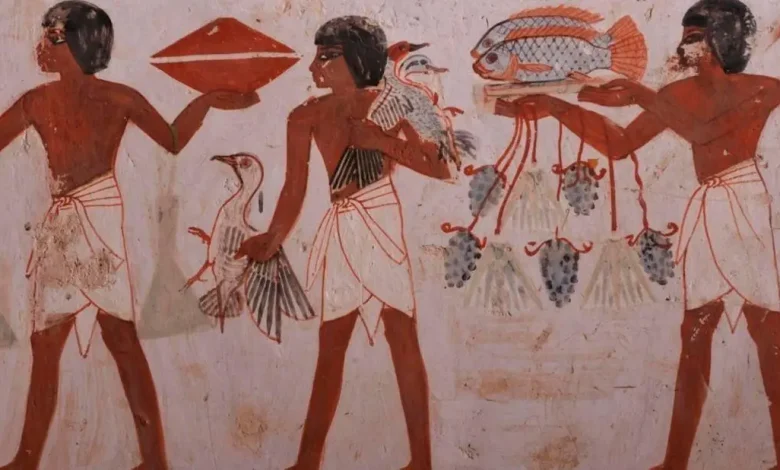
In the collective memory of Egyptians, spring is never merely a passing season. It is a sprawling ritual, a legacy handed down from ancestor to descendant over millennia. It finds its most vibrant incarnation in Sham El-Nessim, a festival that carries within its folds the twin hallmarks of continuity and renewal. This holiday, birthed by the ancient Egyptian and rooted in a sacred communion with nature and the sanctification of life, was not merely preserved in papyrus; it was immortalized visually upon the hallowed walls of temples and tombs. There, fleeting moments of joy were transformed into enduring archaeological murals that defy time and safeguard the history of Egypt.
From those ancient friezes to the canvases of modern fine art, the narrative has continued its documentation, albeit through shifting tools and revitalized perspectives. Contemporary Egyptian artists have refashioned these same scenes with a modern spirit, drawing inspiration from the minutiae of daily life and folk celebrations. Between the past and the present, these murals and paintings offer a window for comparison, allowing us to trace how the Egyptian image has maintained its essential soul despite the march of eras and the changing mediums of expression.
Sham El-Nessim: The Dawn of History
In academic texts, much debate exists regarding the precise origins of historical milestones. Yet, it is certain that Sham El-Nessim has withstood the tides of changing languages, religions, and rulers, remaining a cornerstone of Egyptian identity that anchors the individual to the land and its harvest. Historical records suggest the name originates from the Hieroglyphic word Shemo (The season of harvest). As the ages interlaced specifically during the Coptic era the word Nessim (Zephyr) was appended to it.
Regarding its timing, Essam Statti notes in his book Sham El-Nessim: Myths, History, Customs, and Rituals that the date was never chosen at random. Instead, it was tethered to the vernal equinox, when day and night find perfect equilibrium. This period coincides with a specific astronomical phenomenon at the Great Pyramid; thus, the ancient Egyptians regarded this day as the beginning of the world’s creation or the resurrection of life.
Ancient Egyptian Festivities
According to a study by Sherine Sadek El-Gendi titled Sham El-Nessim Celebrations in Egypt, the historian Plutarch noted that Egyptians traditionally ventured out into gardens and orchards on this day, carrying food and drink in an atmosphere reflecting their profound connection to spring and the renewal of life.
The day’s rituals became inextricably linked with Fesikh (salted fermented fish), a symbol of fertility and the persistence of life that remains a staple on Egyptian tables to this day. Onions also held a sanctified status for the ancient Egyptian, utilized in religious rites and presented as offerings. This was accompanied by the coloring of eggs, alongside greenery such as lettuce, arugula, and Malana (Green chickpeas).
Murals: Art as Heritage Preservation
The murals and inscriptions of ancient Egypt reveal a meticulous dedication to documenting these details: scenes of excursions to gardens, sitting amidst blooms, and strolling along the banks of the Nile. Specific elements recur with rhythmic frequency the lotus flower, tied to rebirth; and the presentation of food, including fish, signifying an abundance of blessings. These images were no mere decoration; they were a mirror of the human relationship with the environment. The ancient Egyptian did not stop at temple walls; this documentation extended into the domestic sphere, seen in the coloring of eggs, evidenced by decorated ostrich eggs dating back to the pre-dynastic era of King Menes, a tradition that traveled through time to be celebrated even at the royal wedding of King Fuad and Queen Nazli.
The Continuity of the Scene in Modern Painting
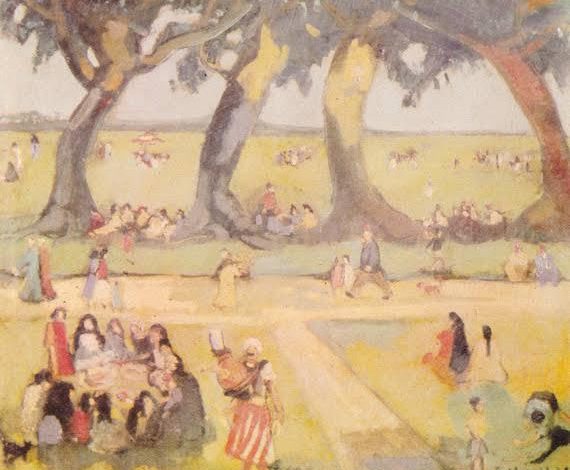
As the arts evolved, the iconography of Sham El-Nessim did not vanish; rather, it proliferated. Fine artists have reimagined these scenes through a contemporary lens. The same details recur under different guises: the family in the garden, children at play, the Nile shimmering in the background, and the vivid hues of spring. Despite the divergence in styles from realism to expressionism the core remains unshakable. Sham El-Nessim remains anchored in communal joy and the return to nature.
These paintings capture the ritual of the “outing,” where families sit in the dappled shade of trees, reflecting a sense of serenity and an escape from urban clamor into the vast rural landscape. They highlight the gathering of families in small circles to inhale the spring breeze an ancient tradition aimed at renewing one’s energy at the zenith of the growing season.
Returning to the Roots
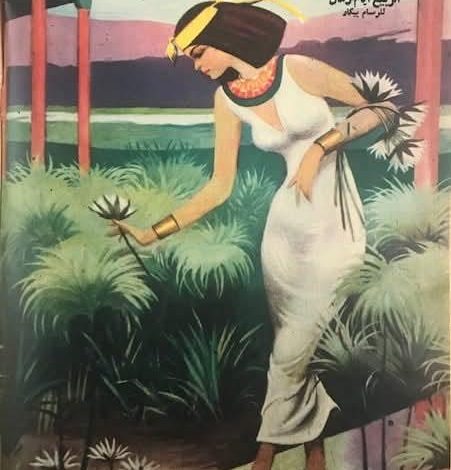
Hussein Bikar captured the essence of this day in his work Returning to the Roots, which highlights the ancient Egyptian origins of the spring festival. A woman in pharaonic attire stands amidst papyrus stalks, plucking a lotus flower. The piece serves as a documentary of identity, whispering that this festival is an extension of thousands of years. The muted, calm colors reflect the sanctity of nature to the ancestors and their celebration of life’s awakening.
Meanwhile, Mostafa Rahma, in his painting Hanem Eating Fesikh and Onions, blends modernity with ancient symbolism. The woman’s green skin is an allusion to fertility and growth the very colors of spring. The fish on the table represents Renga (Smoked herring) or Fesikh, while the green onions confirm the specific moment of Sham El-Nessim. A cat in the frame evokes the revered status of felines in ancient Egypt, while the work as a whole conveys a private indulgence in inherited rituals with a touch of whimsy.
Fesikh in the Village
In the work of Gerges Lotfy, Sham El-Nessim manifests in the spirit of the collective and the beloved “crowd.” Numerous faces, boats on the Nile, and people celebrating with food express the popular, folk face of the event, where social distinctions dissolve into the shared fabric of folklore.
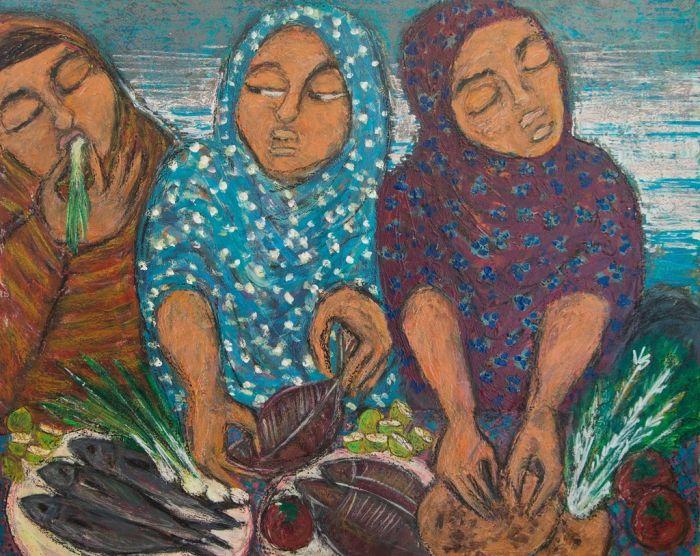
In a similar vein, Assem Abdel Fattah’s work represents Sham El-Nessim within the Egyptian village. A woman carries a basket upon her head while goats graze below, reflecting the holiday’s link to the harvest and the bounty the earth yields at this time of year. Here, the routine of rural life merges with the vibrancy of spring. Hala El-Sharouny, however, focuses directly on the ritualistic table. She depicts three women in traditional dress and Mandil bi Oya (folk headscarves with lace trim) as they prepare and consume Fesikh, Renga, onions, and lemon. This is perhaps the most visceral embodiment of the holiday’s customs. The movement of hands, the cleaning of the fish, and the communal “gathering” around the Tabliya reflect a total immersion in a heritage passed through generations.
Eternal Symbols and Unchanging Features
If Sham El-Nessim in ancient Egypt was a festival steeped in sanctity, where myth intertwined with faith, its table carried deep heritage symbols. From the egg, symbolizing the dawn of existence, to the Fesikh, stemming from the Nile as the primary source of creation; from onions to ward off evil, to lettuce and Malana as pulses of fertility.
These rituals were once practiced with contemplation and awe, with offerings made in anticipation of the sun’s blessing. Today, while it retains its general spirit as a spring festival, it has migrated from the sphere of sacred belief to the space of social folk life. It has become an occasion for collective mirth, garden excursions, and family gatherings where coloring eggs is a playful game for children rather than a cosmic symbol.
Nonetheless, the silhouettes of the past remain present on the table and in the habits of the people. They are the thin threads binding the present to deep-reaching roots, confirming that this festival has not lost its essence, but has merely reshaped itself to fit the modern age, preserving a memory that stretches between myth and reality.