The Feminine Resonance: Reclaiming the Simsimiyya for Women’s Rights
Zat Foundation is reclaiming the Simsimiyya, Egypt’s traditional instrument of resistance, to amplify feminist voices. Through art therapy and rhythmic storytelling, women in the Canal cities are transforming folk heritage into a modern anthem for equality, education, and bodily autonomy.
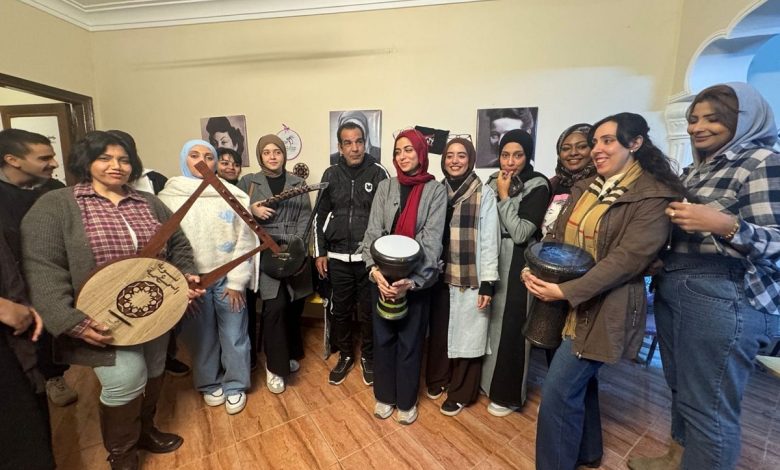
The musician begins to tune the familiar, rhythmic scales of the Simsimiyya (a traditional lyre-like instrument), while the participants prepare to perform a song whose lyrics have been meticulously reimagined. This time, the verses do not speak of old wars, but of a contemporary struggle: the right of girls to education and the pursuit of equality. It is a clever appropriation of the instrument’s historical symbolism, an artistic endeavor to transform a heritage anthem into a “soft weapon” for women’s advocacy. The “Zat for Sustainable Development” initiative has set out to recover the feminine lineage of the Simsimiyya, weaving feminist discourse into the fabric of traditional music by re-engineering folk songs and composing new, evocative works.
A Feminine Heritage of the Lyre
“In the Suez Canal cities, we know the Simsimiyya as an instrument of resistance,” says Rasha El-Sherif, the initiative’s coordinator. “It sang the epics of war, the War of Attrition, and the grassroots defiance of the people. We are now employing that same spirit to defend the rights of women.”
She continues with a smile: “We are also reclaiming the instrument’s feminine history. It appears on the walls of ancient Egyptian temples, cradled by women. One could say the Simsimiyya, or the Tanboura, or the Kinnar (ancient names for the instrument), is fundamentally a woman’s instrument. This explains the title of our project: ‘Feminism on the Simsimiyya.’”
This step by the “Feminism on the Simsimiyya” initiative complements existing efforts by women to assert their presence in the instrument’s history. These include performers and craftswomen in Port Said such as Fatima El-Morsi and Asmaa Hammouda, the Iman Haddou troupe, and the “Al-Naddaha” initiative, which teaches the craft of manufacturing and playing the lyre. El-Sherif adds: “We seek to connect with female-led musical initiatives and form partnerships to re-produce these songs and present them in live concerts.”
The Genesis of the Initiative
El-Sherif clarifies the project’s origins: “The idea was never merely to teach the participants how to play or sing. It was about personal storytelling, with the songs acting as one of the creative outputs. For this reason, we relied on the musician Reda Qandil, as there were no female players in Ismailia we could collaborate with at the time.”
She continues: “The initiative began with storytelling and creative writing sessions as a form of art therapy, transforming raw text into lyrical phrases that articulate women’s issues. The goal was to broadcast messages of support and empowerment. Consequently, the result was more performative than a traditional vocal performance in the sense of the Damma (a traditional musical gathering) where men would congregate at night to sing of the day’s events.”
Folk Songs Recalling Heritage
The initiative utilized traditional instruments to amplify the presence of women and their causes, leveraging the Simsimiyya’s place in the collective memory as the voice of popular resistance against occupation.
The project yielded six songs. Four of these are reinterpretations of folk classics; most notably, the famous “Sing, O Simsimiyya, to the Bullets of the Rifle” was transformed into “Sing, O Simsimiyya, for the Rights of the Girl.” Another, “Who Are You Singing For, O Dove?”, was adapted to celebrate the mother as the pillar of the home. These were joined by two entirely original compositions in both lyrics and melody: “I Dream, O Sea” and “The Houses.”
“I Dream, O Sea” was born from interactive storytelling sessions involving women and girls as part of the “Breaking the Circle” campaign organized by the Zat Foundation to combat violence against women in 2024. The lyrics plead:
I dream, O sea, that one day I may feel safe,
To never hear words that wound, nor fear the hand of harm.
To never be judged for my gender or my form,
And to walk as free in my land as a bird within the sky.
Narrative as Art Therapy
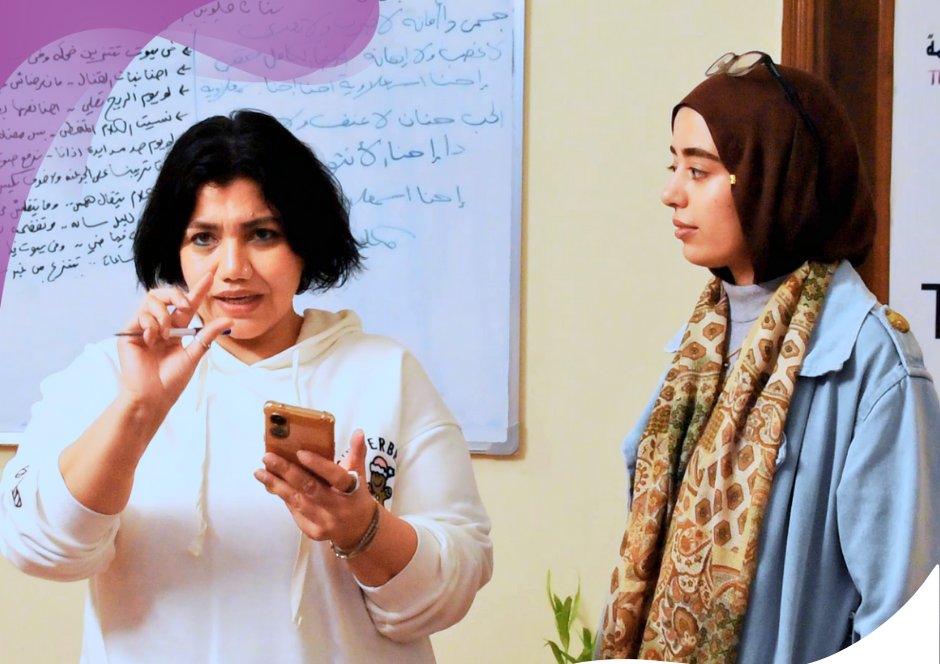
Nevin Abdel Aziz, the foundation’s creative writing coach, reflects: “In the ‘Feminism on the Simsimiyya’ project, my role was to convert a safe space for storytelling into a space for living artistic creation. I worked with the participants to extract their authentic voices not just as personal anecdotes, but as a conscious feminist discourse expressing their experiences with the body, identity, and social constraints.”
She adds: “The storytelling sessions were initially moments of profound honesty that exposed the unspoken, revealing painful daily details. My role was to help participants see the artistic, social, and political value in their stories. Even when they seemed simple, they were profound.”
She continues: “We then deconstructed these stories and refashioned them using the tools of creative writing: imagery, rhythm, repetition, and a language close to the soul. The most vital step was converting these texts into lyrical sentences that suited the spirit of the Simsimiyya, simplifying the expression without losing the depth of the cause. We created a Chorus (refrain) that was easy to repeat, ensuring the song could spread through collective chanting.”
Abdel Aziz concludes: “The Simsimiyya here is not just a musical instrument; it is a cultural medium carrying a history of narrative and resistance. The challenge was to integrate women’s issues such as bodily autonomy, FGM, and freedom of choice into a folk musical mold that reaches people with simplicity and sincerity. The result was songs born of genuine experience, not imposed from above. They speak with the voices of women directly, and they possess the power to influence. For me, the experience was a joy, and I was moved by the pride the participants felt in the fruit of their creativity, expressing their ‘selves’ in a truly safe harbor.”