The Silent Outposts of Port Said: Ruins Beyond the Reach of Visitors
The haunting beauty of Port Said’s foreign cemeteries, where the echoes of Commonwealth soldiers and European elite linger. A lyrical journey through “cities of the silent” that reveals the forgotten cosmopolitan heart of Egypt’s canal history.
By Osama Kamal
In the far western reaches of Port Said, at the precise point where the city’s clamor dissolves and the sea becomes a living, breathing anchor of memory, the narratives of sunset and departure begin. There, specifically at the gateway to Al-Jamil beach, stand the gates of three cemeteries. They appear as stratified layers of time, refusing to yield their secrets to any but those who know how to listen to the whispers of the departed: the Commonwealth, Catholic, and Orthodox graveyards. There, as a watchman told me, one does not merely enter a cemetery; one crosses over into the remnants of souls whose stories remain unfinished. These narratives are etched into the very marrow of the headstones, phrases that linger like the final echoes of voices long since stilled.
The Bitter Script of Loss
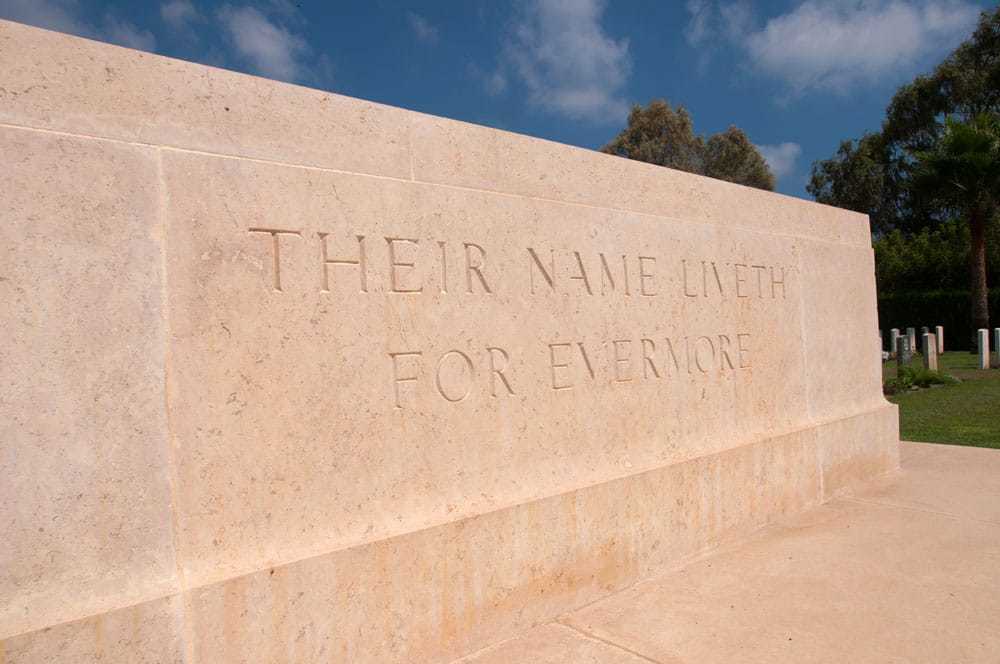
Within the Commonwealth War Graves, the narrative is carried by two brothers, Mohamed and Ibrahim Mohsen, who inherited the stewardship of this hallowed ground from their father. Stepping inside did not feel like entering a new territory, but rather like crossing into a different realm of meaning. At the entrance, upon a majestic marble wall, an inscription captures the essence of the place: “Their Name Liveth For Evermore.” It is a tribute to those who perished in the two World Wars, as if the site is not content merely with preserving bodies, but seeks to fix memory itself against the tide of oblivion.
At the very first tomb, my eyes fell upon words that seemed not carved by a tool, but forged from the bitterness of bereavement: “My dear son.. rest in peace.. in this foreign land.. so far from your loved ones… who weep for you.” It is a father’s missive to his son, Sergeant J.R. Marchello, who fell during the Second World War. This was not the only haunting refrain; I was arrested by another sentiment on a headstone: “God has hidden our beloved from our homes, but he has not vanished from our hearts.” It is a sentence that collapses the distance between loss and longing, between departure and enduran`KP]-ce. It was not just the name that settled in the mind, but that vast, aching expanse between the “foreign land” here in Port Said and the “loved ones” far away in Europe those who realized, through the death of a son, that passing is not a fleeting moment but a protracted absence.
A Strict Order Bestowing a Lost Serenity
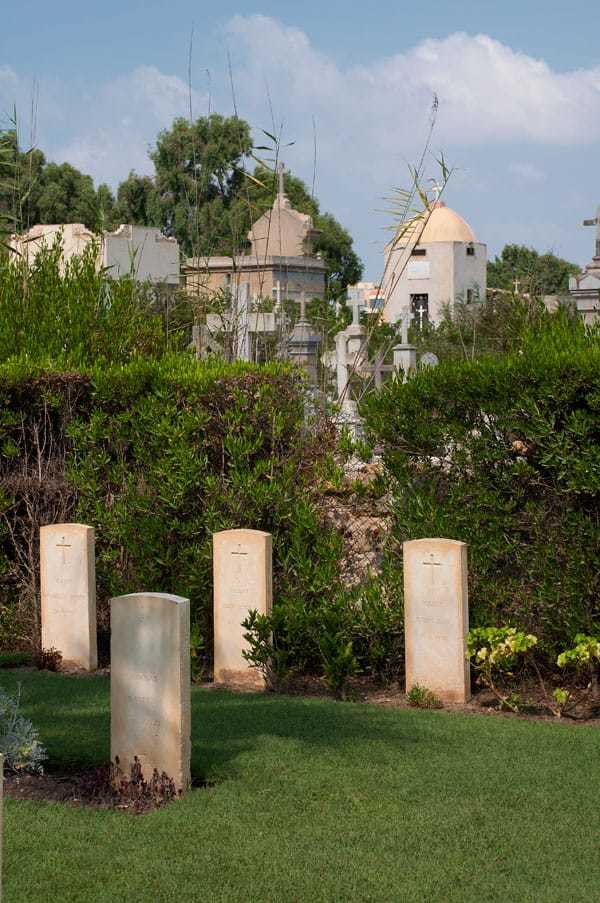
With the next step, as Ibrahim Mohsen explained, fear dissipates. This is not because death has become mundane, but because the space reorganizes the chaos we typically associate with it. In this cemetery, the verdant grass is manicured with daily precision, and roses are scattered like overdue love letters. The graves are aligned in a strict, rhythmic order, granting the dead a lushness and tranquility that life perhaps denied them.
Here, the brothers tend to the grounds as if it were a garden of remembrance. Mohamed Mohsen, a 1985 graduate of the Higher Industrial Institute, joined the cemetery staff in 1994, succeeding his father who began his tenure in 1973. His labor is confined to the meticulous daily grooming of the turf and the nurturing of the flora that populates the site. He notes that since the conclusion of the Second World War in 1945, nothing has changed neither the count of the tombs nor the number of the dead.
His brother, Ibrahim Mohsen, a 1992 Science graduate, joined in 2000 following a career in teaching. He points out that Egypt hosts sixteen Commonwealth cemeteries, stretching from Cairo and Alexandria to Ismailia, Suez, Marsa Matrouh, and Aswan. All follow the same architectural ethos, save for the Salum and El Alamein sites, which are shrouded in the resilient flora of the desert.
The Distinction Between the Citizen and the Soldier
The cemetery houses 1,094 tombs of military personnel and approximately two hundred graves of British civilians who once resided in the old city. A stark visual contrast exists between the two sections: the military headstones stand in a majestic, uniform stability, while the civilian graves appear humbler, more fragile and modest in their shadow.
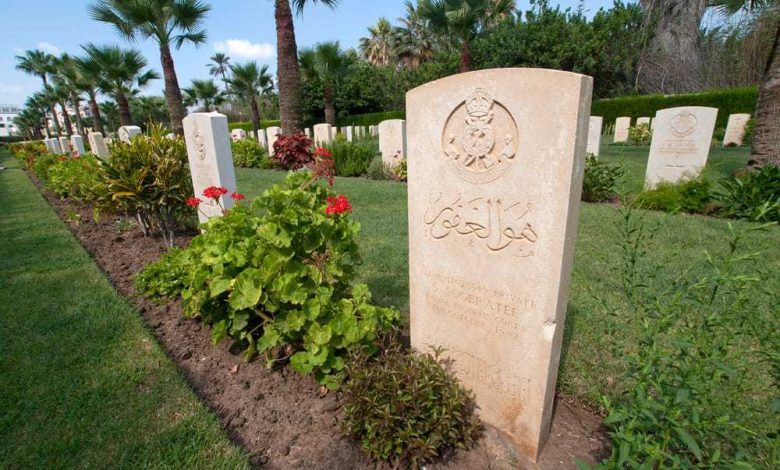
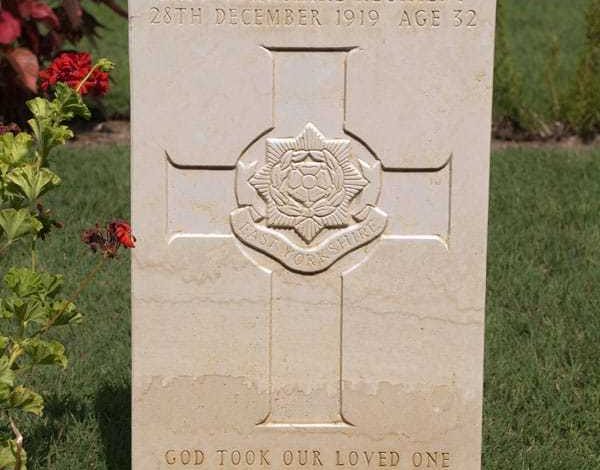
Upon each military headstone, one finds the name of the deceased, their unit, the date of their passing, and occasionally a brief allusion to the moment of their departure. These headstones, crafted in Italy from the zenith of fine marble, are crowned with diverse religious symbols: crosses, stars and crescents, and even Hindu engravings. Beside them lie short humanizing phrases, profound in their impact, condensing an entire life into a single line.
In one arresting moment, I stood before the tomb of a Muslim Senegalese soldier. Upon its face was inscribed the phrase Huwa al-Ghafur (He is the All-Forgiving) in exquisite Thuluth (a sophisticated, rhythmic Arabic script), as if language itself had traveled across oceans to catch up with its owner.
A Registry of Nations
Here lie 983 soldiers from the First World War (1914–1918) and 111 from the Second (1939–1945). The majority are British: 457 from the first conflict and 101 from the second. They are followed by the French, numbering 437 from the Great War. The rest of the nationalities form a global mosaic: Australia (67), New Zealand (11), with smaller numbers from South Africa, India, the West Indies, East and West Africa, Serbia, and America.
They all came to Egypt as transients, only to become its eternal residents. This site is one of 40,000 cemeteries overseen by the Commonwealth War Graves Commission (CWGC), established by Royal Charter in 1917 to immortalize the memory of 1.7 million dead.
Not Merely Graves, but Documents of Life
Regarding Egypt’s relationship with the World Wars, the country was at the heart of the storm, never on the periphery. In the First World War, Ottoman forces attempted an assault from the East but failed; subsequently, Egypt was transformed into a British military bastion for incursions into Sinai, Palestine, Lebanon, and Syria. It also served as the launchpad for Commonwealth forces in the Gallipoli campaign.
In the Second World War, Egypt faced an onslaught from the West led by German forces under Rommel the “Desert Fox” until they were halted at El Alamein in October 1942. Between the wars, Egypt remained a vital artery and a pivot for campaigns reaching Ethiopia, Northern Greece, and the Levant. Through a small iron gate, before the tone of the narrative shifted, the insights of researcher Ahmed Ragab provided a second doorway to understanding. An antiquities inspector specializing in the history of the Canal Cities, he does not read graves as mere stone, but as vital documents of existence, linking names and dates to the human and geographical shifts behind them.
The Catholic Grounds: A Union of Europe and the Levant
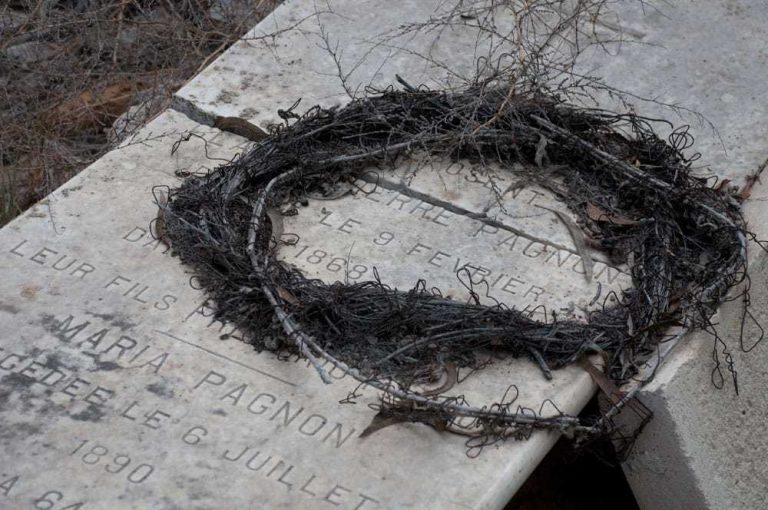
In the Catholic cemeteries, the story is no longer one of meticulously preserved memories, but of an absence that is slowly eroding. The ruins of tombs point to a vanished grandeur and a community that has nearly faded from the city’s fabric.
The watchman, a Muslim man with European features, steadfastly refused to give his name or allow a photograph, citing his family’s and particularly his children’s disapproval of his residence within the site. He represents the fourth generation of his family to live within these walls since 1943, having taken up the mantle in 1984 after his father’s passing. Since then, he has witnessed the dwindling of the Catholic congregation, most of whom were foreigners drawn to this land by their dreams: Italians, French, Cypriots, Maltese, and Levantines.
“The last person I buried, fifteen years ago, was Monsieur Francois… the last of the Maltese in the city,” he says in a hushed tone. “No one comes anymore. No one remembers.”
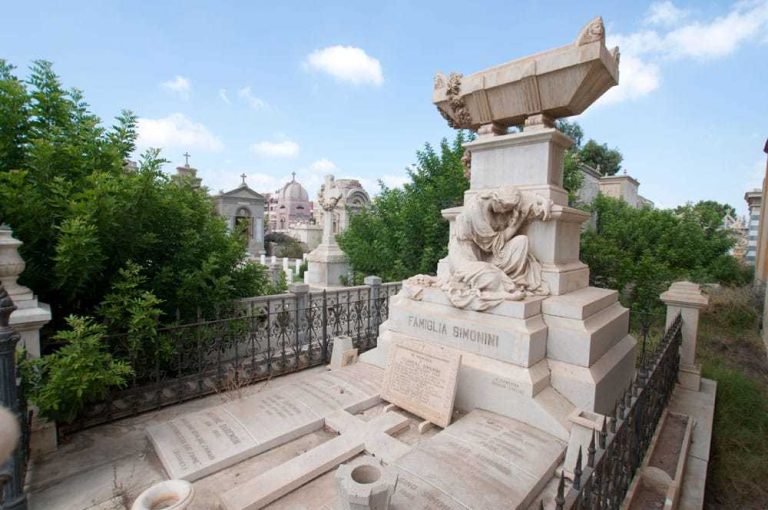
He summons names that were once pillars of Port Said’s history: Monsieur Simonini, a pioneer of hospitality and owner of the Casino de Palais and the “Iron House” one of the city’s most exquisite structures, later transformed into a grand hotel. He speaks of Monsieur de Castro and Madame Gran, the city’s social titans in the first half of the twentieth century, and the “Kings of the Sea” who owned the great ship-chandling firms.
He offers a fleeting smile. “Now, no one knows them. Even the city has forgotten.”
Statues and Smiles Defying Death
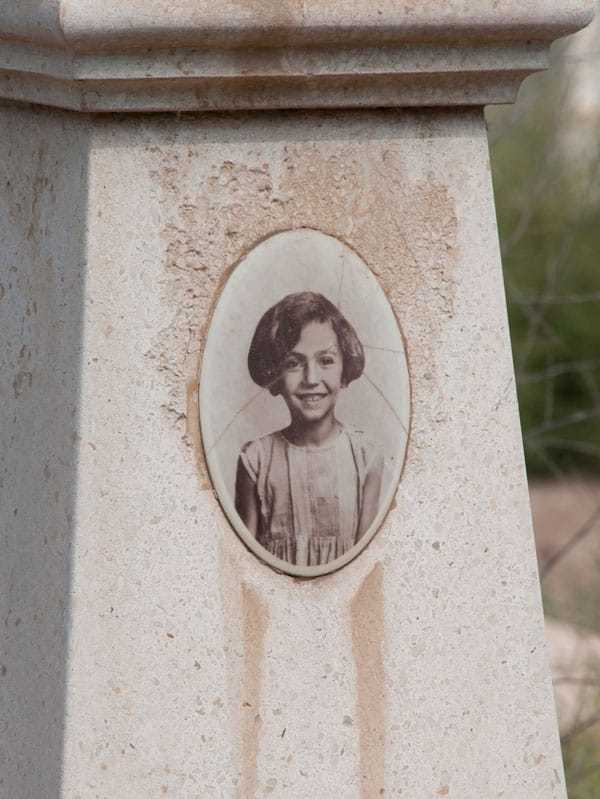
The Catholic cemetery is not as silent as it first appears; it is populated by whispering images. Statues of a sorrowful Virgin Mary crown some tombs, while marble angels stand sentry over the void. Faded photographs remain, among them the portrait of a smiling young girl who departed nearly a century ago. Her smile traverses time untouched, as if death had no claim over it.
This image intersects with the account given by Ahmed Ragab regarding the tomb of the Demetrius family, a Greek dynasty that lived in Egypt in the early twentieth century. The tomb, dating back to 1351 AH (1932 AD), is built in the classical style. Upon its facade is a marble plaque with Greek inscriptions, translated with the help of descendants who still visit.
The inscription reveals an elegy for a child named Katerina, who died in Athens but whose family brought her body back to Egypt to be interred here. At this juncture, the photograph is no longer a fleeting memory; it becomes an extension of a singular story. A girl smiling from behind a century, and another returning from a distant city to sleep here. It is as if the two girls meet in a single smile as if belonging were deeper than geography, and the city that embraced them in life was destined to cradle them in death.
Where Egyptians and Greeks Rest Together
The Orthodox cemeteries appeared even before entering as the synthesis of all that came before. Here, the testimony of the guards meets the analysis of the researcher. The cemetery feels like a natural extension of the Catholic grounds in its aesthetic, its statues, and its portraits, yet it feels closer to the present. It houses Egyptian Christians alongside the remnants of the Greek community.
The dates here are relatively more recent, and the visits have not entirely ceased. Yet here, as everywhere else, absence continues its silent work: softening the sound of footsteps and weighing heavy upon the memory.