The Temples of Medamud: Ancient Ruins Defying Decay and Rising Tides East of Luxor
Explore the fading grandeur of the Temple of Medamud near Luxor, where ancient ruins dedicated to the war god Montu battle rising groundwater and decades of neglect. This feature examines the site’s storied past, its architectural link to Karnak, and the urgent call for a narrative-driven restoration to save this archaeological treasure.
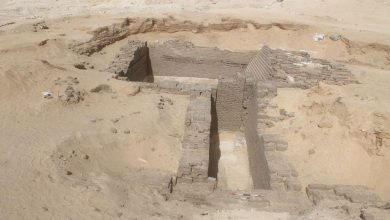
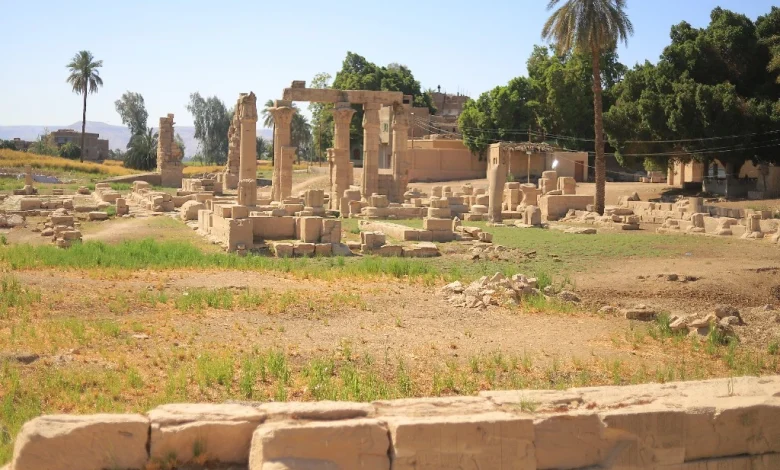
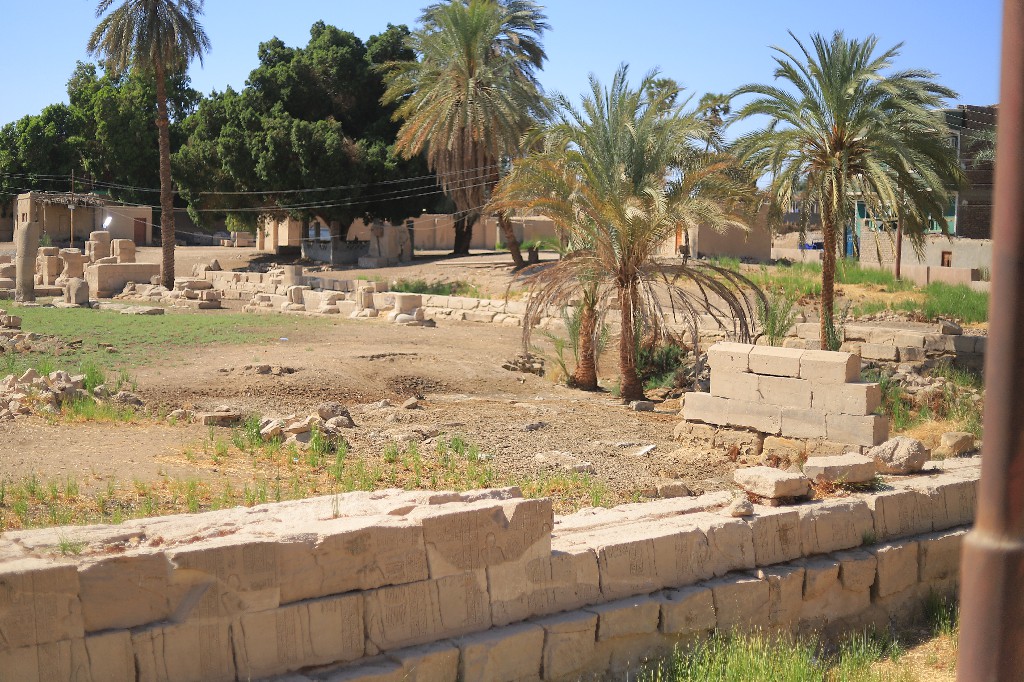
In a village bearing the same name east of Luxor, the Temple of Medamud stands as a haunting witness to millennia of history. Despite being shrouded in neglect, the site retains its essential skeletal grandeur, silently resisting the passage of time. It waits for a bold mandate to restore its lost splendor before the encroaching groundwater an existential threat to its survival deepens its toll.
Sprawled across approximately 14 feddans (acres), the temple was erected during the New Kingdom and consecrated to Montu, the deity of war and ferocity. This sacred dedication explains the striking architectural parallels between Medamud and the Karnak Temples, which also house a sanctuary for Montu. The site features a lake reminiscent of the Sacred Lake at Karnak, along with a dromos (avenue of sphinxes) and other structural elements that mirror the great complexes of Thebes.
“Madu”.. The Primordial Name
Mustafa Ahmed Ali, an antiquities inspector at the temple, tells Bab Misr that the region’s original name was “Madu,” serving as the regional hub for the Fourth Nome of Upper Egypt. The temple acted as the northeastern gateway to ancient Thebes, anchored by a unique sanctity as the center for the worship of Montu (or Monsu), the war god whose prominence reached its zenith during the Middle Kingdom.
Ali describes the temple as a kinetic “chronological record.” Construction never ceased within a single era; instead, successive civilizations left their mark. Its foundations were laid in the Middle Kingdom, expanded during the New Kingdom, and reached further development in the Greco-Roman period. The site also shelters archaeological remnants from the Byzantine and Coptic eras.
This architectural diversity transforms the site into an open-air archive of rare features. Among them is a lake once connected to a Nile canal similar to the one at Karnak and an avenue of sphinxes commissioned by King Nectanebo II of the 30th Dynasty. The site also boasts pylons dating to the Emperor Tiberius, who repurposed masonry from the reign of King Senusret III.
A Monument Besieged by Greenery
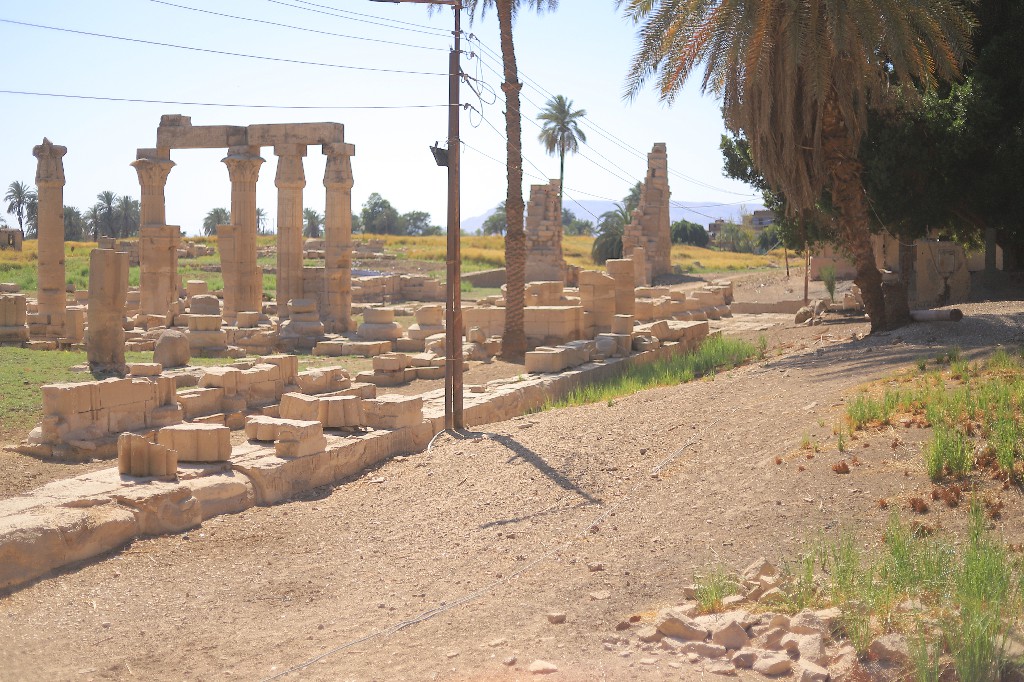
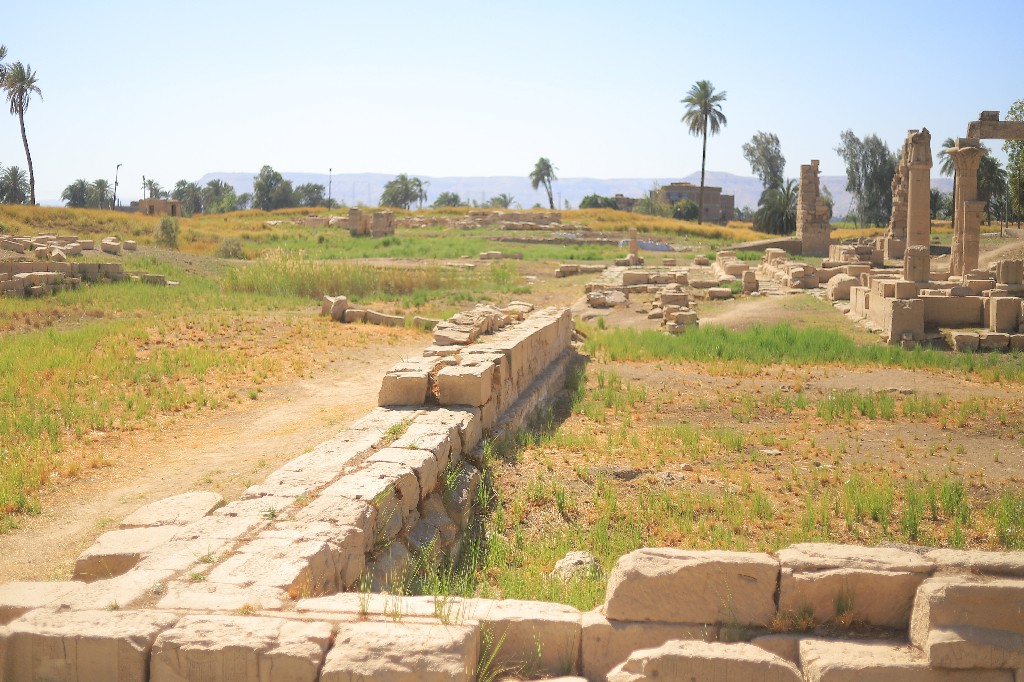
“Despite the temple’s profound archaeological weight, it faces challenges that threaten its very existence,” the inspector continues. “The rising water table, exacerbated by the lack of a modern sewage system in the village, coupled with the encroaching agricultural lands nearby, has begun to erode the sandstone. It is in desperate need of an emergency salvage plan.”
While the Ministry of Tourism and Antiquities has approved a plan to reroute drainage away from the archaeological zone, the temple still requires an immediate project to lower groundwater levels. The Sacred Lake remains submerged and choked with debris, a condition that compromises the structural integrity of the entire site.
Ali notes that the temple was a vital link in a religious network dedicated to Montu, which included cult centers in Armant and Tod, forming what is known as the “Sacred Triangle” of the deity. The complex includes an audience hall and a Great Hypostyle Hall, alongside chambers adorned with reliefs depicting Montu in the company of King Ptolemy scenes that masterfully illustrate the intersection of divine authority and royal power.
Heritage Beyond Borders
Ali confirms that a portion of the temple’s treasures now resides outside Egypt, most notably within the halls of the Louvre in Paris, which houses significant statues and artifacts, including a ram statue from the era of Nectanebo I.
Current excavations and restoration efforts have been led by a French mission for several years. Ali suggests that transforming the site into a proper open-air museum requires elevating the inscribed stone blocks onto mastabas (stone platforms) to allow visitors to appreciate the intricate carvings. The temple is encircled by a Roman-era wall built under Emperor Trajan, featuring a relief of the sacred Apis bull—a symbolic evolution of the martial qualities of Montu.
The Temple of Medamud remains a living record of how the ancient Egyptian expressed concepts of power and protection through the divine, weaving religion into the fabric of daily life and politics. Ali emphasizes that preserving this site is an inescapable responsibility to ensure its survival for generations to come.
A Sanctuary Awaiting a Massive Investment
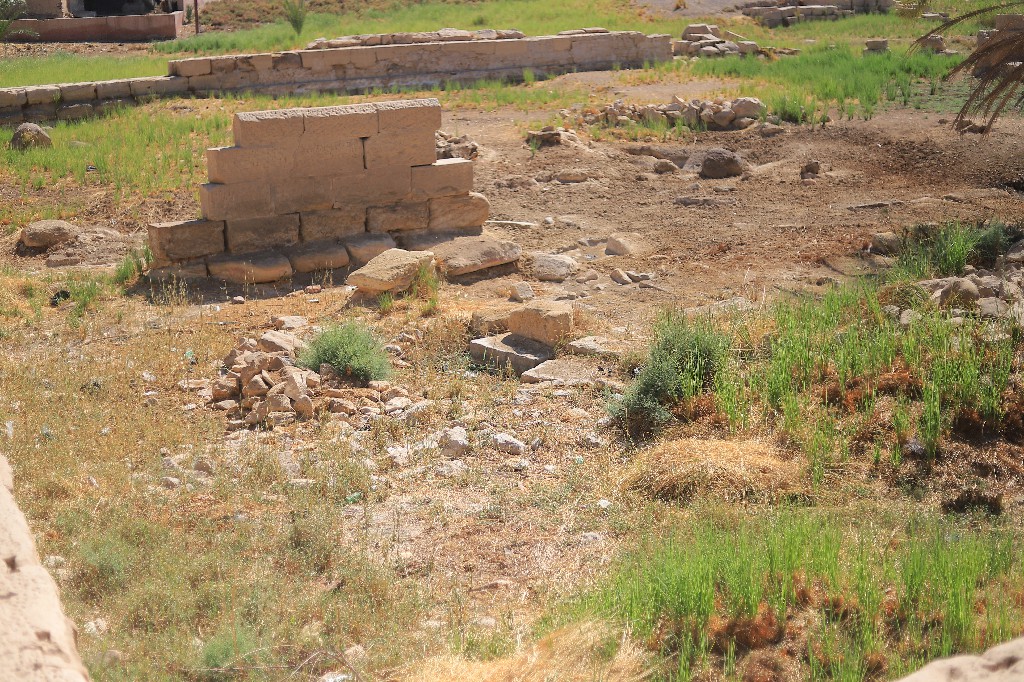
Dr. Abdel-Ghaffar Wagdi, Director of Luxor Antiquities, explains to Bab Misr that the temple in its current state is a collection of ruins, and transitioning it into a primary tourist destination would require a staggering budget. Currently, the site is open only via special permits, primarily for scientific and academic research, rather than general public access.
Wagdi questions the economic feasibility of pouring investment into a site with limited footfall when giants like Karnak, Deir el-Bahari, Medinet Habu, and the Valleys of the Kings and Queens dominate the lion’s share of tourism. He points out that development is not merely about restoration; it involves paving roads, securing the perimeter, and solving the complex hydro-geological issues, making a full public opening an arduous decision.
For over a decade, a mission from the French Institute (IFAO) has focused its efforts on the southern sector of the temple. Their work has unearthed remains of ancient pottery kilns, revealing why “Madu” was once a vital industrial center, fueled by the high-quality Nile silt (clay) deposited in the area.
Secrets Yet to Be Unveiled
Samar Nagi, a tour guide and founder of the “Know Your History” initiative, argues that the 14-feddan expanse still holds secrets buried beneath the earth. The visible columns and stones represent only a fraction of the site’s true footprint, which extends both north and south. Previous surveys have hinted at layers of ceramics spanning multiple eras.
“The Temple of Medamud is one of Egypt’s most significant sites, even if only ruins remain,” Nagi asserts. “The ancients did not build their temples in vain; every stone carries religious and historical weight, hiding stories yet to be fully told.” She believes that reclaiming these narratives and weaving them into compelling stories could transform the site into a premier attraction.
Nagi points to other nations that, despite having far more modest heritage, successfully market their sites through evocative storytelling. “Some countries find a stone over a century old and spin a tale around it that draws thousands of visitors,” she says. “Egypt possesses genuine treasures; we simply need to present them through a different lens and a more captivating narrative.”
She concludes that rehabilitating Medamud and integrating it into official tourism circuits could yield significant economic returns, a step that has become essential in the urgent drive to bolster tourism resources and secure foreign currency.