Beyond the Veil: Zeinab Al-Sajini and the Eternal Radiance of Her Daughters
A retrospective on the life of Dr. Zeinab Al-Sajini, a matriarch of the Egyptian visual arts who transformed the sanctity of motherhood into a lifelong odyssey. This feature traces her fusion of folk heritage with magical realism, and her role in carving a modern identity for the Arab avant-garde.
By Amany Ibrahim
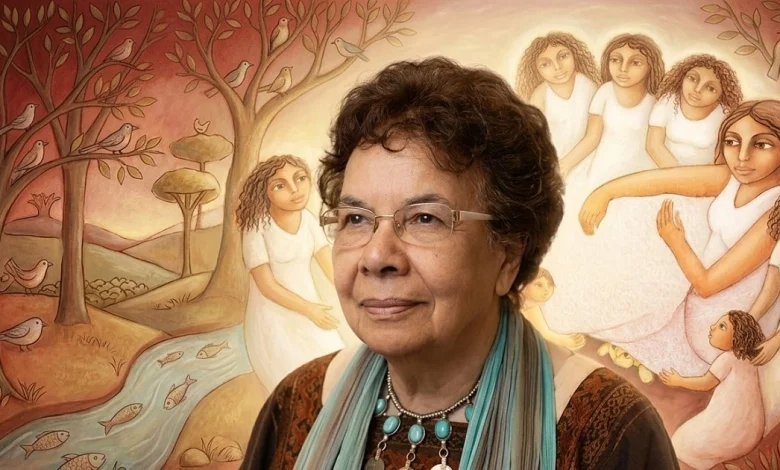
“Mother of the World’s Daughters,” “Mother of the Earth,” “Pioneer of Egyptian Portraiture,” and “Artist of Heritage and Emotion.” These titles belonged to the venerable Dr. Zeinab Al-Sajini, who passed away at the age of 96, leaving the Egyptian art world to mourn one of its most luminous trailblazers. Through her singular artistic journey, Al-Sajini etched an unmistakable signature upon the canvas of history. She championed the common soul through her “daughters” and their garments of light, drawing from the sanctuaries of motherhood and childhood to craft a sincere visual language that fused expressionism with the ethereal grace of abstraction.
Motherhood and Childhood
From her earliest beginnings, the late artist Zeinab Al-Sajini (February 20, 1930 – April 7, 2026) remained preoccupied with the themes of motherhood and childhood. These twin pillars formed the central axis of her creative universe.
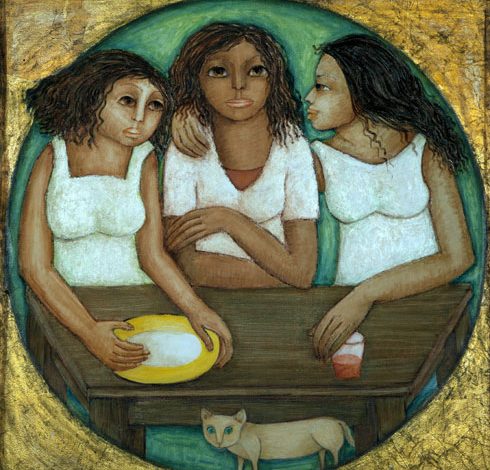
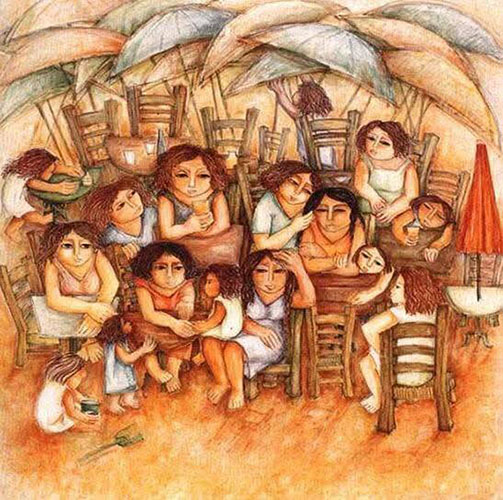
Al-Sajini distilled a multitude of events and emotions through the symbolism of the mother and child. She channeled grief, joy, anticipation, and catastrophe through the intimate lens of a mother and her daughters. This vision manifested in her paintings, where she portrayed the world itself as a “Woman” transitioning through the various seasons of life.
Art critic Hesham Qandil, Chairman of the Arab Atelier for Culture and Arts and owner of the Dai Gallery, reflects on her storied career. Speaking to Bab Misr, Qandil observes that Al-Sajini expressed these themes with a spontaneous, innate style devoid of affectation. “Her work was distinguished by an emotional sincerity and a palpable human warmth,” he explains. “This infused her pieces with a unique character, recognizable the very moment one beholds them.”
Zeinab Al-Sajini earned her Bachelor’s degree from the Faculty of Fine Arts, Department of Decorative Arts, at Helwan University in 1956. She followed this with a degree from the Higher Institute of Art Education in 1957. She further honed her artistic prowess through rigorous academic study, culminating in a Doctorate in the Philosophy of Art Education in 1978. Qandil notes that her academic path, which bridged the world of fine arts with the pedagogy of art education, played a vital role in shaping her artistic consciousness. Beyond her studio, she served as the Head of the Design Department at the Faculty of Art Education, Helwan University.
A Singular Imprint
Qandil observes that, over time, Al-Sajini succeeded in carving out a “unique artistic signature that the eye cannot mistake,” identifying her among those known as “innate artists”. She managed to formulate a private methodology that distinguished her from her peers, allowing her practice to stand as a self-contained odyssey, detached from traditional movements or mere mimesis.
He further noted her connection to the artist Abdel Rahman Al-Nashaar. Despite this proximity, she was steadfast from the outset in maintaining an independent and divergent style, steering clear of imitation or the direct shadow of any singular artist or trend.
The critic explained that her canvases masterfully weave expressionism with abstraction within a spontaneous, primordial framework. Her work remains deeply colored by the cultural and social tapestry of her formative years a period regarded as one of the most pivotal epochs in the history of modern Egyptian art.
The Generation of Genius
The formative years of Zeinab Al-Sajini were steeped in the storied geography of Al-Zahir, where she inhaled the atmospheric essence of Old Cairo the labyrinthine alleys of Al-Gamaleya, the hallowed grounds of Al-Hussein and Al-Azhar, and the metallic resonance of Al-Nahhasin (the coppersmiths’ quarter). Regarding her place within the 1960s cohort, Qandil describes it as the “Generation of Genius,” defined by a grand flowering across the creative landscape, from the silver screen and the stage to the rhythmic pulses of poetry and the plastic arts.
The era following the July 23 Revolution was a season of reconstruction and cultural zenith, instrumental in forging a distinct Egyptian artistic identity. This period left an indelible mark on Al-Sajini’s practice, anchoring her work in a profound sense of national belonging. “She was the quintessential model of a deeply private Egyptian artist,” Qandil continues, reflecting on her journey. He emphasizes that she remained steadfast in her local heritage, refusing to be swept away by Western spectacle or European currents. Instead, she was determined to channel the soul of the Egyptian environment through her own singular lens. Among the most striking visual hallmarks of her work, he notes the raw spontaneity with which she navigated the world of childhood, capturing the stark innocence of her subjects with a rare, unstudied grace.
The Perfection of Expression
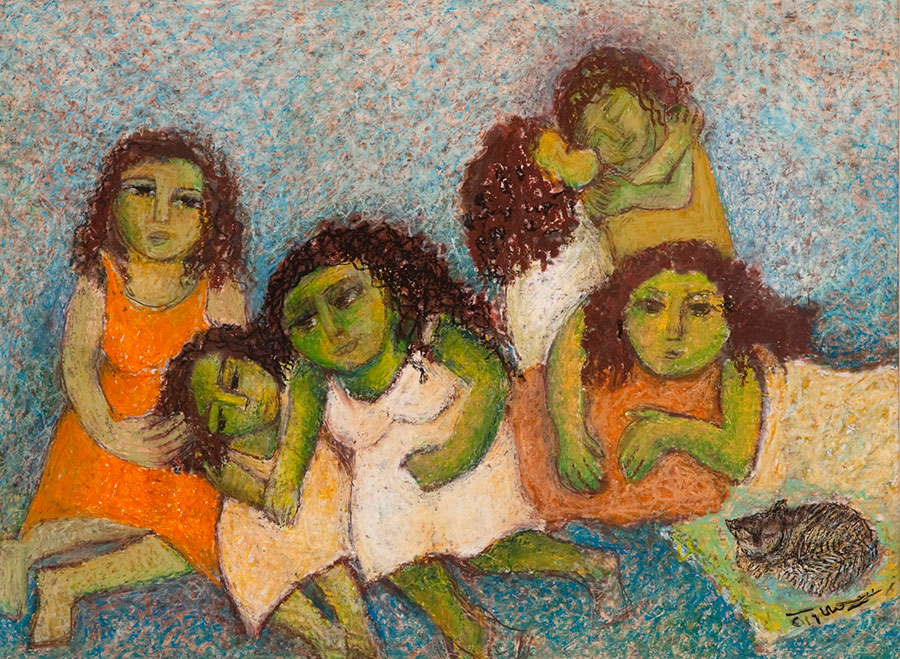
Qandil characterizes her aesthetic as one founded upon “the perfection of expression” (kamal al-ta’bir) rather than the “perfection of form” (kamal al-tashkil). She consistently afforded priority to expressive energy and human emotion over the constraints of geometric rigor. He further observes that the color red, in its myriad gradations, maintained a commanding presence across her canvases. It served as a vital thread weaving through her body of work, which was generally defined by an atmosphere of joy, optimism, and a pulsing vitality—as if she were beckoning the viewer into a spirited dialogue with the frame.
Her artistic odyssey underwent distinct transformations across the decades. In her early years, specifically throughout the 1960s and 70s, she fixated on the theme of motherhood through compositions that leaned toward the ethereal realm of abstraction. By the 1980s, however, her focus shifted, bringing the worlds of childhood and maternity into a sharper, more visceral clarity. “She was never a mere documentarian recording reality, nor was she a captive to the subject of motherhood as some might presume,” Qandil asserts. He maintains that she offered an integrated artistic vision that transcended simple documentation to reach a plane of profound human resonance. “It was our deep hope to see her honored with a major state prize,” he concludes, “a tribute befitting her pioneering spirit and her towering stature.”
Matriarchs of the Canvas
Qandil anchors the legacy of Zeinab Al-Sajini alongside the most formidable matriarchs of Egyptian art, placing her in the company of Tahia Halim, Gazbia Sirry, Inji Efflatoun, and Zeinab Abdel Hamid. Together, he considers them the “Preeminent Quintet” of the Egyptian women’s art movement.
He maintains that Al-Sajini’s oeuvre warrants preservation within a dedicated museum bearing her name to immortalize her artistic odyssey. He points to existing precedents for such tributes, most notably the museum dedicated to her late husband, the artist Abdel Rahman Al-Nashaar. “I believe her family, and specifically her daughter, Dr. Iman Al-Nashaar, will see to this mission, ensuring her artistic heritage is safeguarded,” he remarks.
An Indelible Epoch
“Zeinab Al-Sajini lived an expansive artistic life that remained vibrant until her final breath, rendering her a definitive landmark that cannot be overlooked,” says Dr. Mohamed Kamal, artist and critic, as he reflects on her tenure within the movement. As a pioneer of the first generation of modern Egyptian art, her work possesses a clarity of purpose and a distinct visual vernacular.
Speaking to Bab Misr, Dr. Kamal elaborates on the immediate recognizability of her style. “Zeinab Al-Sajini represents a vital symbol for both the Faculty of Fine Arts and the Faculty of Art Education,” he notes.
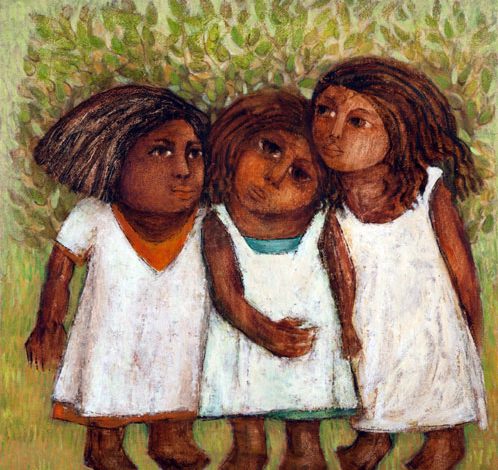
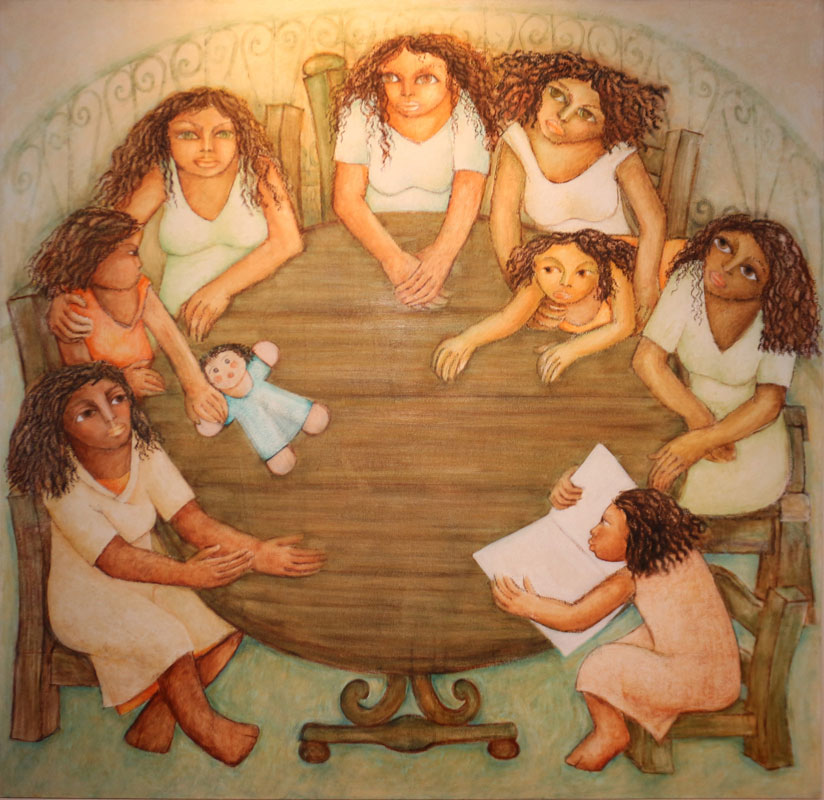
Her journey began within the halls of Fine Arts before she pursued pedagogical qualifications a dual path that mirrored the artistic, academic, and deeply human dimensions of her work. In her paintings, girls appear as butterflies in raiment of light, as if weaving a private universe that transcends the immediate confines of reality.
In the Realm of Magical Realism
Her visual architecture places her practice within the sphere of “Magical Realism.” Kamal notes that her work sprouts from the soil of reality only to bloom into invisible or unfamiliar worlds, maintaining a delicate equilibrium between the tangible and the surreal. He likens her artistic compositions to the literary tapestries of Gabriel García Márquez.
Kamal further examines the nationalist dimension of Al-Sajini’s journey, explaining that her upbringing prior to the July 23 Revolution and her subsequent immersion in professional life during the height of the Egyptian National Project exerted a profound influence on her trajectory. She lived through the surges of pan-Arabism and the successive crucibles of war from 1948 to 1973. These seismic shifts resonated in several of her works, most notably The Martyr, where national struggle commanded a powerful presence in her vision. Kamal also points to her marriage to the artist Abdel Rahman Al-Nashaar as a significant juncture; they were initially bound by a shared devotion to the nationalist perspective, particularly as Al-Nashaar produced seminal works such as Jerusalem (Al-Quds). Yet, despite this common grounding in the political climate of the time, each eventually cultivated a distinct artistic project, departing on unique paths rooted in the Egyptian environment without one ever becoming a shadow of the other.
Womanhood and the Spirit of Liberation
The odyssey of Dr. Zeinab Al-Sajini has been chronicled in numerous critical volumes, including a 1999 monograph bearing her name that surveyed her works alongside the insights of contemporary critics and artists.
Her legacy is also woven into broader critical texts that dissect the political and social landscape of her formative years. Among these is Woman in Literary, Media, and Cultural Discourse, which explores the early stirrings of liberation in the Arab world and the transformation of the female figure into a symbol of independence.
The book observes that, during this era, the woman became a “national image embodying the collective meanings stored within Egypt’s patriotic journey.” She emerged as an icon whose form, attire, and posture summarized the plight of a people, their struggle, their clinging to memory, and their nostalgia for a lost geography specifically referencing Palestine. However, while these images were laden with modern concepts of freedom, they often remained traditional in their artistic rendering and classical in their technical execution.
The Arab Visual Vanguard
The narrative continues: “The Arab woman entered the sphere of the plastic arts in the mid-twentieth century in very modest numbers. Yet, she did so with confidence and force, distinguished by a creative prowess and a singular talent that made an undeniable contribution to the authorship of Arab art in the last century.”
This pivotal shift marked the transition of woman from the subject behind the canvas to the creator before it. She transformed into the artist who would personally mold the features of her own image as the creative force standing at the easel, and as the imagined figure within the frame. From the 1960s onward, as the ripples of global movements like Impressionism, Cubism, and Surrealism reached Egypt, women championed the cause of the artistic avant-garde. They dared, they experimented, and they embraced the risks of the new.
Womanhood and the Modernist Project
As noted in Woman in Literary, Media, and Cultural Discourse, while men were long preoccupied with the weight of heritage (turath), the female artist devoted herself to the pursuit of modernity.
The works of Dr. Zeinab Al-Sajini achieved global resonance. From 1956 until her departure, she held numerous solo exhibitions in Alexandria and Cairo, as well as abroad in Lebanon and Yugoslavia. Her paintings found homes in private collections across the globe, reaching the United States, Denmark, England, Saudi Arabia, and Kuwait, according to the official records of the Fine Arts Sector.
Another critical study—the first installment of a critique by Dr. Mohamed Kamal, published in the encyclopedia The Treasure (Al-Kanz) by Akram Abu Dunya via the Alex Adv Foundation—examines her work under the title “The Mythical and the Environmental within the Vessel of Heritage.” In this text, Dr. Kamal pauses before the artist’s vast experience, noting that Al-Sajini’s career reveals a bedrock of academic rigor. Her graduation from the Faculty of Fine Arts in 1956, followed by her diploma from the Higher Institute of Art Education in 1957 and her 1978 Doctorate in the Philosophy of Art Education, formed a formidable intellectual foundation.
This scholarly path, as he observes, was never detached from her creative practice. Instead, it was fused into her artistic project, smelting her academic background into the distinct contours of her private visual language.
The Architecture of the Daydream
The text suggests that her work underwent a meticulous evolution until her ethereal world finally crystallized a world populated by her “daughters,” who appear in her paintings robed in light. Clad in garments akin to white vestments, they move through a visual expanse that bridges geographical reality and the sublime imaginary, anchored in a vision of “Magical Realism” with a distinctly mythic dimension.
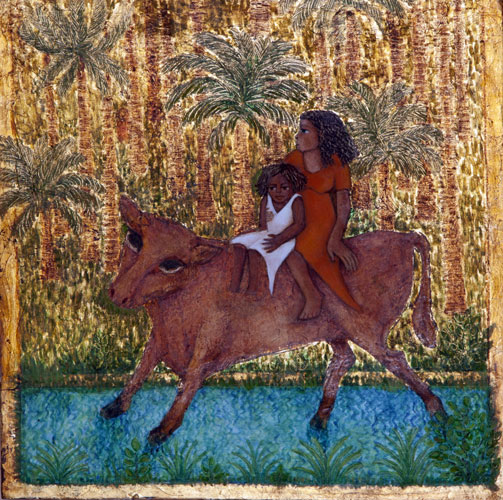
This realm does not rely on the mimesis of reality; rather, it harnesses the “daydream” (hulm al-yaqaza) to establish a highly private pictorial state. Here, uniqueness manifests in the structural composition, the feminine lexicon, and the spatial context. According to Dr. Mohamed Kamal’s critical study, Al-Sajini possessed a singular ability to intertwine the subjective with the collective through a visual architecture rich with elements drawn from the folk conscience (al-wijdan al-sha’abi): fish and fishing nets, birds and beasts, trees, boats, mountains, seas, rivers, plains, and valleys.
The Fetus and the Womb
At the heart of this universe, the “young female” occupies a central station. She appears in manifold forms that blend childhood with burgeoning womanhood a symbolic expression reflecting the profound umbilical relationship between the fetus and the womb. The critic concludes that this integrated visual tapestry, with its heavy freight of symbols and relationships, does not merely reflect an individual artistic journey. Instead, it founds a unique aesthetic vision that springs from local culture and environment, re-presenting them through a contemporary mythic formulation. The presence of white raiment in Al-Sajini’s work feels like an extension of her private cosmos a world brushing against the idea of a reimagined “Paradise,” where these elements materialize as emblems of purity and spiritual serenity.
From this vantage point, a delicate artistic bridge is formed between the narrative and the visual, between the heard and the seen. Through realistic atmospheres saturated with a storyteller’s mythic touch, she evokes the inspiring spirit of The Thousand and One Nights.
Sculpting the Identity
Dr. Mohamed Kamal continues his conversation with Bab Misr, explaining that the presence of the woman in Zeinab Al-Sajini’s work transcends its role as a mere formal element. It is, instead, an expression of “the world in its entirety.” In her artistic vision, the woman is the axis of the universe and the font of life. Kamal notes that while she did not intentionally put forward direct socio-political “women’s issues,” her artistic project itself constituted a self-contained cause linked to privacy and identity. The elements she employed the women and the flora transformed into an idealized state, a world akin to heaven. It is as if she were summoning this world from higher realms to reshape it visually.
Reflecting on the first generation of female pioneers, Kamal points to luminaries such as Marguerite Nakhla, Kawkab Al-Assal, and Zeinab Abdo, each of whom possessed a distinct artistic character. He adds that this excellence emerged during a historical era that saw a relative retreat in the social status of women, perhaps due to colonial conditions or shifting social tides. This context made the establishment of a private artistic identity for each of them a form of creative struggle a way to sculpt the self and assert their presence in history.