A Rare Egyptian Craft Battles Extinction in Beheira
An ancient familial art fights for survival. Discover how master artisan Essam Abdullah resurrects discarded water buffalo horns into exquisite, lyrical sculptures, defying economic ruin and the quiet erosion of a rare cultural legacy.
By Mahmoud Dowair
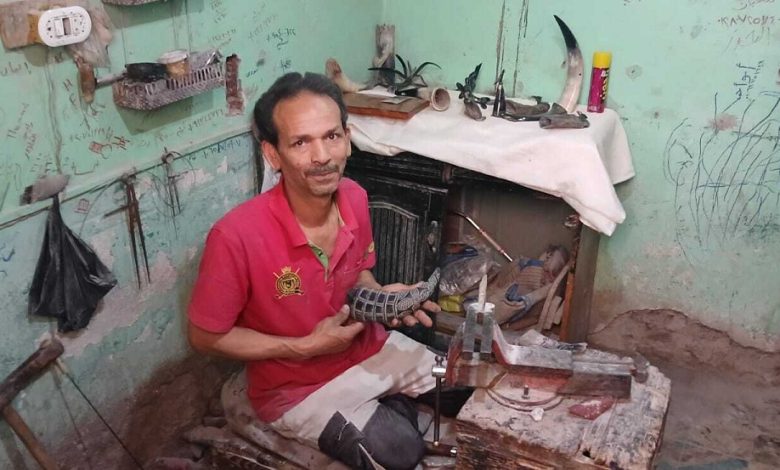
Essam Abdullah within his cramped workshop, meticulously shaping water buffalo horn. (Photo: Mahmoud Dowair)
For more than half a century, the family of Essam Abdullah has fiercely guarded one of the rarest heritage crafts in the Egyptian countryside: the art of carving water buffalo horns. Passed down through generations, this meticulous trade has woven itself into the very fabric of the family’s identity and history. Yet, while they have successfully kept the craft alive for decades, they now confront mounting adversities that threaten its survival, pushing it to the brink of extinction.
From Abattoir Waste to Rare Masterpieces
Deep within his home workshop in the village of Zawiyat Ghazal, located in the Beheira Governorate, Abdullah continues his life’s journey with this exceptional craft. Guided by more than four decades of experience, his hands deftly transform raw buffalo horns into exquisite artifacts and objets d’art that reflect the vibrant spirit of Egyptian folk creativity.
Now 51 years old, Essam Abdullah Ismail inherited the craft from his father. He has never viewed it merely as a livelihood, but rather as a sacred familial and cultural legacy to protect and pass on to future generations. Despite the distinct beauty and rarity of horn carvings, this ancient craft faces brutal economic pressures. Skyrocketing production costs, stagnant marketing channels, and a dwindling interest among youth to learn the trade collectively threaten its continuity. Poised between his manual carving tools and the raw horn, Abdullah stands as a living witness to a craft that has resisted the ravages of time for decades, but now desperately requires institutional patronage to save a unique chapter of Egyptian artisanal heritage from vanishing.
Abdullah recalls absorbing the secrets of the trade during his childhood, entering his late father’s workshop at the tender age of ten alongside his four brothers. He explains that the production process spans more than twelve intricate stages, beginning with simple tasks suited for beginners and progressing to the mastery of sculpting, carving, and final finishing.
While his father successfully trained all his sons, a significant number of them abandoned the workshop in recent years as demand waned. When asked if he has passed the torch to his own children, Abdullah notes that his sons, the eldest of whom is married, have all learned the trade. Each age group takes on tasks suited to their capability; the younger children begin with the sanfara (sandpaper smoothing) stage, advancing to more sophisticated techniques as they mature.
Transmuting Meat Scraps Into Art
Regarding his raw materials, Abdullah explains that he procures the horns from slaughterhouses after they have been thoroughly cleaned and prepared, resurrecting animal waste into fine heritage pieces. However, raw material prices have surged dramatically in recent years. Once sold for nominal sums, a single horn now commands upwards of 75 Egyptian pounds, rendering them exceedingly scarce—a crisis exacerbated by the export of raw horns abroad.
Describing the arduous process of sculpting, Abdullah notes that it begins by purging the horn of impurities. The artisan then determines the optimal design based on the unique geometry and size of each piece, as no two horns are identical. Next comes the sketching phase, followed by using a hand saw to cut out the rough silhouette. The piece is then exposed to direct flame, allowing the artisan to mold and refine it using rasps and specialized chisels. The work intensifies during the engraving phase, where minute details are etched into the surface, culminating in a rigorous polishing process using specialized compounds that bestow the final artistic luster.
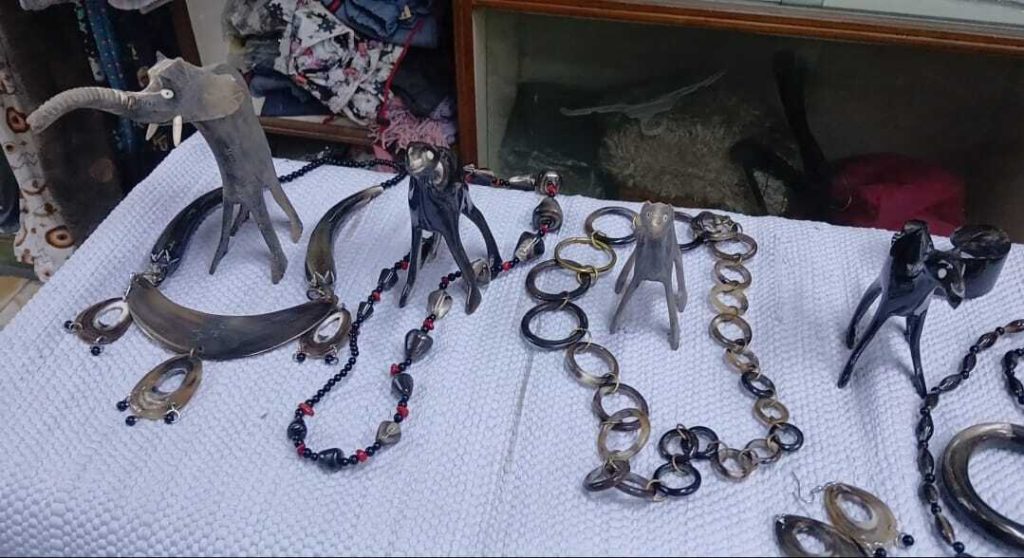
Carving buffalo horn extends far beyond mere decorative trinkets. The workshop yields an array of figures, capturing the essence of birds, camels, and gazelles, alongside bespoke accessories, jewelry, mabakhra (incense burners), and elegant office stationery.
Beheira: The Heartland of a Vanishing Art
An alumnus of an industrial technical school, Abdullah spent decades showcasing his work at productive family exhibitions both within and outside Beheira, where his creations drew enthusiastic crowds captivated by their rarity. He frequently conducted live demonstrations, allowing tourists and exhibition visitors to witness the mesmerizing metamorphosis of raw horn into intricate art. He emphasizes that Beheira has historically reigned as the premier enclave for this heritage craft. Today, however, the refusal of younger generations to embrace the grueling apprenticeship threatens its future. Abdullah pleads for targeted intervention to rescue the craft, calling for youth training initiatives and robust marketing assistance both domestically and internationally.
The Marketing Impasse and Shifting Desires
Mahmoud Abdullah, director of the Productive Families Association exhibition in Beheira, recalls a time when the craft enjoyed far greater prosperity, with steady orders streaming in from institutions and connoisseurs alike. In recent years, however, demand has plummeted drastically. The association currently stands as the sole commercial outlet for these creations in the entire governorate.
He adds that the inflation of raw material prices and production costs has severely crippled both manufacturing and marketing, forcing many artisans out of the trade due to meager financial returns. While exhibitions remain vital lifelines for heritage crafts, there is a dire need to multiply these events to connect artisans with the public. Furthermore, shifting consumer tastes toward modern, mass-produced items have depressed the market for traditional handicrafts. Many contemporary buyers remain entirely ignorant of the nature of the craft or the material used until the grueling labor behind it is explained to them. Without swift promotional support and structural care, the dwindling number of active artisans guarantees the craft’s demise.
Halted Training and the Threat of Disappearance
The systemic threat to the craft is underscored by the closure of formal training avenues. Shahira Saad Ahmed, a former instructor in a long-running buffalo horn carving project supervised by the Ministry of Social Solidarity, laments the suspension of an initiative that once successfully trained young men and women. The project operated for more than 20 years under the auspices of the Development Association for Family and Disability Care in Damanhour.
According to Ahmed, the project ground to a halt in recent years due to a compounding crisis: the soaring price of raw horns, dwindling institutional support, and a stagnation in the exhibition circuit that served as the primary retail vein. Consequently, the economic yields of the craft shrunk to a fraction of the immense physical toil required.
While hundreds of youth received training over two decades, only a handful managed to pursue the craft professionally or establish independent workshops, thwarted by prohibitive start-up costs and weak economic viability. Following the cessation of activities, all machinery and tools were surrendered to the Ministry of Social Solidarity.
Reviving this art, Ahmed insists, demands a coordinated effort between the Ministry of Social Solidarity and the Ministry of Local Development, alongside the creation of sustainable marketing platforms. Marketing remains the ultimate hurdle. While the public routinely marvels at the beauty of the carved horns, current economic anxieties have forced consumers to prioritize basic necessities over decorative artwork. Preserving this rare craft now hinges entirely on official state intervention to anchor these artisans and secure sustainable commerce before the art vanishes forever.