Masterpieces Capturing the Hidden World of Football
Discover how iconic fine artists like Nicolas de Staël and L.S. Lowry immortalized the beautiful game, capturing the profound human drama hidden behind the stadium lights.
Beyond the clamor of the FIFA World Cup 2026 matches lies a quiet universe of human intimacy that has long seduced fine artists across the globe. They have captured it all on canvas: the fleeting ecstasies of victory, the crushing desolation of defeat, the roaring terraces, and the whispered colloquies within the dressing rooms. Within the hallowed confines of the mostateel al-akhdar (the green rectangle), creators found a rich tapestry for artistic expression. As the world immerses itself in the energy of the 2026 tournament, Bab Misr revisits the defining masterpieces that immortalized the beautiful game.
The Most Valuable Canvas on the Pitch
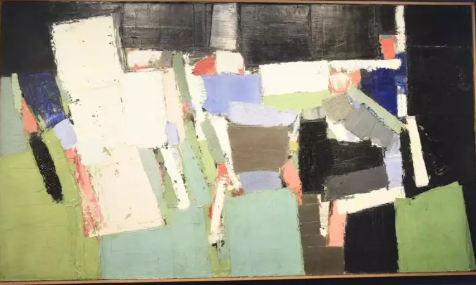
The Russian-born French maestro, Nicolas de Staël, turned his gaze toward documenting football matches, creating a masterpiece that shattered records when it fetched €20 million at a Christie’s auction in Paris, cementing its place among the most expensive sports-related art acquisitions in history.
According to Agence France-Presse, the 1952 painting captures a friendly match between France and Sweden during a golden era of French football. The artwork, which long remained fiercely guarded within the artist’s family estate and rarely saw the light of public exhibition, carried an initial estimate of €18 million to €25 million before making its debut on the auction block. Standing as a zenith of de Staël’s oeuvre, the canvas evokes a match at the historic Parc des Princes stadium in Paris, using thick, layered strokes of color that shift from a deep teal to a brilliant, luminous white.
The Pilgrimage to the Match
For the British painter L.S. Lowry, fame came anchored to his celebrated series Going to the Match, which chronicled the rhythmic tides of spectators surging toward sporting arenas. The crown jewel of this collection remains his 1953 canvas, capturing football devotees on their pilgrimage to Burnden Park. This was not Lowry’s first foray into the subject; he had previously used the same title for a 1928 work depicting crowds heading to a rugby match, returning to the motif in 1946 with a piece capturing spectators descending upon a sporting event. The valuation of these works climbed relentlessly over decades. By 2021, the 1928 painting commanded an estimate of £2 million to £3 million before finding a home in a private collection. Meanwhile, the iconic 1953 masterpiece hung on loan at The Lowry museum in Salford from 2012 until 2022, before commanding an astonishing £7.8 million at public auction later that year.
Football and the Fine Arts
The year 1953 witnessed a remarkable convergence of football and high culture, culminating in the landmark Football and the Fine Arts exhibition. Decades later, the National Football Museum drew direct inspiration from this historic showcase to curate its own exhibition, The Art of Football, assembling a grand collection of over 100 artistic pieces.
Amid these works, Lawrence Toynbee’s Mid-Week Training at Stamford Bridge (1953) stood out, securing one of the major prizes in the painting category. Executed in rich oils on canvas, the piece was one of two submissions Toynbee entered into the 1953 competition. It earned rapturous praise from the eminent art critic David Sylvester. Toynbee stood alongside three other laureates in the painting division, each receiving a prize of £250 in recognition of their exceptional artistry.
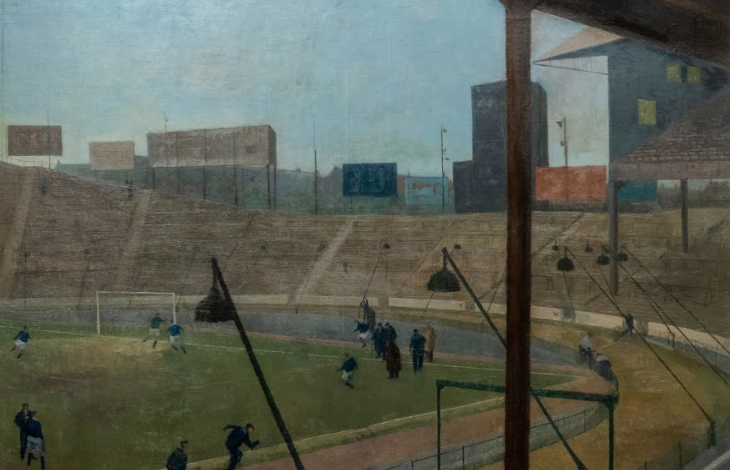
Meanwhile, Robert Tavener’s The Dressing Room emerged as one of five triumphant entries in the engraving and lithography category at the 1953 exhibition, earning the artist a £50 prize for his intricate craft.
Born in 1920, Tavener’s early discipline was anchored in the military, having entered an army school at the age of 20. Following the cessation of the war, he pivoted toward the fine arts, studying through the Army of the Rhine’s foundational college. In 1953, the very year he finalized The Dressing Room, he secured a position as a printmaking instructor. In the later chapters of his career, Tavener flourished as an illustrator and designer, creating promotional posters and editorial illustrations for magazines and books, cementing his legacy as a titan of British printmaking and commercial art.
The Anatomy of Triumph
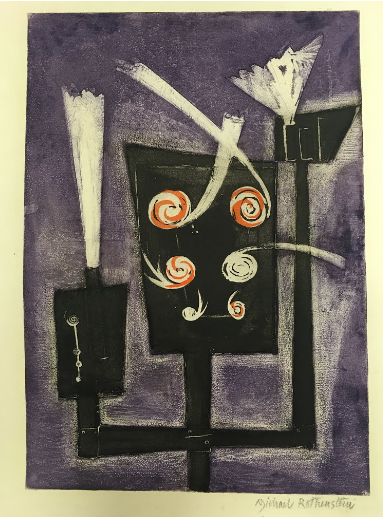
Another triumph in the engraving and lithography category belonged to Michael Rothenstein’s The Moment of Victory, a masterful blend of etching and aquatint that secured a £50 prize. According to the exhibition’s records, the piece employs an abstract design, depicting a vivid purple pitch pierced by swirling, colorful geometries. Viewers can interpret these forms as celebratory streamers, blinding floodlights, or perhaps the kinetic forms of players mid-celebration. Rothenstein ranks among the vanguard of British printmakers, though his creative interiority extended gracefully to painting. Notably, his legacy includes creating the illustrations for the first British edition of John Steinbeck’s classic novel, Of Mice and Men.
Leveraging his deep familial connections, Rothenstein also co-founded the Great Bardfield Artists, a collective of creators who nested in the village of Bardfield within the English county of Essex. Though their individual aesthetic approaches diverged, they remained bound by a shared devotion to figurative art and the poignant depiction of the human condition and everyday life.
Inside the Sanctum of the Dressing Room
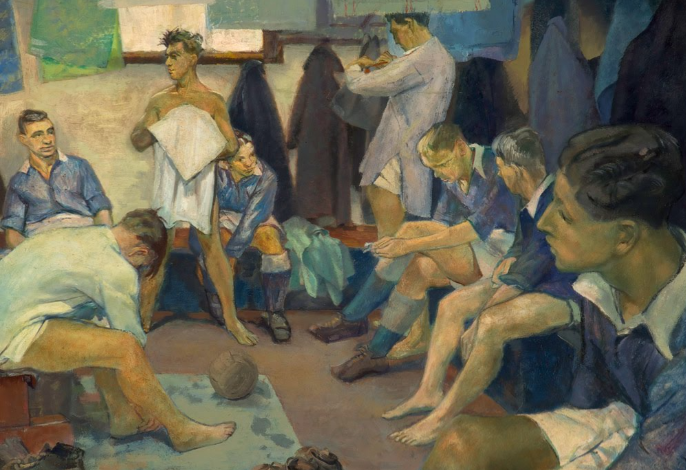
The brushes of these fine artists frequently bypassed the grand theater of the game to document the hidden, vulnerable moments of an athlete’s life, specifically the quiet, anxious atmosphere that precedes a match deep within the belly of the dressing rooms.
According to the exhibition archives, Hubert Andrew Freeth’s 1953 painting, The Watford Dressing Room, captures this profound human reality in exquisite detail. The preparatory studies for the artwork include a sketch of Tony Collins, a towering figure who etched his name into English football history as the league’s first Black manager. Collins famously guided Rochdale AFC to their historic, lone appearance in a major cup final in 1962, and his presence remains anchored in the bottom-right foreground of the final watercolor piece.
As for Hubert Andrew Freeth himself (1912 to 1986), the British portraitist and engraver received rigorous formal training and exhibited extensively throughout his life. During the Second World War, his career took a dramatic turn as he served as an officer in British Intelligence and as an official war artist deployed across the Middle East.