The Theatre of the Pitch: Football Between Anthropological Phenomena and Popular Spectacle
Exploration of football, tracing its deep-seated cultural roots from ancient Egyptian tomb paintings to the global popular spectacle of the modern World Cup.
By Massoud Shoman
A game of evasion, a ritual of catharsis where spectators cleanse themselves of daily tribulations, dreaming of a triumph realized by the feet of others. They escape with expectant, joyful hearts, eager for communal participation, discharging energies that would otherwise fracture the self, were it not for this collective, exuberant fervor finding its expansive arena of expression.
These emotions run deep, drawing their threads from our ancestors. Though I am no practitioner of ancestor worship, nor do I seek to unearth Egyptian roots for every modern event, I must insist that we do not strip ourselves of our civilizational glory. Egypt’s magnificent history has long been plundered by the world—others draw deeply from our well, sometimes through artifice, sometimes through outright theft, and occasionally to fortify their own fabricated histories.
Perhaps this is an occasion for contemplation, a leisurely stroll through our civilizational gardens to recognize the alloy of values, arts, and movement that sculpted the true features of the Egyptian character, which many now labor to distort. Let us merely cast our spirits upon the tombs of Beni Hasan, where the grandeur of the wall paintings holds an overwhelming presence. We shall breathe life into them, seeking to touch, with our very eyes, the pastimes of our forefathers.
With them, we reclaim the ancient Egyptian game of Huksha (a traditional stick-and-ball game), which has since transformed into a global sport. Invented and played by our ancestors, Huksha is a legacy passed down through millennia. The ball has never ceased running between Egyptian feet and before their sticks; its rules, tools, and techniques transmitted from one generation to the next, surviving in villages and working-class neighborhoods.
The children of this land practiced this game through motion, viewership, and heated debate, creating a popular ritual of total interaction. Here, the ball serves as a mere icon for gathering, diversion, athleticism, and the affirmation of skill. Thus it remained anchored in our soil until the British witnessed it during their occupation of Egypt. Enchanted by the spectacle, they exported it to their homeland, where Huksha became “hooksha,” the vocabulary evolving gracefully until it crystallized into “hockey.”
Huksha: The Plundered Pastime of the Egyptians
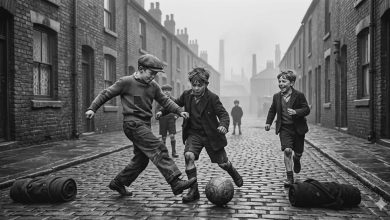
Huksha was uniquely the game of the common people, played by children in narrow alleys and winding lanes. We can distill its rules quite simply: the ball is placed in the center of the pitch between two teams. The leader of the first team calls out: “Tarneeza,” to which the opposing leader replies: “Bahri al-Giza” (towards the north of Giza).
This is Huksha, its roots buried deep in Egypt, its branches stretching across the globe, played before the sticks of modern youth. Nor is this legacy confined to Huksha alone. Anyone contemplating the tombs of Beni Hasan in Minya will discover a rich, abundant array of sports—though this is not the venue to catalogue them all or to prove their widespread popularity across the Egyptian expanse.
Yet, we must point to football itself. Historical indicators and murals strongly suggest that the sport traces its lineage back to the ancient Egyptians. Researchers have unearthed balls fashioned from linen, and others crafted from animal hides, within ancient Egyptian tombs.
Furthermore, several scholars rely on these historical drawings and archaeological discoveries to affirm that Egyptians played football alongside Huksha. The Greek historian Herodotus, visiting Egypt in 460 BC, observed groups of young children playing with a ball made of goatskin or straw, each striving to score goals by navigating the ball toward a cord strung between two pillars.
Is this not the very football whose source is Egypt? Granted, some persist in chanting the refrain that football was born in Egypt solely at the hands of the British during the occupation. But what then do we make of the ancient frescoes and the balls discovered in the tombs? Shall we falsify history merely to flatter British eyes?
We possess no absolute certainty, yet these signs and physical examinations guide us back to our roots. The British resurrected the game, perhaps, playing it within their military camps, thereby bridging the chasm between our forgotten ancient history and the contemporary Egyptian passion for football.
When we ponder the history of this ball, we find that proponents of the diffusionist theory wherein a cultural element, in this case the ball, radiates outward from a single source view Egypt as the ultimate origin. Meanwhile, others clash to locate its birth in China, Japan, Greece, or England.
Conversely, adherents of the polycentric theory suggest that all these regions embraced the ball simultaneously, driven by shared social, psychological, and spiritual needs. The rivalry endures because football is inherently built on competition, the pursuit of pleasure, and the scoring of goals. It unfolds upon a stage of green turf, before an active, present audience fully aware of the game’s laws. Everything transpires with translucent clarity, devoid of masks, presenting us with a grand popular drama where the audience circles the pitch to experience a form of emotional catharsis. Can we, in this light, deem football a popular spectacle?
The Popular Spectacle
Is the game truly a spectacle? Is it a mass phenomenon or a popular one? Does it realize individual virtuosity or collective brilliance? Can we read its evolution through the same theatrical frameworks found in folk arts? And what, precisely, is the definition of a spectacle?
To speak of the cultural heritage of the popular spectacle—as an expansive cultural space with deep historical and geographical roots—is to immerse ourselves in a myriad of forms: rituals, ceremonies, and customs where dance, song, and instrumental music intertwine.
It relies on highly expressive languages and mediums, including the spoken word—whether through traditional chants or the choreographed “Dakhlat” (elaborate stadium banner displays) of matches. These displays become fertile ground for physical and aesthetic creativity, alongside a sophisticated body language of gestures, dances, and movements.
Among football crowds, the popular spectacle submits to a disciplined set of rules and conventions agreed upon by the supporters. This manifest structure governs their organization, loyalty, chants, the preparation of the stadium displays, and the specific scenography that transforms the terraces.
This artistry reveals itself in the vocabulary and composition of the performed texts, the methods of display, the choice of attire, the techniques employed, and the orchestration of time and space.
It is worth noting that these arts of the spectacle are never devoid of entertainment, wit, occasional gravity, and elements of deep-seated belief. They transform the terraces into a monumental festival and a popular theatre complete with all its essential components. We witness a carnival where the majority participates, gazing at their own reflections as they begin a journey of psychological purging, healing the inner pains that inhabit them. The tension exits their bodies, released through dance and the venting of oppressions, anxieties, inhibitions, and the burning dream of victory.
The concept of the spectacle, as Dr. Abu Al-Hassan Salam observes, leads us to the meaning of Infeeraj (alleviation or resolution). Resolution is the exact antithesis of suppression and crisis; it signifies deliverance from hardship. In modern linguistic usage, it denotes the viewing of wonders—it is the act of witnessing. Resolution, much like the crisis or the zenith, is a structural element of plot in classical dramatic architecture. Its purpose is revelation, enlightenment, and untangling after the crisis reaches its peak. Thus, resolution brings profound relief to the receiver, marking the end of a conflict that had sustained tension and suspense.
Does this connect to football? Can we discern this crisis, resolution, and spectator relief when a team triumphs, or even when they perform beautifully without winning?
Let us contemplate the collective joy that serves as a vital lung for the public after a victory. Consider Egypt’s match against the Congo and its sheer dramatic arc: the ecstatic joy of scoring the first goal against the group’s weakest team, followed by the Congo’s equalizer in the dying minutes, which instantly transformed the stadium into an arena of glazed stares and tears flowing down faces. Then came the resolution of the crisis Egypt was awarded a penalty. Mohamed Salah stepped up to take it, burying the winning goal while every heart in the stadium and before the screens offered prayers to the heavens.
The crisis dissolved into a state of joyous hysteria, framing a melodramatic film starring Mohamed Salah in a cinematic finale. The public spilled into the streets to dance, proclaiming victory through a symphony of car horns, drums, and tambourines, firing blank cartridges in pure celebration.
For a moment, Egypt forgot its hardships, leaving the floor to pundits discussing tactics, hopes, and future triumphs. Politicians, media figures, and clamorous pundits entered the fray, yet the truest image remained the public huddled around screens and pitches, vibrating with every movement and touch of the match.
A Stage of Green Turf
We find ourselves gathered around a stage of green turf, animated by twenty-two players. At the heart of this tableau stand the managers, thousands of spectators, and a ball kicked according to calculated strategies to breach the net.
It is a conflict, a physical, psychological, and tactical exercise. Commentators, analysts, and critics arrive, spinning hours of debate into what might be called the narratives and aesthetics of football. Through explanatory diagrams, shifting icons, and precise camera angles, they pause at every play, dissecting the match frame by frame to illuminate the skills of every player and manager.
All these components have granted football an enduring resonance among almost every nation on Earth.
The Scale of Values and Concepts of Victory and Defeat
Football has evolved into a masterwork of spectacle, accumulating a rich cultural heritage of songs, gestures, dances, flags, and distinctive sartorial color codes. It has carved out an expansive territory for industries and economics the value of which is not our concern here just as it has ignited fierce debates across social media, screens, and newsprint.
Indeed, it has drawn us into political skirmishes. Some have exploited the crowd’s presence to propagate political ideologies, unleash violence, or declare allegiances. The game, by its very architecture, relies heavily on body language on the pitch and in the stands, carrying potent signs of rejection, bias, joy, and fury. All of this demands careful documentation, tying the sport back to the essence of the spectacle and the emotional archive of the public before, during, and after the match.
Matches are no longer merely twenty-two players contesting an inflated bladder to secure a win; they have become an expansive mirror reflecting a crucial segment of society’s scale of values. They intertwine with notions of triumph and defeat, the realization of goals, the shifting nature of belonging, the venting of the repressed, verbal sparring, jokes, satire, and the cultural commentary that pulls the public toward an arena far grander than a ball kicked between players.
The game is accompanied by deeply anthropological dimensions, manifesting in talk of magic, ritualistic dances, and traditional attire that signifies the regions of African and Asian peoples. These anthropological markers transport us back to the history, heritage, customs, traditions, and tribal lineages of these regions, particularly during major continental tournaments or the World Cup.
An observer of these tournaments, where nations and their peoples converge, will find that every country carries its history on its back, alongside its unique customs, cuisines, and colors. We witness diverse expressions of ritual and celebration where dance embraces song, and oral slogans merge with written banners.
The public scripts the scenarios, the archives overflow with tales, and these elements are inextricably bound to a body language that anchors us in geography as a cultural signifier. Yet, these signs also blend with global gestures, transcending geography to become a universal language.
A Popular Spectacle of Dazzling Skill and Physical Creativity
The footballing stage is open to all, enjoyed either through direct presence or mediated screens. While it is undoubtedly a mass spectacle, I hesitate to definitively apply the term “popular spectacle” to an audience that is not strictly homogenous, pending a deeper analysis of this phenomenon.
This spectacle is inherently familiar to its audience, who eagerly seek it out in person, on screen, or via radio waves. It does not materialize out of chaos; it is meticulously planned, its time and space strictly delineated, governed by rules and laws enforced upon all.
It is enveloped in performance rituals: the entry onto the pitch, the salutation of the crowd, the kickoff, and the identification of the two opposing forces. Because the spectacle aims to produce diversion, mirth, whimsical situations, and moments of astonishing physical virtuosity, it blends silence, wonder, screams, and participation. This synthesis allows the audience to escape suppression and attain joy a fulfillment realized when the supported team triumphs.
Ninety pure minutes constitute the life of a single match. Ninety minutes that unite millions, teeming with excitement, suspense, and the companionship of loved ones. These moments are archived in photographs, videos, the locking of hands, embraces, and kisses. For ninety minutes, the audience lives life to its absolute zenith: laughing, weeping, fearing, cheering, dancing, singing, waiting, praying, celebrating victory, or falling into a stark silence sometimes, the intensity even claims the lives of vulnerable fans.
Yes, it is a game with strict laws, yet it offers its spectators spaces to bypass those very laws either by breaching them, leaping over their clauses, exploiting the referee’s momentary blindness, or inventing new skills that demand a revision of the rules themselves.
Why then should football not achieve this immense popularity when it grants bodies their liberation and gives tongues the energy to speak the unspoken? Just as a community sings collectively, we see each team practicing its own collectivism. And because a singing group is never devoid of the singular talent who carries the traditional ballad, a football team is never devoid of the virtuoso who cuts through defenders like a wave to score, causing the stands to swell with ecstasy and bliss.
Collectivism and the Logic of Conflict
Is collectivism one of its secrets? Is it the logic of competing for a ball to achieve a singular goal, delivering euphoria to the masses? Perhaps it is this, or perhaps it is the kaleidoscope of colors sketching two distinct worlds, between whom referees glide while everyone in the arena hangs upon their footsteps and listens for the final whistle.
Is it because the game knows no limits on numbers when played in alleyways and streets? It can be played with any number of souls, with any type of ball a plastic sphere, a ball woven from threads and Kulla (traditional adhesive paste), or the heavy ball known as Kafar, a name seemingly derived from the English word “cover.”
It invites the young and the old, lifelong friends and complete strangers, the short of stature and the tall, unfolding upon dirt tracks, asphalt, or lush grass. It is a game that surrenders itself to everyone, embracing the naturally gifted and the uninitiated alike.
Some have called it “the game of the poor,” and indeed, the greatest talents in Egypt and across the globe emerged from the lap of poverty. Yet, does it remain the game of the impoverished? Now that it has built its own massive economy, pursued by advertising giants, where players become celestial stars, contracts command millions of dollars, and sports agents operate as corporate magnates, the ball has altered its trajectory, courting the children of the wealthy, even those devoid of natural talent.
Sports academies have opened their gates, presenting a new portal for dreams of upward mobility an ascent before which poetry, prose, and avant-garde literature suffer defeat. In its presence, professions that once occupied the highest echelons of society, such as medicine, engineering, and the judiciary, pale in comparison.
To such an extent, one can read the signs of pride and the dream of ascending the social ladder in the eyes of intellectuals themselves. And there is no shame in this, for the scale of values and its metrics have shifted. There was a time when parents forbade their children from playing football, viewing it as a waste of time and an obstacle to academic excellence, believing that only those without intellectual ambition occupied themselves with it. Today, the majority of society strives to scale the heights of social status by leaping upon a football.
The Greatest Mass Spectacle in Human History
The entire world awaits the World Cup the greatest and most pervasive spectacle in human history. Here, conflict is personified, and human gestures multiply in a cascade of joy, anger, sorrow, wonder, denunciation, and rejection.
Celebrations spill into the streets, stadiums, and outside team hotels. Diaspora communities gather to reclaim their homelands in exile, summoning them by donning traditional attire, carrying folk musical instruments drums and wind instruments crafted from wood, reed, or brass hoisting banners, and roaring into song.
It is a grand carnival displaying the raw features of identity: language, dress, and music. Alongside this, traditional dances rooted in native soils emerge; in the streets and terraces, the world witnesses matches no less fierce or vital than those contested upon the turf. Because the spectacle is characterized by its total inclusivity, it is never devoid of vibrant colors, banners, prayers, and the mosaic of beliefs that the public uses to supplicate for victory.
Because we stand before a true spectacle, the spectator has become an inseparable part of the very event watched by millions on screens. And since every spectacle engages the senses, heightening emotions, every match becomes an arena not merely for linguistic and historical invocations, but for political, social, and cultural contexts ripe for an anthropological reading.