Abdel Aziz Makhyoun: A Man Apart From His Time
Exploring the life of late Egyptian actor Abdel Aziz Makhyoun, tracing his cinematic legacy, his iconic portrayal of the defeated intellectual, and his unwavering political commitment across decades of Arab theater, television, and film.
By Fady Sami
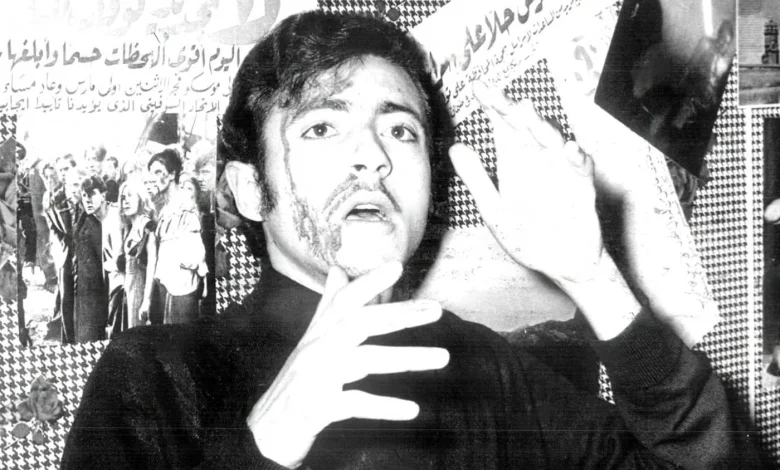
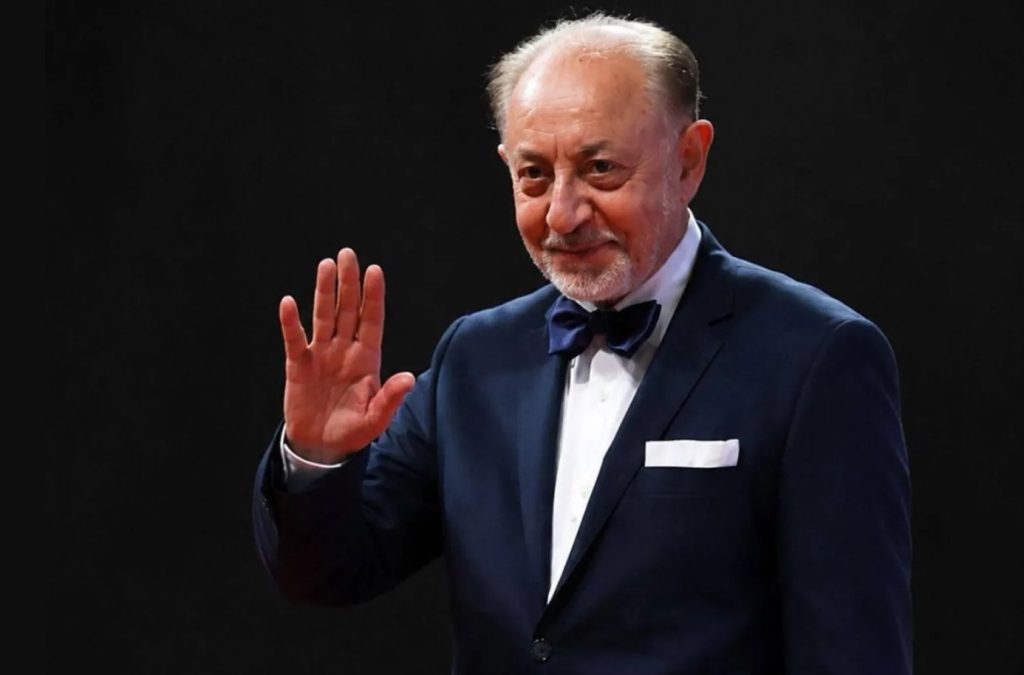
A slender man dressed in simple, traditional attire; he chose either a modest shirt or a suit layered over an unbuttoned collar, always dispensing with a tie. Strands of silver graced his hair and face, lending him a quiet dignity and wisdom. This gravitas became all the more striking whenever he spoke, his resonant voice carrying a calm that rarely deserted him, even in the heat of performance. It was easy to imagine him as a grandfather spinning bedtime stories. Yet, his deep-set eyes harbored a gaze that left one suspended between a buried, smoldering anger and an innate kindness, keeping the observer in a state of perpetual vigilance.
The artist and director Abdel Aziz Makhyoun, who passed away last Wednesday, stood as one of the most singular figures of his generation. This distinction arose not from adherence to a particular school of acting, but from a unique persona that set him apart from his peers, forged across decades of diverse experiments spanning theater, cinema, and television. If one were to gather these varied experiences under a single canopy, it would undoubtedly be that of “commitment” as Makhyoun uniquely understood and lived it.
The phrase “the committed artist” may ring like a worn cliché today, yet it remains the most accurate descriptor of Makhyoun. What did this commitment truly mean, and what did it signify to him? To understand this, one must return to his origins and the cultural matrix that always distinguished him, and of which he was fiercely proud.
Born in February 1946 in the village of Abu Hummus in the Beheira Governorate, Makhyoun drew his deepest sensibilities and identity from the rural landscape that left an indelible mark on his soul. He grew up within a wealthy, landowning family, one of Beheira’s most prominent dynasties, and inherited his name from his uncle, Abdel Aziz Bey Makhyoun, a member of the National Assembly, a local notable, and a poet. The poetry salons hosted by his uncle, the boisterous celebrations of parliamentary victories, and the competing orators and poets rushing to offer their congratulations all held a mesmerizing charm for the young Makhyoun, even before he could fully grasp the weight of the words. This pristine consciousness blossomed into a grand passion for the arts, nurtured by his father’s profound love for music, particularly the compositions of the legendary Mohamed Abdel Wahab, and a sacred weekly ritual of gathering around the radio. At the Damanhour Secondary School, he took his first steps into the artistic realm by learning the violin. He never quite mastered the instrument, quickly abandoning the bow to pursue his truest ambition: acting. In 1963, he journeyed to Cairo to audition for the Higher Institute of Dramatic Arts, graduating in 1967 within the same historic cohort as the great Nour El Sherif.
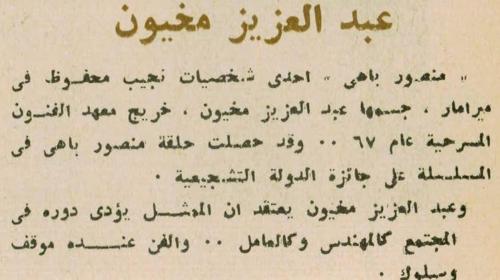
Following graduation, director Mohamed Fadel auditioned him for the leading role in the television series Cairo and the People alongside Nour El Sherif. The role ultimately went to El Sherif, delaying Makhyoun’s breakthrough until 1969, when he portrayed Mansour Bahi in the television adaptation of Miramar. Mansour Bahi, a hesitant soul paralyzed in the shadow of his brother, marked the genesis of a long lineage of “the defeated intellectual” archetypes that Makhyoun would embody. These characters served as a mirror to his own identity as an intellectual anchored in the dreams of the Nasserist era, out of step with his contemporary world, fiercely believing that the committed artist carries a profound societal and even political message, an existential stance above all else.
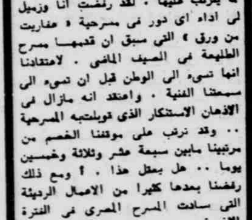
During the 1970s, Makhyoun attempted to integrate into the mainstream Egyptian artistic community. He joined the Avant-Garde Theater (Masrah Al Tali’a), only to be shocked by the deteriorating standard of the productions, which failed to offer a canvas wide enough for his talent. When he and his colleagues dared to object, they were met with administrative investigations. Ultimately, the public sector theater of those declining years had morphed into a bureaucratic machine designed to tame artists rather than liberate their creative potentials. Confronted by this disillusionment, Makhyoun abandoned the state theater and retreated to his village of Abu Hummus, specifically to the estate of Zaki Effendi, to fashion a theater of his own making.
The production was The Deal (Al Safqa). Makhyoun intervened minimally, offering only light directorial guidance and acting coaching, leaving the entire mechanism of the play, from acting and set design to lighting and logistics, to the peasants themselves. They grew so bold that they even altered Tawfiq al-Hakim’s original ending, substituting a denouement of their own creation. The play opened at Zaki Effendi before transferring to Cairo, where it received immense critical acclaim. This triumph caught the attention of French cultural authorities, who granted Makhyoun a three-year scholarship to study modern theatrical methodologies in France.
Makhyoun returned in the early 1980s as an actor and director armed with nearly fifteen years of experience, yet the commercial market still viewed him merely as a “promising, rising actor.” Makhyoun frequently remarked that he never viewed himself as a conventional professional; he never employed a talent manager, nor did he accept roles that failed to align with his artistic whims and intellectual convictions. In other words, he sought only works that possessed true merit according to his rigorous standards.
Makhyoun always emphasized the role of serendipity in his life. Fortune placed him in an era populated by creative giants like Osama Anwar Okasha and Wahid Hamed, who discerned in his features and demeanor the perfect vessel to manifest the defeated intellectuals of their narratives. His first major steps in the early eighties offered variations on this theme in series like The Gates of the City (1981) and Honey and Tears (1983). However, Makhyoun’s quiet, deeply sensitive delivery caused his performances in these limited spaces to pass quietly; though universally praised for his brilliance, he achieved this without the loud clamor of public stardom. It was not until 1986 that he found a more expansive canvas as Adel in the series The Journey of Dreams, portraying a broken intellectual who abandons his home and family to wander the streets in a desperate search for order. That same year, he appeared in the film The Hunger opposite Shadia, Souad Hosny, and Mahmoud Abdel Aziz, directed by his close friend Ali Badrakhan. Here, he delivered another iteration of the archetype within the neighborhood-strongman universe of Naguib Mahfouz, playing Jaber Al-Gibali, a man who confronts his tyrannical brother Faraj by awakening the consciousness of the locals and leading them in rebellion.
In 1991, Makhyoun took on the archetype of the intellectual officer, forced to confront his own morals in two distinct films released that year. The first was The Escape, directed by Atef El-Taieb, a filmmaker with a legendary preoccupation with the intellectual’s clash with authority. Makhyoun played Major Salem, a childhood friend of the protagonist Montaser, who is duty-bound by his office to hunt him down. Salem endures a bitter internal conflict between legal obligation and the sacred bonds of friendship, ultimately finding himself in direct opposition to the brutal state apparatus itself. In Beggars and Nobles, he played the police officer Noureddine, tasked with upholding the laws and societal values of a system while battling a profound crisis of identity and desire, clashing with a circle of nihilistic intellectuals like Gohar, El-Kordi, and Yakan.
Within the architecture of these works, we glimpse Makhyoun’s excellence, but we also recognize the brilliance of the texts and the creative ensembles surrounding him. Makhyoun was not the type of actor to leave an explosive stylistic imprint that eclipsed the characters he inhabited; rather, he rendered them with a composed, deliberate performance that occasionally veered toward slight exaggeration, as seen in certain moments of Adel in The Journey of Dreams. He gave a character its exact measure, no more, no less. Consequently, his roles achieved greatness when embedded in high-quality productions with harmonious ensembles, while fading into the background of lesser works. Between these dynamics, Makhyoun’s true strength lay in his audacity to select complex, highly specific roles, a courage missing in other artists who perhaps surpassed him in raw talent. This remained true even when Makhyoun occasionally repeated the mold of the committed intellectual, playing figures who resembled his authentic self more than the words written on the page.
Makhyoun was fully aware of this repetition. When offered the role of Adel Abu Leila in the series Zizinia (1997), the writer Osama Anwar Okasha explicitly challenged him to break his own mold. Makhyoun relished the character because, as he noted, “it was a delicious role to perform, completely distinct from the textbook intellectual. I was delighted by it because it allowed for playfulness and true acting.” Though Adel Abu Leila initially appears as a cultured dissident operating safely within Makhyoun’s comfort zone, the audience soon uncovers that this intellectualism and activism are mere façades. In truth, he is a repulsive fraud, rendered absurd through moments of dark comedic irony.
By the dawn of the third millennium, this sense of commitment assumed an explicit political form within Makhyoun’s life. He immersed himself in public advocacy, becoming deeply politicized and co-founding the Kefaya movement in 2004. The following year, a sensational assassination attempt by his wife dominated the front pages, an incident subjected to exhaustive political analysis alongside his ongoing public declarations. Contrastingly, his uncompromising stance toward the artistic quality of roles began to soften. He began appearing frequently in works of lesser distinction, accepting roles that added little to his artistic legacy. He reached a point of participating in five or six projects a year, driven by the pragmatic realization that a professional actor must remain active and work with the material available, rather than retreating into an isolation that had previously stalled his career.
These later years yielded few definitive roles, save for a few notable exceptions. He appeared in Khaled Youssef’s Shehata’s Shop (2009), once again embodying a Nasserist intellectual. In the television series Shaykh al-Arab Hammam (2010), he portrayed Ismail, the cousin of Sheikh Hammam who loves and supports him, yet harbors a secret, corrosive jealousy that ultimately culminates in betrayal and defeat. In this specific performance, the maturity of age and experience bore fruit. Makhyoun inhabited the character with his signature restraint, yet managed to lay bare its psychological fluctuations and dramatic transformations with masterly precision.
Over the final two decades of his life, his output expanded rapidly. Even while preoccupied with his active participation in the January 25 Revolution and its turbulent aftermath, he remained a fixture of the Ramadan drama season, acting as a reliable anchor within supporting roles. This allowed him to maintain a constant screen presence, appearing in at least three series per season. Audiences remember his exceptional performance immediately following the revolution in Without Mentioning Names (2013), an extraordinary season penned by his favorite writer, Wahid Hamed. He replicated this success in The Brotherhood II 2017 portraying the Muslim Brotherhood’s General Guide, Hassan al-Hudaybi, and later as Mohamed Badie in The Choice 3 (2022), alongside smaller roles in his twilight years within commercial serials attempting to replicate popular folk formulas, such as the vehicles of Mostafa Shaban and Amr Saad. With the exception of Without Mentioning Names, neither the writing nor the overall caliber of these productions gave him the space to truly shine. Even his portrayal in The Brotherhood II, which garnered considerable critical praise, was a source of constant complaint for him due to the grueling production conditions that have come to characterize the modern industry, sometimes requiring twenty-four hours of continuous labor.
In his interviews, Abdel Aziz Makhyoun always spoke with an intense nostalgia for two deeply contradictory eras: the Monarchy and the Nasserist period. He viewed the former as the wellspring of “the masters, the intellectuals, and the artists from whom he learned,” and the latter as the intellectual cosmos in which he came of age and found his purpose. I often reflect that had Abdel Aziz Makhyoun emerged in the 1960s, he might have become a classical leading man in the style of that era’s icons. Yet, he was never a star in the conventional Hollywood sense, a concept he long disdained. He was an artist who held an almost religious devotion to the concept of commitment in an age where that very ideal was fracturing and fading, despite art’s desperate need for it. For this reason, his human and political convictions became as legendary as his numerous roles. Through his quiet methodology and arresting presence, even when repeating himself, he succeeded in painting a unique, profoundly authentic color onto the canvas of Egyptian cinema and television. He may not have been the most naturally gifted or the most fortunate of his generation, but he was undeniably one of its most embraced, magnetic, and dignified figures.