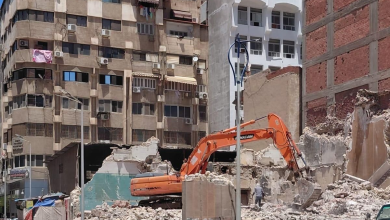

The Battle for Alexandria’s Tracks: Heritage Court Case Awaits Judgment as Activists Decry Urban Dismantling
A legal battle unfolds in Egypt as activists sue to halt the modernization of Alexandria’s historic tramway, fighting to preserve the city’s architectural heritage against concrete urban redevelopment.
By Mahmoud Dowair
Cultural and heritage circles dedicated to preserving Alexandrian identity are watching with bated breath as a high-stakes lawsuit heads toward judgment. The legal action demands an immediate halt to what petitioners describe as the systematic demolition and alteration of one of the Mediterranean city’s most iconic historic landmarks. While the Ministry of Transport maintains that the sweeping modernization project aims to revitalize an aging transit system and elevate public services, opponents argue that several key components of the plan pose an existential threat to the city’s architectural heritage and historic fabric.
Mohamed Fattouh, the attorney who filed the lawsuit against the Alexandria tramway development project, confirmed that the Administrative Judiciary Court has reserved the case for judgment, scheduling its ruling for the upcoming session on July 18. The litigation, officially registered as Case No. 8397 of Judicial Year 80, has captured public attention as the “Alexandria Tram Case.”
A Groundswell of Local Solidarity
Fattouh revealed, in exclusive statements to Bab Masr, that the lawsuit commands immense public backing from the people of Alexandria. This solidarity manifests through packed courtroom galleries, passionate online campaigns, and continuous debates across social media platforms. Several digital coalitions and community groups have championed the defense of this historic transit system, working tirelessly to ensure its preservation, bolstered by a public petition signed by more than 2,000 Alexandrians.
Furthermore, prominent human rights organizations have aligned themselves with the cause. The Egyptian Initiative for Personal Rights issued a formal statement endorsing the community’s demands to safeguard the tramway’s historical character and architectural legacy.
Guarding the Soul of the Tramway
Fattouh clarified that his legal challenge does not target the ethos of development itself, but rather objects to the execution of the current blueprint, which mandates the destruction of several historic stations. He emphasized that preserving the heritage value of the Alexandria tram must serve as the cornerstone of any modernization strategy.
The tramway represents a vital artery of the city’s visual identity and cultural landscape, functioning beautifully as a clean, sustainable mode of mass transit that serves a vast cross-section of society.
The current project, however, introduces a stark departure from this legacy, proposing the elimination of 18 existing stations to make way for elevated platforms and monolithic concrete bridges. This overhaul threatens to fundamentally alter the tram’s historic path, rendering the project an exercise in erasure and replacement rather than a faithful, heritage-conscious restoration.
Fattouh noted that should the court issue an unfavorable ruling, alternative legal avenues remain open, including an appeal before the Supreme Administrative Court. Throughout its various stages, the case has garnered vital momentum from select political factions and Alexandrian parliamentarians. Nevertheless, Fattouh continues to steer the litigation independently, fueled by a deep personal conviction to protect one of the city’s most sacred historical symbols.
He observed that many residents poignantly liken the current architectural upheaval to the dystopian premonitions of the classic television drama El-Raya El-Beida (The White Flag). Decades ago, writer Osama Anwar Okasha and director Mohamed Fadel brilliantly captured the heartbreaking perils of dismantling Alexandria’s urban heritage and aesthetic wonders.
Echoes of Alexandria’s Historical Identity
Addressing the solidarity of his peers, Fattouh disclosed that he extended formal invitations to numerous colleagues and the Lawyers Syndicate to form an expanded defense coalition. However, these invitations have yet to yield practical participation in the ongoing litigation.
“I had hoped this case would be driven by an expansive defense committee,” Fattouh reflected. “Yet, thank God, the legal trajectory remained resilient, and the lawsuit has advanced to this critical zenith.” He expressed optimism that the coming phase would witness broader mobilization from those dedicated to safeguarding Alexandria’s historic soul. Emphasizing the collective nature of the struggle, he added: “This is not a personal grievance; it is a cause that belongs to every Alexandrian. Ultimately, it touches the very cultural identity of Egypt, bound to the survival of one of our most treasured historical monuments.”
Public Convergence
Fattouh reiterated his desire for a grander coalition of lawyers and urban experts, given that the case addresses the public commons and the preservation of Alexandrian memory. He credited the profound public warmth and solidarity he felt from everyday citizens as the true engine behind the sustained legal movement.
This civic momentum is further mirrored by solidarity from members of parliament representing the Egyptian Social Democratic Party and the Al-Adl (Justice) Party, alongside endorsements from civil society organizations and political groups, including the Socialist Popular Alliance Party.
The legal battle commenced when Fattouh initiated Case No. 8397 of Judicial Year 80, specifically seeking an injunction against the demolition work targeting several tram stations celebrated for their distinct architectural style. The legal dossier includes video evidence documenting the destruction of the historic clock tower at the Bulkley Station, alongside recent photographs revealing the uprooting of ancient, majestic trees across several historic neighborhoods.
The petition also presented official copies from the National Registry of Buildings of Distinctive Architectural Style. Utilizing precise code numbers, the documentation demonstrates that the stations of Bulkley, Mostafa Kamel, Sporting, and the University enjoy strict legal protection under the mandates of Law No. 144 of 2006 and the Egyptian Constitution. The suit demands an immediate realignment of the proposed path, urging authorities to abandon the construction of elevated concrete stations and bridges.
The Ministry’s Blueprint for Modernization
Conversely, the Ministry of Transport countered the narrative in a press release, asserting that comprehensive transit studies for the Alexandria Governorate revealed an urgent, unavoidable need to rehabilitate the Raml Tram. The ministry stated that the line suffers from severe infrastructure degradation and archaic operational systems, leading to a continuous decline in ridership due to compromised technical safety and poor operational efficiency.
The authorities explained that these deteriorating conditions forced commuters to rely on alternative, fragmented modes of transport, thereby exacerbating the city’s paralyzing traffic congestion. The ministry also noted that work has concurrently begun on the Alexandria Metro project. According to their findings, the complete overhaul of the transit system remains the sole viable solution to resolve the province’s traffic bottlenecks, particularly since the city relies on just two main longitudinal arteries to connect its eastern sectors to the city center—the Corniche Road and Horriya Road—complemented by a single urban corridor linking the center to the west via El-Max Street and its extensions.
The ministry concluded that the rehabilitation project encompasses a holistic modernization of both the underlying infrastructure and the tram fleet, designed to elevate service standards, maximize passenger capacity, and dramatically reduce travel times across the metropolis.