In Port Said, an illiterate artist’s Hajj murals still haunt the city’s walls
In Port Said’s working-class alleys, illiterate artist Taha Shehata painted Hajj murals that transformed poverty into spiritual triumph. More than 40 years after his death, his grandson preserves a vanishing folk tradition.
By Osama Kamal
Port Said was born nearly 170 years ago, carved out of the earth with the digging of the Suez Canal in 1859. When the Red Sea and the Mediterranean finally met in 1869, after a decade of grueling labor, the city was split into two souls inhabiting a single body.
On one side stood the European quarter, with its imported facades, quiet balconies, and the elegance of foreigners who crossed the sea and settled on its banks. On the other side lay the neighborhoods built by sweat: the Arab quarter, then Al-Manakh, and to the south, the Qabuti district, isolated in its own charm. These were the districts of the poor — men who had come from the Delta and Upper Egypt, dug the canal, loaded coal onto ships, and then took up the various trades of the sea, passing them down like an inheritance.
Hajj in the soul of a working-class city
In those alleys, where the scent of sea salt and fish mingled with the reality of poverty, Hajj was not merely a religious ritual. It was the greatest dream of the Egyptian folk spirit. The poor man who owned little more than his daily bread dreamed of touching the Kaaba with his eyes, of returning from Hejaz carrying light and blessings.
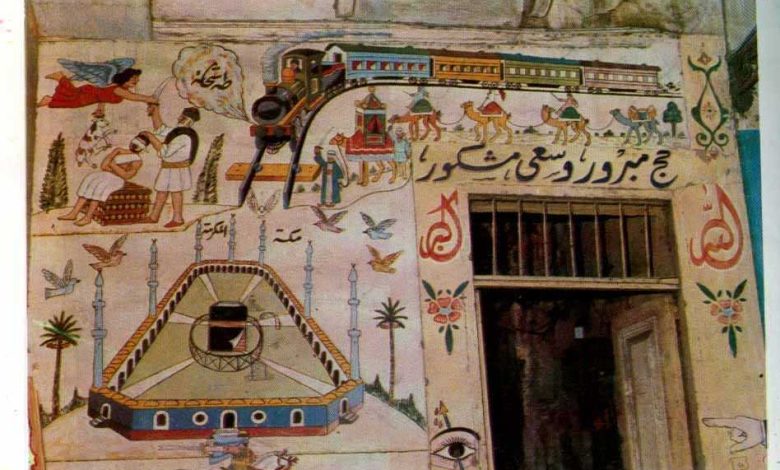
For this reason, walls filled with Hajj paintings on the homes of the poor — most of which were little more than shacks and huts. Many painters came and went, but the city waited for its most famous artist, the one with the deepest reach and the closest bond to its soul. He emerged from the heart of Al-Manakh in the early 20th century. His name was Taha Shehata.
His name was not ordinary, like the thousands recorded in civil registry books or the municipal council ledgers of the time. It was like a magical signature he left behind, eternal in the city’s sky. More than forty years after his death in 1982, the people of Port Said still speak of him as if he left just yesterday. Not because his paintings remain intact, but because his shadow still clings to the city’s visual memory.
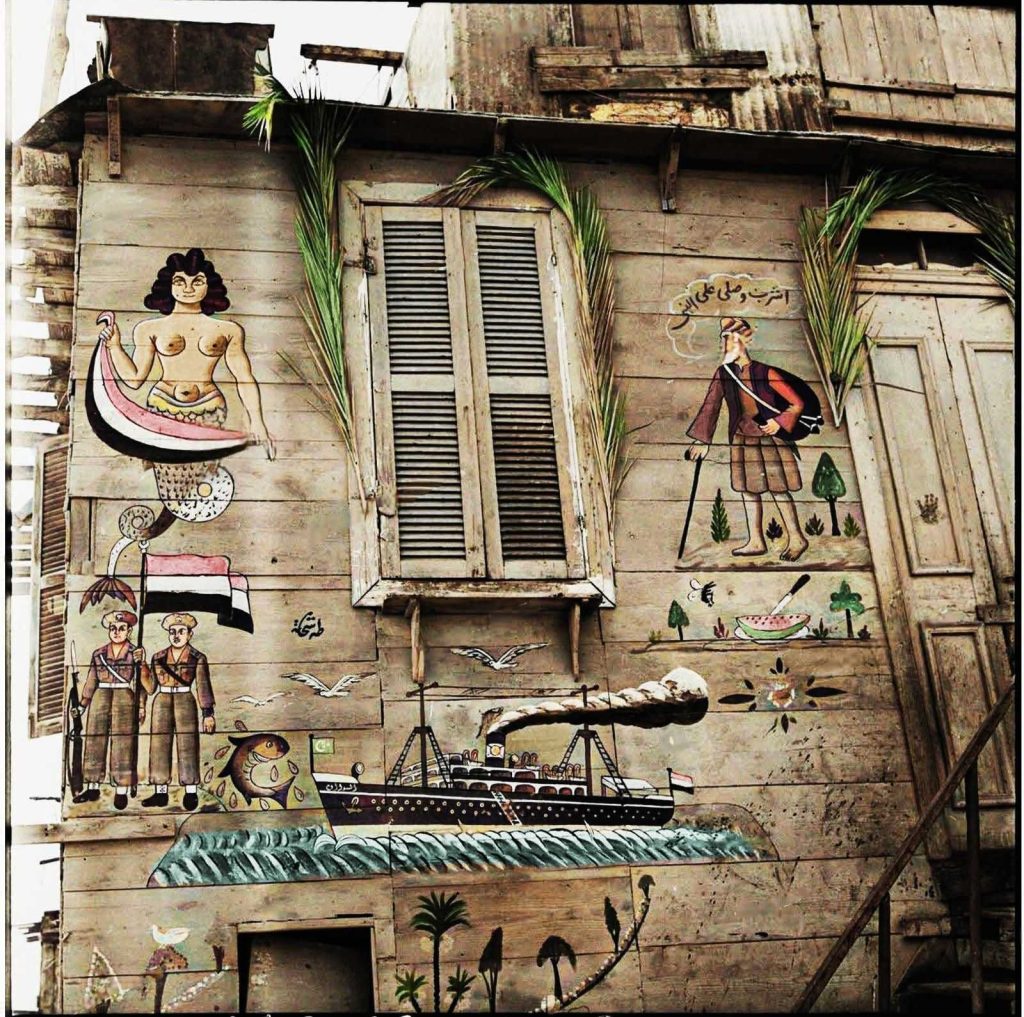
Everyone who lived in the old working-class neighborhoods remembers his Arabian horse, his palm trees, his open hand against the evil eye, the arrow-pierced eye, and his colors — which seemed as if they had just stepped out of an intimate folk celebration.
When paintings become folk tales
But Taha Shehata’s world reached its peak in the Hajj mural. There, the untrained artist transformed into a great folk storyteller. He painted the poor man’s journey to God — not merely as a religious rite, but as the soul’s ultimate triumph over life’s harshness.
The mural often began with a camel or a ship, then the Kaaba and the crescent moon, the pilgrim’s name in script that seemed to hover between drawing and chant, then decorations of uncertain origin — perhaps from the memory of the sea, perhaps from the dream itself. At the heart of it all was the folk soul of Egypt in all its innocence: the ram, the hand, the palm tree, the dove, the colored banners, and words of blessing that in Shehata’s hands became luminous talismans. Strangely, the man who breathed such life into Arabic calligraphy was illiterate — he could neither read nor write.
An illiterate artist
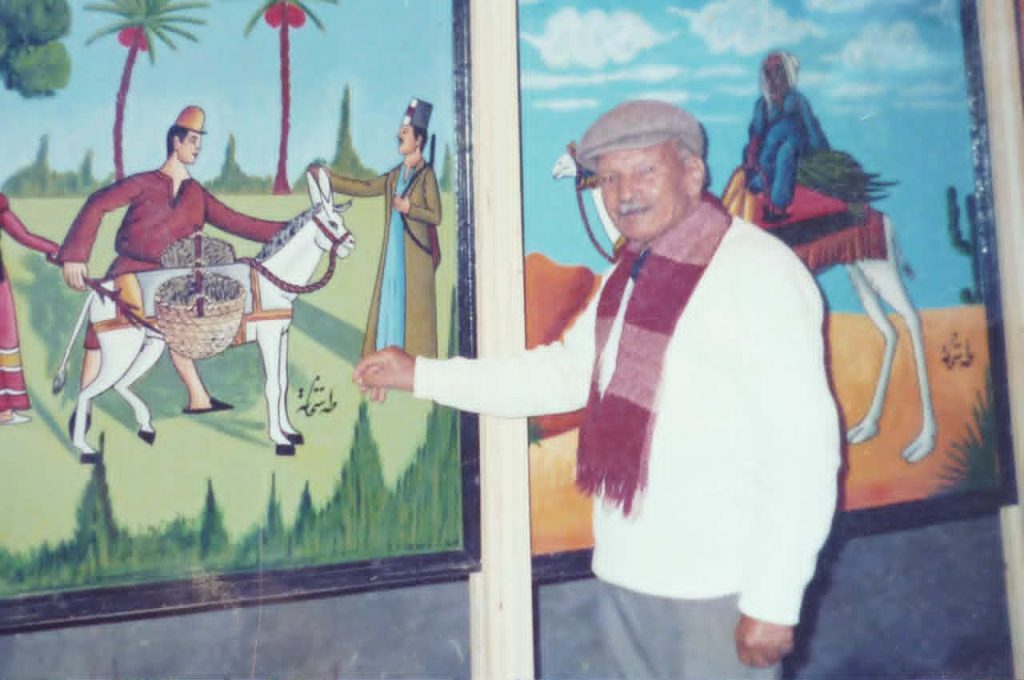
My search for Taha Shehata and his worlds began with his grandson, Ahmed Shehata, who inherited the trade from his father before later abandoning it under the pressure of changing times and shifting tastes.
Ahmed learned the secrets of calligraphy and drawing within the family home. For a time, he opened a publicity and advertising office, influenced by the changing era, before leaving all of that behind. He now works as a freelancer, yet still carries within him the remnants of that old world — all its charm and all its colors.
Through Ahmed, the family’s story unfolded. Taha Shehata had eight children, but only two were sons: Mohamed and Ali. He bequeathed to them the secrets of the craft — not merely as an art form, but as a means of life and a gift for sustenance. He taught them Arabic calligraphy, mural painting, and the subtleties of color. He left them his magical signature, a mark recognized by all the people of Port Said.
Mohamed Taha Shehata, now 77, was the closest to his father and the most attached to his world. He learned drawing and calligraphy at his father’s hands and still keeps his father’s signature on his late works to this day. During the years of illness, when Taha Shehata was stricken with Parkinson’s disease, Mohamed became his other hand — completing what his father had started, moving with him through markets, working-class neighborhoods, and the walls of returning pilgrims.
His brother Ali passed away early. Only Mohamed remains, carrying his father’s legacy and preserving the craft’s details and secrets.