The Rise and Fall of Menatel: Ghosts of Egypt’s Public Phone Booths
Once, 33,000 green-and-yellow booths connected lovers, shattered families, and changed fates across Egypt. Today, they stand as silent ruins. A journey into the lost era of public telephones and the memories left behind.
By Osama Kamal
For ten years, Menatel phone booths lined Egypt’s streets and alleyways, rising to widespread popularity before vanishing unexpectedly. They belonged to an era when a voice emerging from a small booth could travel to distant places, before giving way to a time when everything now happens in secret, sealed rooms.
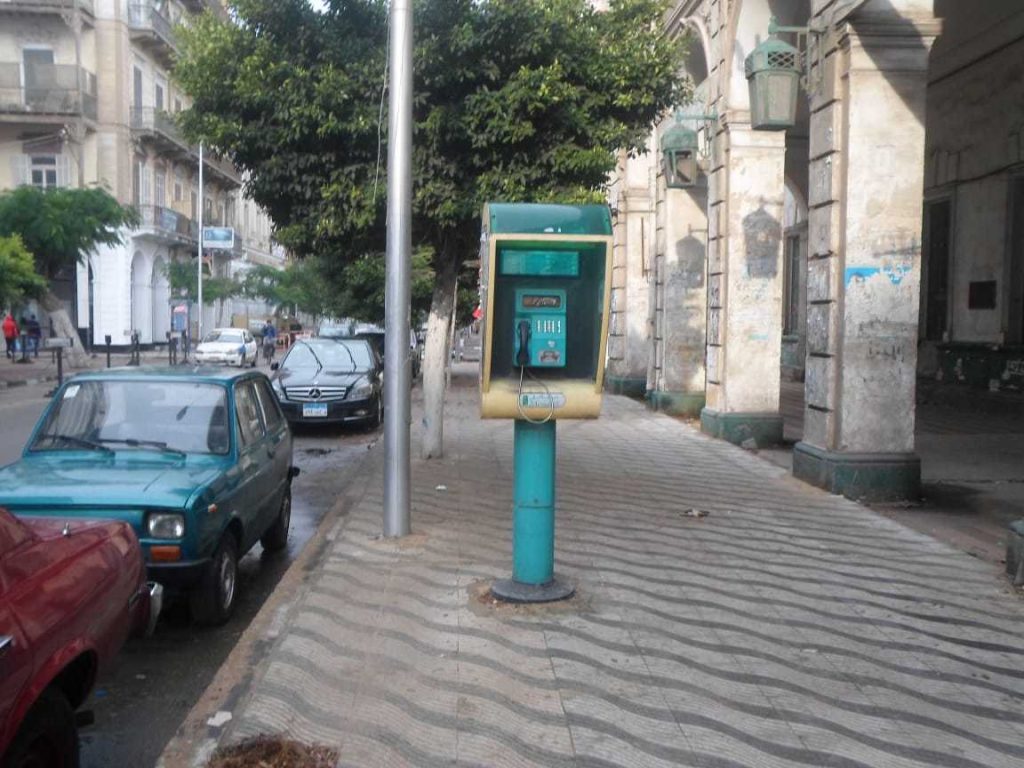
It began as an extension of people’s need to talk. Menatel phone cards became part of everyday language, and the green-and-yellow booths became a fixed feature of cities and villages across Egypt. At their peak, there were 33,400 booths, spreading like vocal arteries through the country. They dominated Egypt’s public telephone market, outpacing competitors such as Nile, Ringo, and Marhaban.
A story spanning more than a quarter of a century
The Menatel Company dates back to March 1998, when it obtained a license to install and operate a public telephone network during the first premiership of Dr. Kamal El-Ganzouri (1996–1999). The company was founded with contributions from the National Bank of Egypt, as well as Egyptel, Al-Ahly for Telecommunications, Atcom, along with local and foreign investment funds and individual shareholders.
Once the booths settled into the streets, cities filled with endless stories. Each booth became an open-air chat room on the pavement, revealing more about those who approached it than it concealed. The booth was a small mirror of human landscapes, where quiet conversations stood next to stormy ones, fleeting calls next to life-changing ones. That is how Menatel turned into a living human map—one through which Egyptians could be read effortlessly.
But change is the only constant in life. Little by little, the booths declined, until they became scattered ruins in the city’s memory—like ancient remnants that stop a poet in their tracks, evoking a time when life felt closer, and more painful too.
Romantic relationships
Ahmed El-Badry, 52, married and father of three, speaks with a voice mixed with nostalgia and surprise. He says that the history of Menatel is the history of his romantic relationships—three relationships before his marriage, all conducted through those booths.
He recalls: “I had a special bond with some booths. One I would wait for in the stillness of the late night, entering like a secret lover. Another would bid me farewell with cold silence after a long call that always ended with something like an apology. I loved some booths and hated others, depending on what was passing through my heart—love or heartbreak.”
The booths, he says, breathed with him. They waited for him on cold winter nights and gave him a vague feeling that someone was listening behind those small metal walls. Today, when he looks at what remains of them, he feels that a part of his personal memory has been extinguished with their disappearance, as if the city cut out an entire chapter of his life without giving him the right to object.
A tool to harm people and tear apart families
Wael Hazen, retired and a former manager at a private company, opens another, crueler side of the story. He says that Menatel booths were not always an innocent space; at times, they became a tool for harming people. He recounts how some of his colleagues used the booths against him—calls turned into missiles that threatened his family life, targeting his wife and children, until the threats reached brutal extremes. In his view, the booths became an open arena for anyone who wanted to hide behind an anonymous voice.
He began searching for the source of the harassment until a friend advised him to go to the company. There, he started tracing the numbers and identifying the booths from which the calls originated. As the call details were reviewed, the thread that led to those who had tried to harm him was uncovered. An internal investigation confirmed the calls, and the case ended up in court.
He stresses that the secret to uncovering the truth was that some people did not realize that card-based calls were monitored and archived, leaving behind a clear trail that exposed them.
The same story repeated itself with Manal Fikri, who faced similar harassment. Her husband traced the source of the calls, identified the booth, set up a stakeout, and managed to catch the perpetrator, handing him over to the police, then the prosecution, and finally the courts.
The boom years and sudden decline
Ahmed Abdullah, 49, a former Menatel employee now working at Telecom Egypt, recalls the boom years. He joined the company in 2000, at its peak, when salaries were among the highest compared to other companies even Telecom Egypt itself.
He explains that back then, a minute of mobile phone service cost 175 piasters, while a landline subscription was around 700 pounds. But times did not stay the same. Call prices dropped sharply, market dynamics shifted, and the company’s ability to compete weakened. Debts piled up until they neared 50 million pounds, and the company was eventually sold to Telecom Egypt to cover its debts.
The company had 450 employees, a number that shrank after compensation packages to 252. They were then given the choice between joining the new company or receiving end-of-service benefits, with most choosing to stay to maintain their social and financial stability.
The Seven Wonders of the World
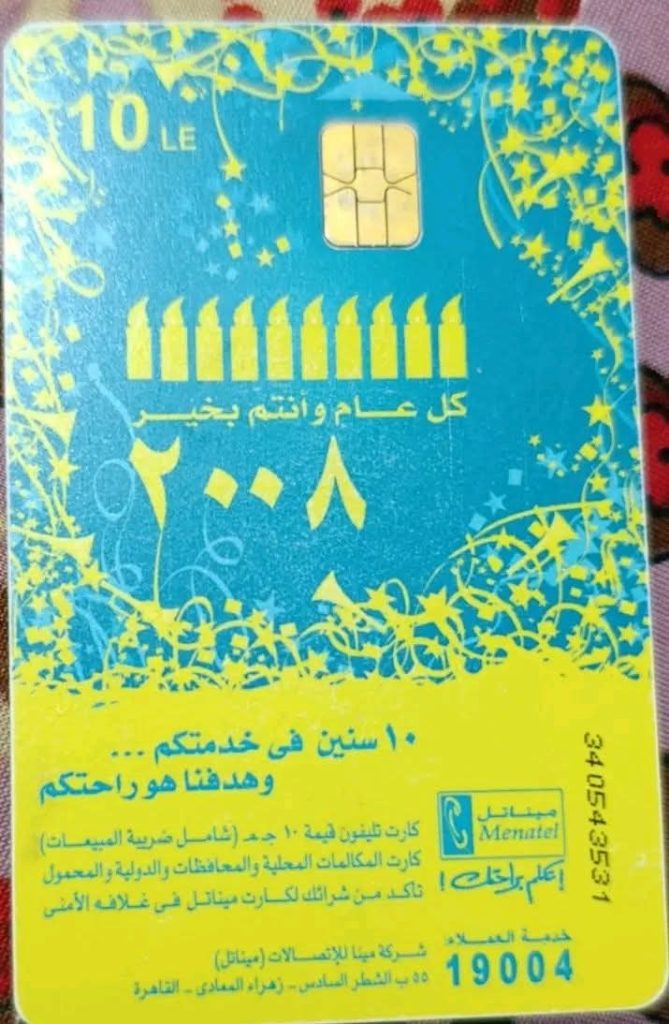
Bakr Younis, 50, lives his life among old things collecting coins, stamps, antiques, and tools from bygone eras, including Menatel phone cards. He keeps complete sets in special albums, as if trying to stop time from slipping away entirely.
He says Menatel was known for issuing a wide range of cards, similar to European and American companies. Collections included the Seven Wonders of the World, different calendars, communication devices, Pharaonic symbols, tourist maps, and commemorative issues tied to the metro, sports tournaments, and more.
The end of an era
Menatel was never just phone booths on the street. It was a complete communications culture that entered Egyptian life, set its rhythm on people, and became a precise mirror of their habits and daily details. Some booths witnessed the beginnings of love. Others heard the last words of a crumbling relationship. And some were silent witnesses to threats and malice that shattered families.
The booths had their loyalists people who preferred them for their low cost compared to mobile phones, which were expensive to buy and maintain in the early days. But as technology advanced and mobile phones became cheaper and more widespread, the need for public phone booths gradually diminished. The convenience of having a phone in your pocket, available at any time and any place, made the fixed booths on street corners seem like relics of a bygone age.
Then came the smartphone, and the scene changed entirely. The booths retreated quietly, as if leaving the stage without a sound. Today, most of what remains is rusting frames, broken glass, and faded colours,ghosts of a time when people would queue outside a small green-and-yellow box just to make a call.
Some have tried to romanticise their disappearance, saying that the booths represented a more human era of communication—one where conversations required effort and intention, not just a swipe and a tap. Others see their demise as simple progress: the old must always make way for the new.
But for those who lived through that era, the Menatel booths were more than just machines. They were part of the city’s furniture, part of its rhythm, and for some, part of their personal history. Ahmed El-Badry, who once poured his heart out inside those booths, now walks past their ruins without stopping. “It’s like running into an old friend who no longer recognises you,” he says. “Or maybe I’m the one who’s changed.”
Meanwhile, Wael Hazen, who once hunted down his harassers through those same booths, admits that despite the pain, he feels a strange sense of loss. “They were flawed, yes. They were abused, and they were used to abuse. But they were also honest in a way that today’s world isn’t. When you spoke inside a booth, you knew you were stepping into a small, temporary world. Now, we carry our conversations everywhere, but we’re never really alone with them.”
Today, as Egypt’s streets continue to fill with newer technologies fibre-optic cables, 5G towers, and ever-smarter phones, the Menatel booth has become a fading ghost. It lingers in the corners of old neighborhoods, in the memories of those who once queued outside it, and in the albums of collectors like Bakr Younis, who refuses to let the past disappear completely.
So the booths sit quietly now, rusting in forgotten alleys, their receivers long gone, their glass cracked, their colors bleached by the sun. They no longer ring with the voices of lovers, the whispers of secrets, or the shouts of arguments. They are just empty shells ruins in a city that never stops changing.