
Amira Howeidy writes: My editor, Hani Shukrallah
Amira Howeidy remembers her editor Hani Shukrallah: the man who saw her before she saw herself and transformed Al-Ahram Weekly into a golden era of Egyptian journalism.
I don’t remember my first meeting with Hani Shukrallah, my boss during the more than twelve years we worked together at Al-Ahram Weekly. I search my memory, but it is dark. There is no scene of meeting him, no first impressions. It is as if Hani’s impact on my development as a journalist was something I recognized as a given, like the great certainties we grow up with before we fully understand them.
I remember my first interview with the paper’s founder and editor in chief, Hosny Guindy, in his office at the main Al-Ahram building. I was still an English literature student looking for an internship. “Professor Hosny,” as we used to call him, opened the doors of Al-Ahram Weekly for me. That was a fledgling newspaper he founded on a foundation very different from Al-Ahram itself, with its orientations and its language aimed at the “foreign reader.” That exempted it from the usual self-censorship that prevailed in the early 1990s. Professor Hosny, the venerable editor of Al-Ahram‘s international affairs section, had the support of Ibrahim Nafea, editor in chief and chairman of Al-Ahram. Together, they allocated a large budget comparable to the salaries of foreign news agencies in Egypt to fund his serious and unprecedented journalistic project. At the time, this was groundbreaking both in the state press sector and in modern Egyptian journalism generally.
The newspaper was launched during the Iraqi invasion of Kuwait in 1991 with a large founding team that included Morsi Saad El Din, Mohamed Salmawy, and Mona Anis, then a PhD student at the University of Essex in Britain. That team changed after two years, when Anis brought in her leftist friend Hani Shukrallah. He was also a PhD student at the same university and a correspondent for a daily bulletin published from London. Hani began his work at the Weekly as a desk editor before Professor Hosny appointed him managing editor in 1993. Together with Mona Anis, assistant editor-in-chief, they formed the foundational trinity of Al-Ahram Weekly. This group shaped the paper’s identity and continued to run its affairs until each of them left.
I would argue that this trinity shone together, exceptionally so, within its framework. When Hosny Guindy died in 2003, the trinity lost one of its most important pillars. That pillar had maintained a delicate balance between successful management, journalistic professionalism that mastered circumventing red lines, and a political orientation that matured in a unique crucible. That crucible was a fusion of national, Arab, nationalist, leftist, liberal, and conservative elements. Hani succeeded Professor Hosny as acting editor-in-chief, meaning temporary and not officially accredited. He stayed until 2005, when he was dismissed from Al-Ahram. That brought to an end the golden era in the history of Al-Ahram Weekly.
After some confusion among different sections at the beginning of my time at the paper, I settled into covering Egyptian affairs. That was during the rise of militant Islamic group violence in the mid-1990s. This is when Hani appears in my memory, which I now realize was also when the core of my journalistic consciousness was being formed. I learned early on from him how to think critically and how to weigh the words we write. We Arabs, in this case, were writing for the foreign reader, specifically the Western reader. Hani decided that we would not adopt certain terms used by Western news agencies to describe political Islam groups. He believed those terms reflected a Western ignorance of the South, whether deliberate or not, or that they were politically loaded. For example, he recommended that we write “militant groups” and not “Islamic terrorists,” as the agencies’ dispatches had it. He also warned us against the phrase “the Jewish state,” which Western journalism delights in using. “Its name is Israel!” he would say.
I was not aware of Hani’s leftist and activist background at the beginning of my work. That is because he never talked about it or brought it up. Not because he was hiding it, but because he was completely absorbed in developing the journalist and writer within himself alongside his new role as managing editor of Al-Ahram Weekly. And because he was a talented and eloquent writer in both Arabic and English, his eloquence and enthusiasm for running the paper made his central role a matter of fact, not an imposed decision. His warm personality reinforced this role, and he used his political experience to shape the paper’s identity alongside its co-leaders. He also helped determine its political compass, which constantly interacted with and was shaped by events in Egypt and beyond. In that period, Al-Ahram Weekly was not just a newspaper presenting news with “an Egyptian perspective,” as its slogan went. It was more like a political, journalistic, and research project, operating in whatever space it could manage. Thanks to the triinity, the paper was showered with their own resources and connections. For example, the paper became associated with Edward Said, who wrote for it because of his relationship with Mona Anis. This helped realize that complex vision for this highly unique project at the time.
Hani had a natural ability to connect with others. His unique way of listening to the person sitting with him made people feel there was a special connection, and that was one of the reasons for his popularity. He encouraged us with his always open office door and his enthusiastic welcome to come to him often to discuss ideas, seek advice, or even find some inspiration. He would drop what he was doing, turning his full attention to his visitor. He did not care about interrupting his own work or hesitate to start a brainstorming session wherever he saw fit. That open door was a hallmark of his character. He was easy in speech, generous in giving, especially when it came to encouragement.
True, he would shout “Brilliant!” to anyone who presented him with a piece of journalism that pleased him, but he also recognized talent and hard work. He would entrust heavy editorial and journalistic responsibilities to those who deserved them. And despite some of his managerial shortcomings, Hani was fair in his evaluation of us. He never lavished praise on anyone without cause. His encouragement took the form of supporting creativity and out-of-the-box ideas. Most importantly, he never took credit for our successes, even though he helped achieve them. Those successes were entirely ours.
Hani was the only person at the paper who would roll up his sleeves and hammer away at his computer keyboard, working his magic to elevate the material that reached him. This was after it had passed through all the professional editors. He would transform it in its final version before being sent to the press. I was always eager to see my piece, to see how Hani made me appear smarter and deeper. He did this simply by adding his touches to the headline, the lead, polishing a sentence or an idea, or adding a historical or political dimension. But more important than that, I first waited for his reaction to what I wrote. If his eyes lit up and he said to me with a smile, “God give you light,” the whole world smiled back at me.
I have a gratitude toward Hani that he never knew about, because I realised it too late, after he was gone. I have never forgotten the day he told me that he had been following me from afar during my first years at the paper, as I transformed from a recent graduate into a journalist. He gave me a compliment that I kept to myself, but it revealed to me that he saw me before I saw myself. It was not easy for me, as Fahmy Howeidy’s daughter, to find my own identity in the field of journalism. But Hani saw me. So he gave me a confidence that I do not know how I summoned in my early twenties. And I would not have grown without the experiences I was given in multiple areas of the paper over a full decade of support and encouragement.
The news of Hani’s dismissal from his post in 2005 hit us like a thunderbolt. Al-Ahram Weekly lost its second pillar, two years after the death of its founder. Not only did our world change, but a feeling of being orphaned was added to it, at least as far as I was concerned. Of course, those in charge did not explain the reasons for removing Hani from the paper, but the gossip at the time talked about “his political orientations” or sometimes about his appearance at a protest against the invasion of Iraq. Others pointed to a photo that supposedly documented his presence at a march in support of the second Palestinian intifada. This was the same march that Professor Hosny participated in at Cairo University before his death. It was as if the man were running a communist cell inside Al-Ahram. None of these reasons was convincing, given that he was a journalist and writer wholly devoted to the profession and to his job at Al-Ahram Weekly. But Hani was smart enough to feel worried after Professor Hosny’s departure, realizing that he was originally an outsider to the system.
After closing the door on Al-Ahram Weekly, Hani went on to do something rare in Egypt and the Arab world. He published opinion pieces masterfully in both Arabic and English, and he founded several journalistic entities, though he never stayed long in any of them. The last of these was Ahram Online, which I helped him and Fouad Mansour, editor in chief of Al-Ahram Hebdo, found and launch in 2010. Hani continued as editor in chief until he was dismissed in 2013 because of his critical stance toward the Muslim Brotherhood.
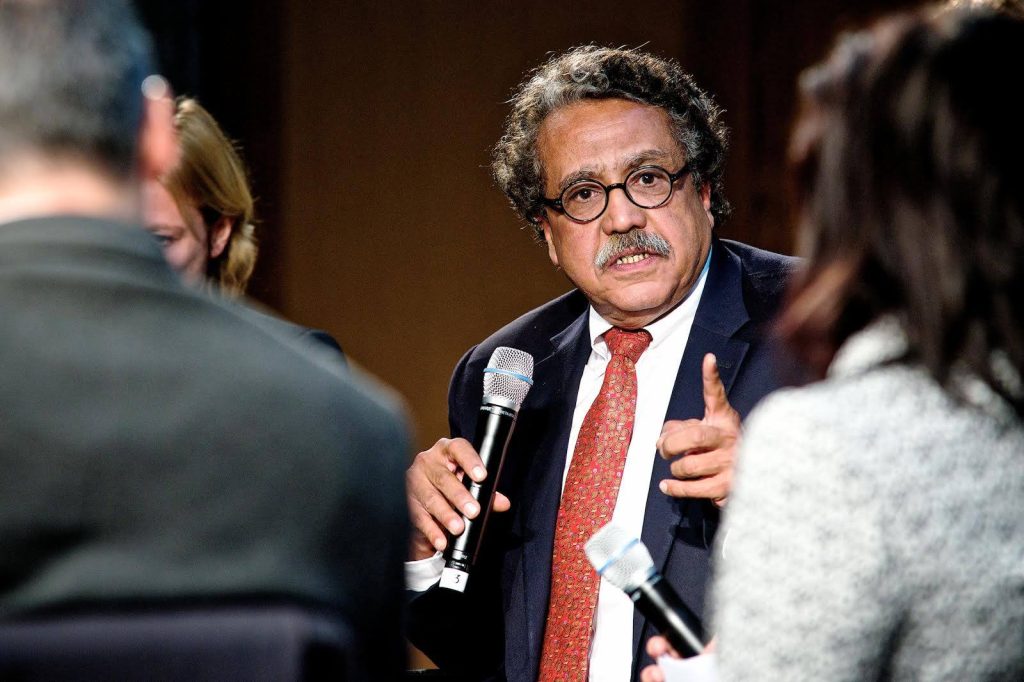
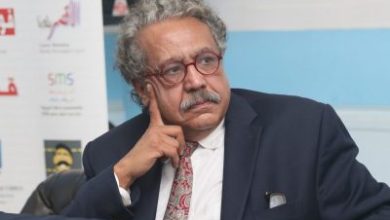
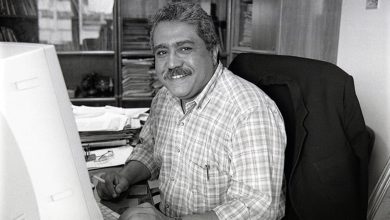
I do not remember when Hani’s health episodes began, but they predated his dismissal from Al-Ahram Weekly. He would return from them to work with a defiant energy, throwing doctors’ warnings to the wind. He would smoke his cigarette, which had become part of his settled features, much like his wavy hair, his round glasses, and his thick moustache. He would touch the ends of his moustache reflexively while absorbed in conversation. Despite the recurrence of his health crises and his returning again with the same defiant energy, along with his cigarette, of course, it became settled in my mind that Hani, even as he risked his life, would remain stubborn in the face of death. But I was also certain that this extraordinary man had been wronged, that he never got his due in Egyptian journalism, and that he knew it.
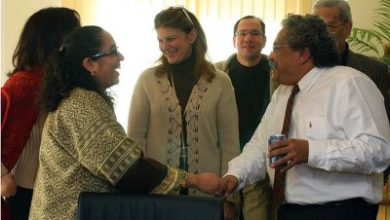
I did not believe the news of Hani’s departure on the morning of May 5, 2019. And I did not believe it even as I walked in his funeral procession. I kept waiting for him to join the great gathering on the day of his memorial service, among his students, loved ones, and friends, to say something clever and sarcastic. I miss my editor, my teacher, and my friend, Hani Shukrallah. I regret that we only have one photograph together. My consolation is that I was honoured to work with him, and that he saw me.
One Comment