Echoes of the Soul: Lina Osama’s Modern Mythology of the Human Face
The chromatic world of Egyptian artist Lina Osama in “Eyes Full of Dreams.” From the ancient influence of the Fayum portraits to the bustling art scene of 1990s Cairo, discover how she redefines the human face as a mirror of the soul in this exclusive look at her latest exhibition at Zamalek’s Picasso Gallery.
By Aya El Samaloussy
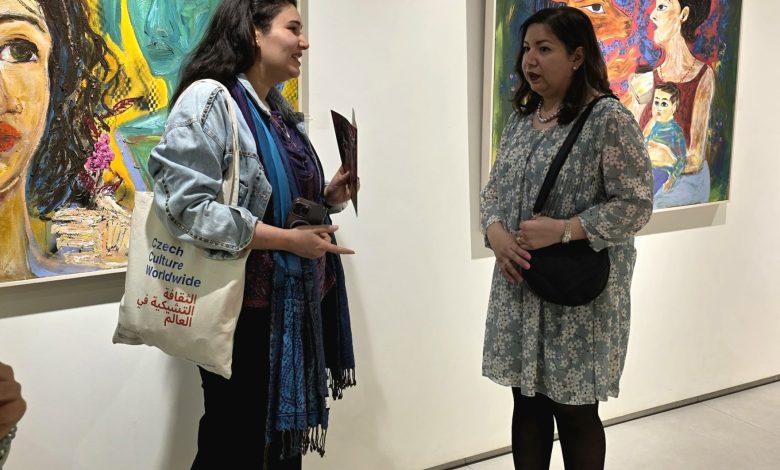
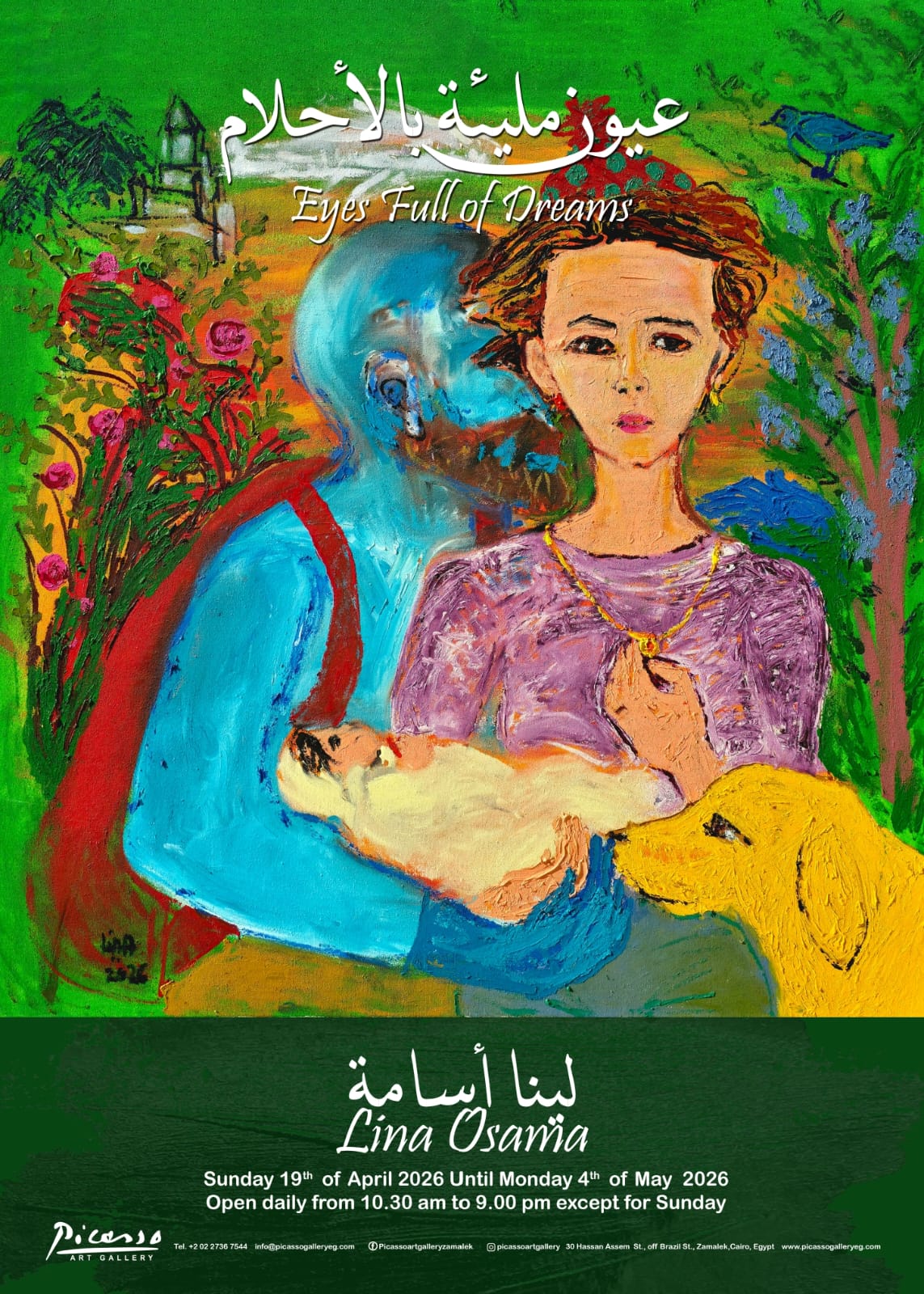
The Picasso Gallery in Zamalek plays host to “Eyes Full of Dreams,” a solo exhibition by the visual artist Lina Osama. Launched on April 19 and extending through May 4, 2026, the exhibition presents a divergent visual odyssey one that navigates the luxury of dreaming and the pull of nostalgia (a bittersweet longing for the past) through a sophisticated tapestry of reality and whim.
Born in Cairo in 1986, Osama is a scion of the Expressionist school, having refined her aesthetic vocabulary at the Faculty of Fine Arts in Cairo and subsequently at the International Summer Academy of Fine Arts in Salzburg, Austria. Her canvases reflect a singular marriage of Egyptian heritage and expressive pictorial narrative. She weaves contemporary symbols into historical motifs (recurring thematic elements), drawing from a life anchored in travel from the delicate etchings of Japanese prints to the hallowed icons of cinema and Picasso’s legendary goat. With a style that leans toward the deliberate exaggeration of hue and proportion to evoke the zenith of emotion, Osama centers the human presence and the female gaze, reconfiguring intimate life moments into universal artistic archetypes. On the occasion of this exhibition, which joins a prolific career of over 140 international participations, we sat down with her to unearth the roots of her chromatic dreams.
The Formative Years
One cannot grasp the interiority of Lina Osama’s art without returning to her primary sanctuary a home she describes as a cultural institution in miniature. She was raised in the embrace of a family that held the sanctity of art in high regard. Her late mother, the translator Taraji Fathi, bridged worlds through German and English, working within the news sector of Maspero while collaborating with various international journals. Her father, Dr. Osama Abdel Hay the current head of the Egyptian Medical Syndicate has balanced the rigors of medicine with a lifelong devotion to political and public service.
Reflecting on these beginnings, Osama notes that her parents nurtured her spark from infancy, presenting her fledgling sketches to their circle of master artists for mentorship. This scaffolding of support saw her immersed in intensive workshops; indeed, her school holidays were often more intellectually demanding than the term itself.
The Crucible of Displacement
At the age of six, Osama moved with her family to England. It was the early nineties, an era before the world collapsed into a “global village,” and before the internet arrived to bridge the chasms of ghurba (the ache of estrangement). She recalls this period as her first profound human transformation, describing the severance from kin and companions to enter a land of alien architecture and tongue as a “Herculean task.”
In this landscape, her mother acted as a psychological North Star, utilizing art as a therapeutic vessel. She raised her daughter to view the brush as a tool for catharsis. If Osama pined for Egypt, her mother urged her to paint her relatives; if she clashed with peers, she was told to paint them.
Over time, Osama discovered that the act of painting truly resolved the conflict. “When you paint someone, you study them; you touch their fragility and their strength, and empathy begins to take root,” she observes. Thus, her philosophical conviction was forged: hatred is the stepchild of ignorance, and art is the bridge that carries us over the snares of prejudice.
The Tutankhamun Epiphany
Amidst this displacement, Osama found her Egyptian soul in an unexpected quarter. When her English school began lessons on King Tutankhamun, the classroom transformed into a sanctuary of Egyptian grandeur. In that moment, she felt a surge of pride and intima’a (a deep sense of belonging) she had never known. She realized she possessed an identity that captivated the “Other,” turning art into her primary language for communicating this distinction.
Osama believes we are born with the essence of ancient art etched into our genetic code. She explains this through the lens of Egyptian children’s drawings: “We draw the eye like a leaf; we render the torso from the front and the feet in profile, just as the Ancient Egyptians did.” This is no coincidence, but an intuitive folk inheritance—a product of a deep-seated bond with the earth, the Nile, and a sun that rises and sets with the same unwavering power every day.
The Downtown Pulse of the Nineties
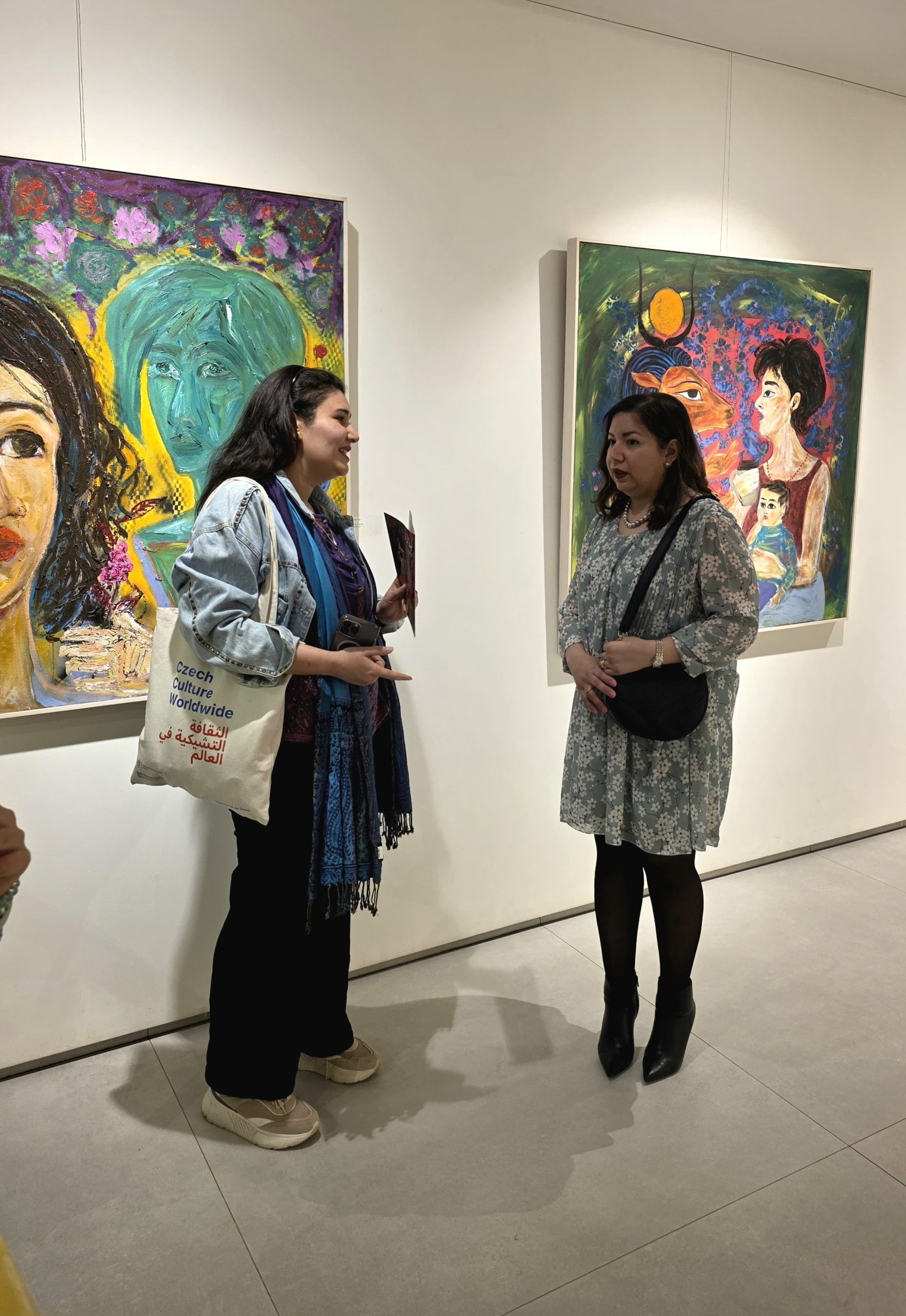
Returning to Egypt at age eight, Osama found a contemporary art movement at its luminous peak. She considers herself fortunate to have returned during a vibrant era that saw the rise of private galleries in Downtown Cairo, such as Mashrabia and Karim Francis. As a child, she wandered among giants Mustafa al-Razzaz, Omar el-Fayoumi, Mohamed Abla, and Suzanne el-Masry. They were the atmosphere in which her artistic consciousness breathed.
This richness ensured she did not rely on raw talent alone. During her preparatory school years, she enrolled in free studies at the Faculty of Art Education under George Fikry, whom she describes as a “formidable maestro.” He taught her to manipulate charcoal, pastel, acrylic, and oil with speed and density, enabling her to produce 50 portraits in record time her true debut before a professional audience in 2002.
Why the Portrait Fades and the Face Prevails
A student of Osama’s work will note an obsession with the human countenance. Since her first exhibition at thirteen, she has painted little else. She explains this passion as a years-long quest for expression through the face; older artists used to jest that she didn’t paint ears, but rather the face as an independent entity not a traditional portrait.
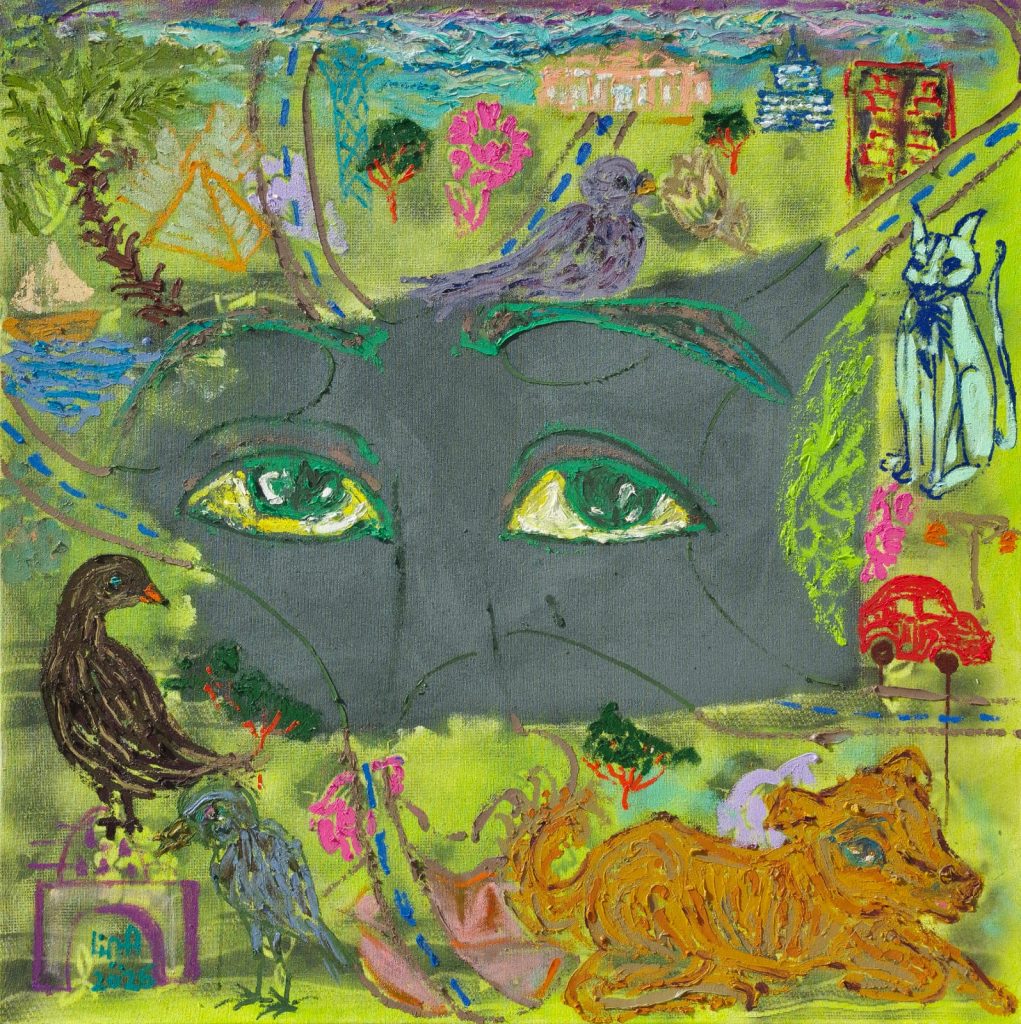
Deeply moved by the Fayum Portraits (mummy portraits from Roman Egypt) and the works of Picasso, she found her home in German and Austrian Expressionism. For her, Expressionism thrives on the exaggeration of everything that reveals feeling. In her paintings, she might enlarge the eyes while diminishing the nose, believing the eye to be the mirror of the soul and the seat of emotion. She distorts color and proportion to create a “positive shock,” transmitting to the viewer her own potent sensation of the moment.
Intellectual Collage: Merging Disney with Hathor
The paintings in “Eyes Full of Dreams” are characterized by a startling intellectual collage. Osama places symbols from Ancient Egypt alongside Picasso’s goat, a vintage public telephone, or characters like Alice in Wonderland. She explains that we live in a hybridity of all things; Egypt is a crossroads of civilizations, and our personal lives are a collage of memory and the present. She merges these layers as one does in dreams unbound by reality, faithful only to artistic truth.
Osama emphasizes that she is a reactive artist. She eschews preparatory sketches; if she does not paint directly onto the canvas, the emotional charge dissipates. Honesty, she finds, lives in that unmediated moment where color meets surface.
Is Art the Luxury of Luxuries?
Osama also reflects on the artist’s societal role. Having worked in exhibition curation, she argues that the Egyptian art movement often surpasses its European counterparts in creativity despite a scarcity of resources. She credits the Egyptian Ministry of Culture for nurturing her talent since the 2002 Youth Salon, where she participated with a painting about Jenin, Palestine, at just fifteen requiring a special exemption because she was too young to hold a national ID card.
Regarding the acquisition of art during economic crises, Osama speaks with grounded realism: art is not a luxury, but an emotional necessity. She cites the noble efforts of the late Hussein Bikar, who sold his works at modest prices to ensure the average citizen could own them, and the “A Painting for Every Home” initiative.
“The artist exerts a Herculean effort in research and materials,” she concludes, “but we are also tasked with creating mediums that make art accessible to all, rather than a trophy for a specific class.”