The Mosque Where Egypt’s Rulers Prayed: 14 Centuries of Ramadan at Amr Ibn Al-As
For centuries, Egypt’s rulers gathered at Amr Ibn Al-As Mosque for the final Friday prayer of Ramadan. Explore the history of Cairo’s first mosque and its enduring spiritual significance
There is a stillness that settles over Cairo in the hour before iftar. The frantic pace of the day gives way to something quieter, more expectant. Streets empty. The scent of frying onions and warm bread drifts from open windows. And then, from thousands of minarets across the city, the call to prayer rises and falls like a wave, breaking the fast and gathering the faithful.
For fourteen centuries, this scene has repeated itself, unchanged in its essence. And for much of that history, at the heart of it all stood a single mosque,the first ever built in Egypt, and the place where generations of rulers, scholars, and ordinary worshippers came to mark the holiest nights of the holiest month.
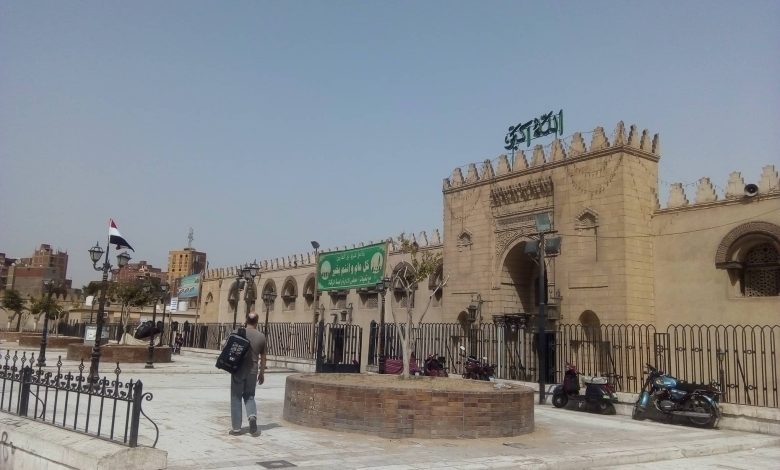
This is the story of the Mosque of Amr Ibn Al-As: the oldest mosque in Africa, the fourth oldest in the Islamic world, and for centuries, the spiritual heart of Ramadan in Egypt.
The Imam of Mosques
So revered is this mosque that it has been called “the Imam of mosques, the source of radiant light. Blessed is he who maintains his prayers within it and perseveres in its observance.”
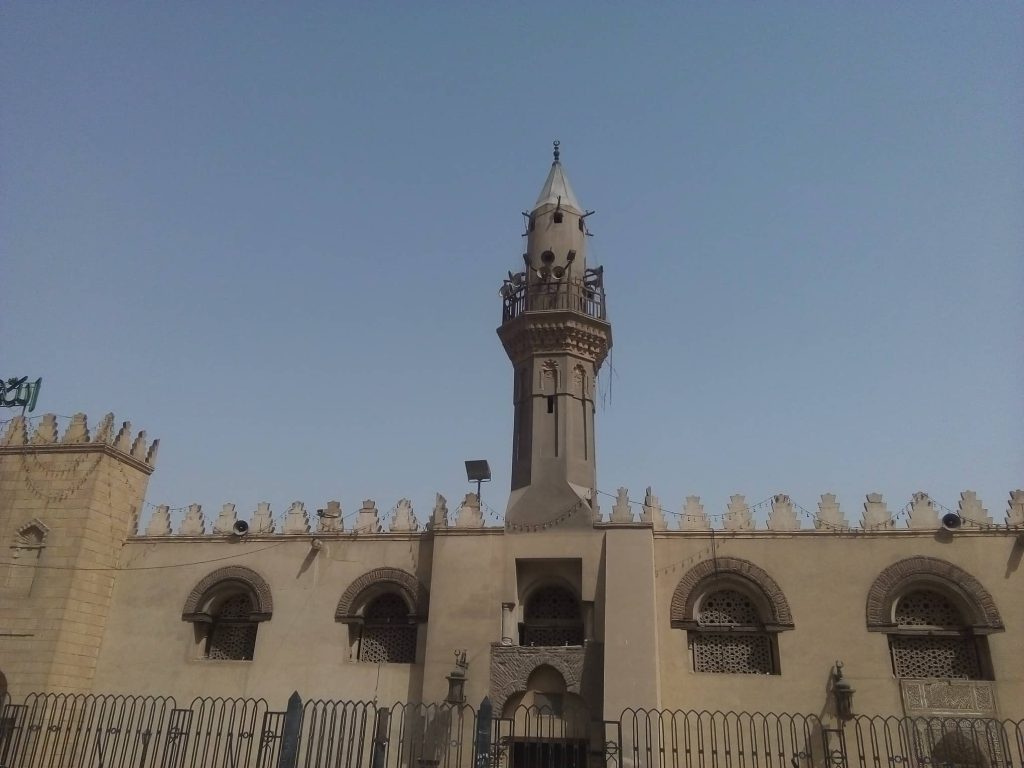
For the Muslim caliphs and sultans of Egypt, the final Friday prayer of Ramadan was inextricably linked to the Mosque of Amr Ibn Al-As. After completing prayers in the three other great mosques of Cairo—Al-Azhar, Al-Hakim Bi-Amr Allah, and Ibn Tulun—they would conclude the month here, as a distinctive mark of reverence for the holy month.
The Fatimid caliphs established this tradition for several reasons. Amr Ibn Al-As himself passed away during the final week of Ramadan, specifically on the eve of Eid al-Fitr. Centuries later, after completing a major restoration of the mosque, Caliph Al-Hakim Bi-Amr Allah chose to reopen it on the last Friday of Ramadan. And Murad Bey, the last of the Mamluk rulers, who undertook extensive renovations to the mosque’s architecture and expanded its area, also inaugurated his work on the final Friday.
Thus, the connection was sealed: for Egypt’s rulers, the last Friday of Ramadan belonged to Amr Ibn Al-As.
The Birth of Fustat
Every great city has a founding story, and Cairo’s began with the establishment of Fustat, where the mosque now stands.
When Amr Ibn Al-As arrived in Egypt, he laid siege to the Babylonian Fortress for seven months. During the siege, the Nile flowed past the fortress, and Amr chose this spot as a camp for himself and his soldiers. After completing conquests in other parts of Egypt, he returned to find a dove nesting in his tent. Taking it as a sign, he decided to build his city here and named it Fustat.
Fustat became Egypt’s capital for centuries to come. Though other cities would later be established—Al-Askar, Al-Qata’i, and finally Cairo,Fustat remained the principal city. Indeed, for a time, all of Egypt was referred to as Fustat.
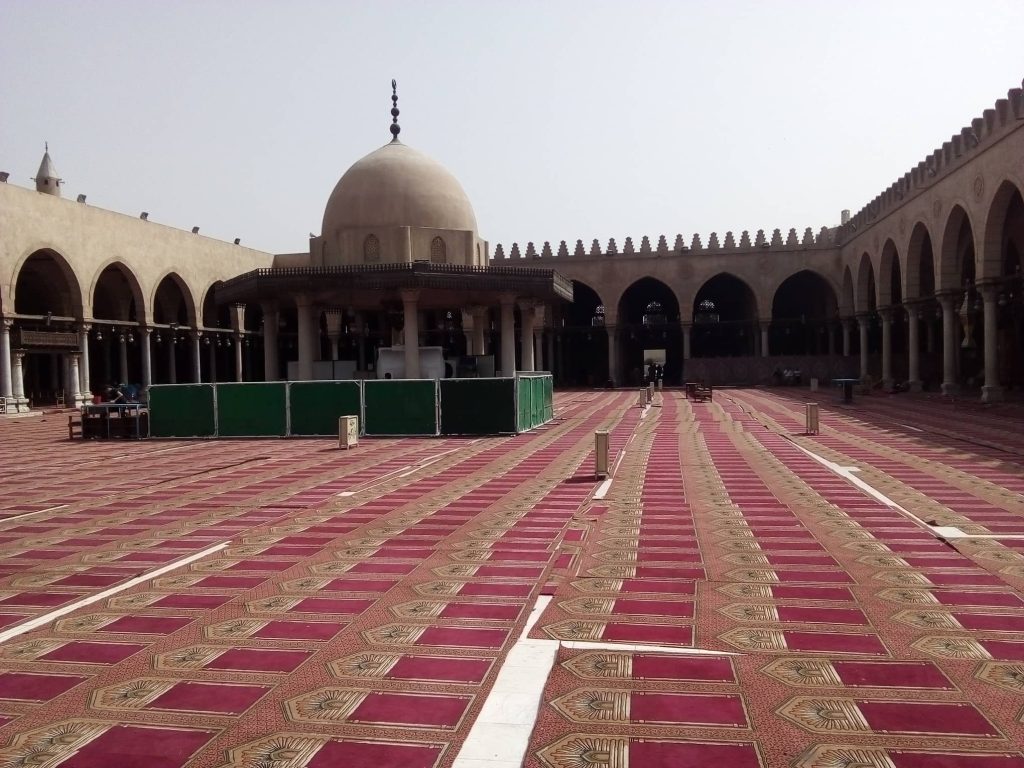
It was here that Amr decided to build a mosque for prayer at the heart of the settlement. In its original form, the mosque was strikingly simple. Its roof was made of palm fronds and branches, its walls of mudbrick, its floor covered with gravel. At its founding, it measured approximately fifty cubits in length by thirty in width. Today, it spans 120 by 110 meters.
A Mosque of the Companions
According to Hamdi Abu Jamil’s book Cairo: Mosques and Stories, the mosque was initially named “Masjid al-Fath” (the Mosque of Conquest), then “Al-Jami’ al-Atiq” (the Ancient Mosque), and later “Taj al-Jawami'” (the Crown of Mosques), before finally settling on the name of its founder, Amr Ibn Al-As. It holds a distinguished place among Cairo’s mosques as the fourth congregational mosque in Islamic history, after the Sacred Mosque in Mecca, the Prophet’s Mosque in Medina, and Al-Aqsa Mosque in Jerusalem.
As for those who built it, historian Al-Kindi quotes Yazid ibn Abi Habib: “I heard our elders who witnessed the construction of the Mosque of Conquest say that eighty Companions of the Prophet stood to determine its qibla direction, among them Al-Zubayr ibn Al-Awwam, Al-Miqdad, Ubada ibn Al-Samit, Abu Al-Darda, and Fadala ibn Ubayd.” Another account names four Companions specifically entrusted with its foundation: Abu Dhar, Abu Basira, Ibn Al-Zubaydi, and Nabih ibn Sawab.
In its earliest days, Amr Ibn Al-As used a simple pulpit—said to be a palm trunk—from which he delivered the mosque’s first Friday sermon.
A Traveller’s Account
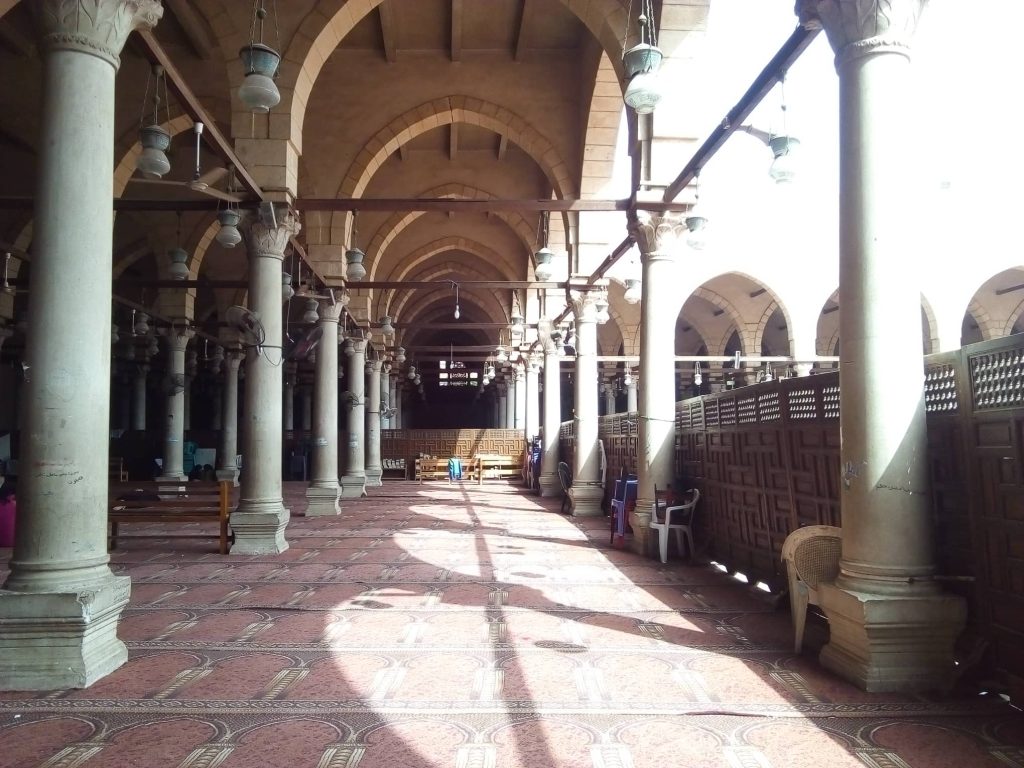
The Persian traveler Nasir Khusraw, who visited the mosque between 1045 and 1047 CE during the reign of the Fatimid Caliph Al-Mustansir, left a vivid description. He wrote that the mosque stood on four hundred marble columns. On religious occasions, more than four hundred lamps were lit. The floors were covered with ten layers of colored mats. It served as a gathering place for the entire city, and at any given time, no fewer than five thousand people could be found within its walls—students of knowledge, travellers, and scribes drawing up legal documents.
Centuries of Transformation
For the duration of the Rightly Guided Caliphs, the mosque remained unchanged in size and structure. The first modifications came under Caliph Muawiya ibn Abi Sufyan, who ordered his governor of Egypt, Maslama ibn Mukhallad al-Ansari, to expand it. Maslama added a significant area and built four minarets at its corners.
The second expansion occurred in 79 AH (698 CE) under Abd al-Aziz ibn Marwan, who demolished parts of the structure to enlarge it further.
Though the Fatimids established Al-Azhar as their official state mosque, they lavished attention on Amr Ibn Al-As. Caliph Al-Aziz Billah surrounded it with wooden porticos and renewed its whitewash. His successor, Al-Hakim Bi-Amr Allah, reportedly purchased the land from Amr’s descendants. He added 1,298 Qurans to the mosque’s library.some written in gold water, and commissioned a silver chandelier weighing seven qintars, valued at one hundred thousand dirhams. So massive was it that crowds could only bring it into the mosque after widening the door thresholds. Al-Hakim also built two arcades, a wooden enclosure, an ornamented mihrab, and two sandalwood columns.
Destruction and Renewal
The mosque was completely destroyed when the Fatimid vizier Shawar set fire to Fustat, fearing its capture by the Crusaders. The flames consumed the city for fifty-four days. Fustat collapsed, its buildings reduced to rubble.
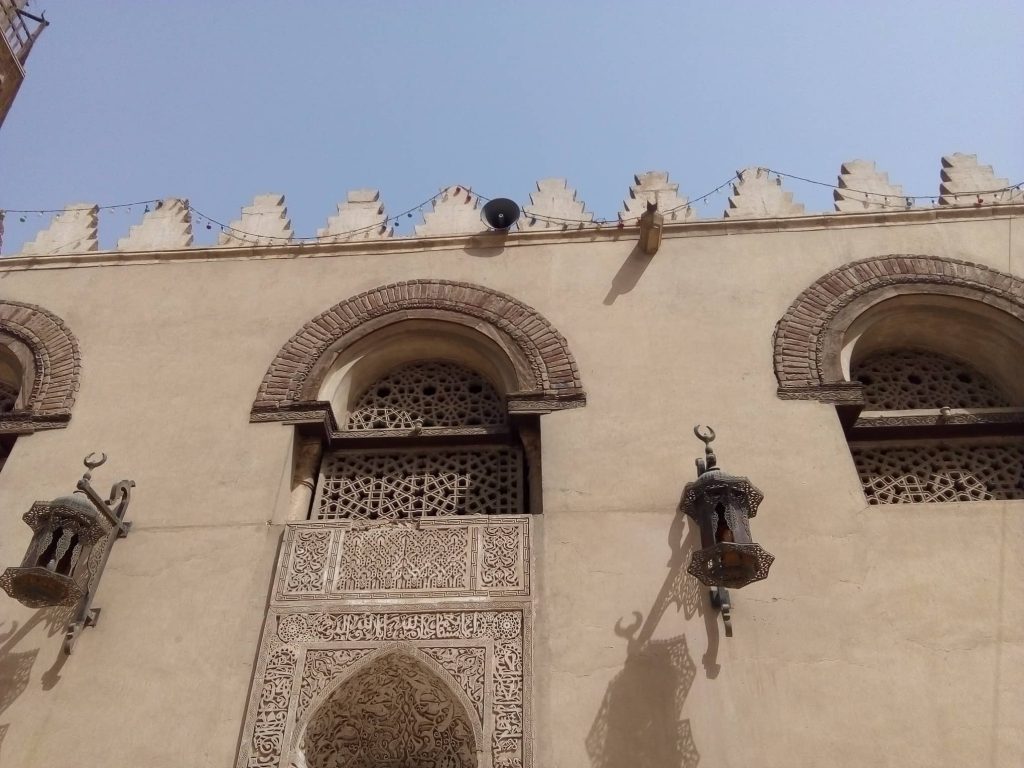
Reconstruction came under Saladin and the Ayyubids, followed by further restorations under the Mamluk sultans Al-Zahir Baybars and Al-Mansur Qalawun. The windows Qalawun installed in the western facade remain to this day, along with an external plaster mihrab featuring a band of Thuluth script and floral decorations.
The most recent major renovations before the modern era were undertaken by Murad Bey, the last Mamluk ruler of Egypt. He spent lavishly, rebuilding its foundations, erecting its columns, adding two minarets, renewing its roof with imported wood, whitewashing its walls, and covering its floors with Fayoum mats. Verses commemorating his work remain carved into the mosque’s walls.
When the French Expedition arrived in Egypt, the mosque suffered the same fate as many others: looting, destruction, and the theft of its woodwork and decorations. The historian Ali Mubarak wrote that it was “in a worse state than during the burning of Fustat,its roof collapsed, its walls cracked.” It languished in neglect for a long period until its reconstruction in recent years as part of a major architectural project.
More Than a Mosque
From its earliest days, the mosque served as a center for religious learning,the first such institution in Cairo. But it was never merely a place of prayer. It functioned as a court for resolving disputes between tribes and housed the Treasury of the Muslims (Bayt al-Mal), from which funds were distributed to the state’s orphans.
Today, the mosque features a large open courtyard. The most magnificent section is the Prayer Hall (Riwaq al-Qibla), which contains three mihrabs: a central main mihrab and two side mihrabs, each commemorating different rulers who contributed to the mosque’s expansion—including Murad Bey. The mosque also contains one of the largest dikkas (platforms for Quran reciters) in Cairo.