Mussolini’s Architectural Message in Egypt: The Fascist Symbol Hidden in Plain Sight in Port Said
Built in 1938 on the orders of Mussolini, the Italian House in Port Said was never just a cultural center. It was a piece of propaganda carved in stone. A new study reveals the building’s secret political symbols and its journey from fascist showcase to abandoned relic.
By Osama Kamal
Reaching the truth about the “Italian House” in Port Said was not easy. For many years, the building stood as a silent enigma, overlooking a world crossroads without revealing all its secrets. This is the story of that conversation, a conversation with researcher Dr. Ahmed Ragab Youssef, who spent nearly four years between 2022 and 2025 immersed in the building’s details, driven by a hidden love for the place and a passion for the history of Port Said. Speaking with him was not merely a transfer of information. It was an approach to the very soul of the building, where his study transformed into a living reading of an architectural and political document.
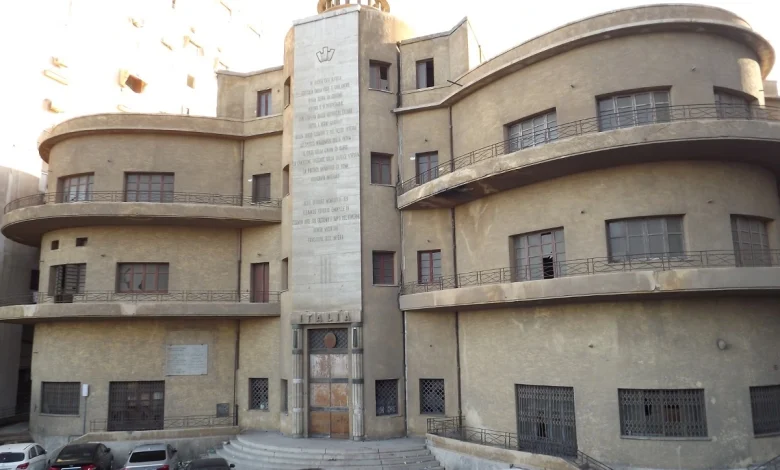
The researcher notes that the location was not chosen randomly. The Italian House is located in the Sharq district, near the northern entrance to the Suez Canal. Its main facade faces Adil Taha Street, while its northwestern facade overlooks Mahmoud Sidqi Street. This strategic location reflects Port Said’s importance in international calculations. The city represented the key to controlling one of the world’s most important waterways.
Fascism and Its Colonial Symbol
The researcher confirms that the building’s construction in 1938, during Mussolini’s era, was not a purely cultural endeavour. It was tied to three main objectives: economic, colonial, and political. Its construction dates to 1938, with the commemorative plaque recording its completion on October 28 of that year. It was officially opened on April 21, 1939.
The building was designed by Italian architect Clemente Busiri Vici, at a time when fascist Italy was seeking to extend its political and cultural influence beyond its borders. After World War I, Italy suffered severe economic crises and saw external expansion as a way out. It also sought to secure its routes to its African colonies, and the Suez Canal was a vital artery that could not be ignored.
Italian Architectural Expertise in Egypt
Discussing the Italian House necessarily leads to the historical relationship between Italy and Egypt, a relationship that long predates fascism. The researcher notes that Italians were among the earliest European communities to settle in Egypt, dating back to the 19th century. In fact, commercial ties between Egypt and Italian cities go back to the Middle Ages.
At the beginning of Muhammad Ali’s era, he sought Italian expertise for his urban renaissance. Italy had no direct political ambitions at that time, making its presence both acceptable and influential.
The researcher adds that Egypt remained, until the early 20th century, one of the most important destinations for Italian emigration. Italian was a common foreign language, and Italian communities spread through Egyptian ports, especially Alexandria and Port Said. The Italian community in Egypt ranked second in size after the Greek community. Their influence relied on their numbers and their economic and social connections with Egyptians.
King Fouad in the Italian Court
An important piece of evidence the researcher mentions is that Italy hosted Khedive Ismail after his deposition. Moreover, King Fouad was raised in the Italian court and absorbed Italian culture, which later influenced the royal court’s relations with Italy. Italian newspapers in Egypt also sympathized with Egyptian demands for independence, creating a sense of psychological closeness between the two sides.
However, this historical relationship took a different political turn in the 1930s with the rise of fascism. Italy sought to spread its principles through schools, associations, and clubs, and the Italian House was one of the most important of these tools. The building was used as a meeting club, a theater, a cinema, and a center for spreading Italian culture. But it carried within it a clear political message.
The Commemorative Plaque
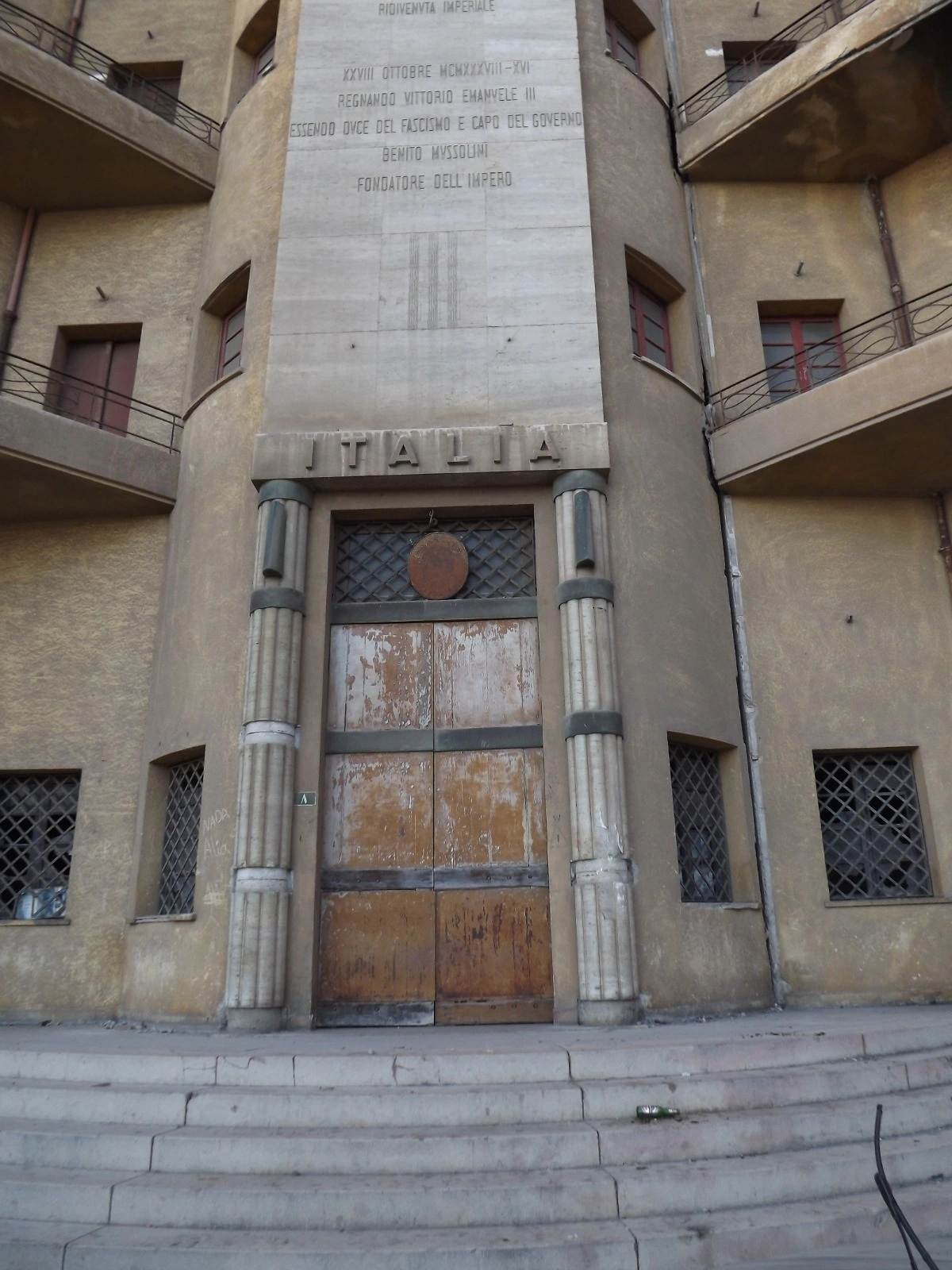
In the course of the conversation, the reading expands to the details of the place itself. The commemorative plaque does not appear as a mere decorative element but as a complete political text carved in stone. The plaque fixed above the main entrance has a vertical, imposing composition, topped by the crown of the Kingdom of Italy, a clear reference to the legitimacy of the monarchy, under whose umbrella fascism was careful to appear.
Beneath the crown comes the Italian text, executed in deep carving and severe geometric script with sharp, straight angles. This reflects the spirit of discipline and power that fascism sought to instil, even in the very shape of the letters. The choice of font was not accidental but part of a propaganda discourse based on severity, simplicity, and clarity, embodying the idea of a strong state that knows no hesitation.
The Commemorative Plaque: A Political Statement of Italian Identity
The phrases on the plaque carry direct ideological connotations. Mentioning the Savoy shield refers to the royal family. The phrase “Rome returning as Empress” refers to the dream of reviving the Roman Empire. The reference to “the worship of Dante’s language” emphasizes the centrality of the Italian language as a tool of national identity.
While the date of October 28 is linked to the number 16, referring to the anniversary of the March on Rome in 1922, the event that brought Mussolini to power, the plaque transforms into a complete political statement, no less clear than any official speech.
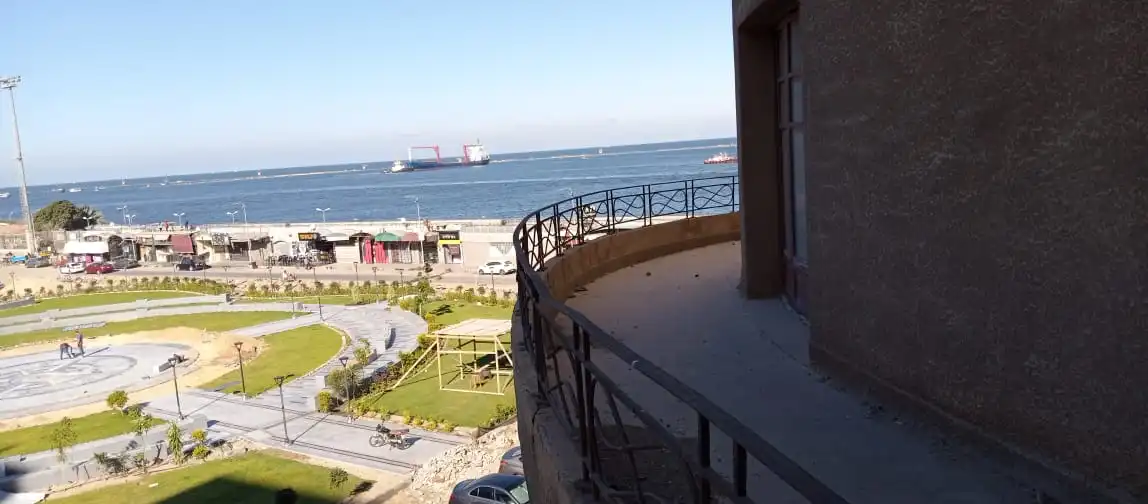
This discourse extends to the architectural composition of the building itself. The curved main facade does not only express an aesthetic treatment but also reflects a trend common in fascist architecture, which blended neoclassicism with simplified modernism.
The curve gives the mass a strong visual presence, making the building appear to advance into space. This is a deliberate effect that reinforces the idea of power and control. The absence of traditional decorations on the facades is consistent with the fascist tendency toward formal austerity, focusing on mass and void rather than ornamentation.
The Symbolism of Immortality in Imperial Discourse
At the main entrance, fascist symbolism becomes even clearer. The main opening is flanked by semi-columns taking the form of the lictor’s fasces, the symbol Mussolini appropriated from ancient Roman judiciary. It consists of a bundle of rods surrounding an axe, signifying unity, strength, and authority. The presence of this symbol at the entrance leaves no doubt about the building’s ideological identity. The same form is repeated in other elements above the facade, reinforcing the unity of the visual message.
The architect also used semi-circular arches, an element derived from ancient Roman architecture, in an obvious attempt to evoke the imperial past. This return to classical models was a fundamental feature of fascist architecture, which sought to assert historical continuity between ancient Rome and modern Italy. The “infinity” ornament also appears in the ironwork of the railings, a symbol of continuity and immortality, consistent with the discourse of an empire that never ends.
A Model of Ideological Architecture
Through all these elements combined, the Italian House in Port Said emerges as a clear model of ideological architecture. Lines, shapes, and symbols transform into political language. The space presents itself not merely as a cultural building but as a propaganda platform embodying fascism’s ambitions for expansion and domination. Hence its historical importance, not only as an architectural landmark in Port Said but as a witness to an era when politics sought to write its message in stone, planting it on the banks of the Suez Canal.
To highlight the fascist architectural character of the building, the researcher draws important comparisons with existing models in Italy itself. The architectural elements appearing in the Italian House in Port Said, especially the lictor’s fasces flanking the entrance, are not isolated from their ideological context but are repeated in well-known fascist buildings.
Parallel Examples in Other Countries
Among these models is the Victory Monument in Bolzano, northern Italy, built on Mussolini’s orders in 1928. Its facade is adorned with semi-columns in the form of the lictor’s fasces, closely resembling those to the right and left of the main entrance of the Italian House in Port Said. Similarities also appear in the House of Fascism in Pomezia, on the western Mediterranean coast, dating to 1939. The same architectural composition is repeated in the main entrance, with semi-columns in the form of the lictor’s fasces.
Added to this is the House of Fascism in Imola, built in 1933. Another model reflecting the unity of fascism’s architectural discourse, it confirms that the Italian House in Port Said was not merely a local building but part of an architectural and political system stretching from Italy to the banks of the Suez Canal.
Embracing Theater, Cinema, and the Arts
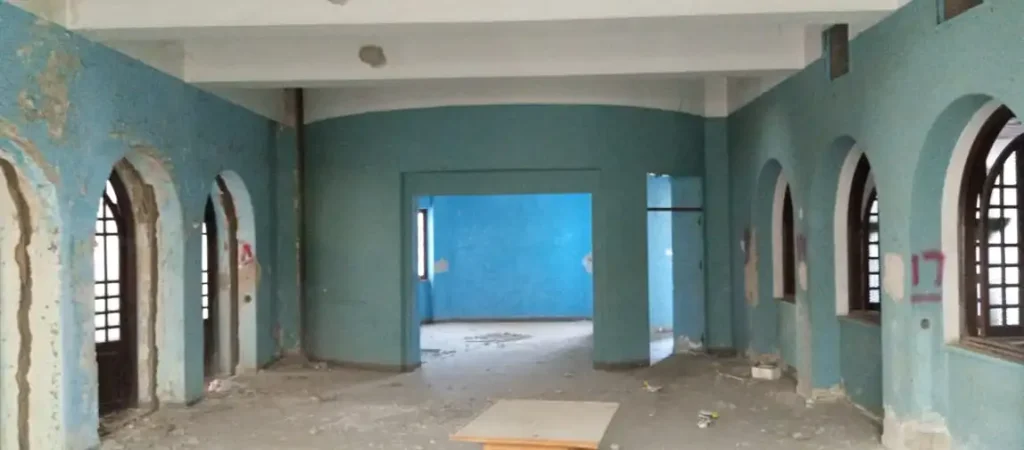
The researcher confirms that from its official opening in 1939, the building seemed to change roles as times changed. In its early years, it served a cultural and social function for the Italian community, hosting theater, cinema screenings, and artistic activities. It was a window through which Italy opened onto the canal city.
Then World War II changed its character. When Italy entered the war in 1940, British forces took over the building, converting it into a British army club with a cinema, a restaurant, small shops, and accommodation for soldiers. The space moved from an ideological message to a practical military function.
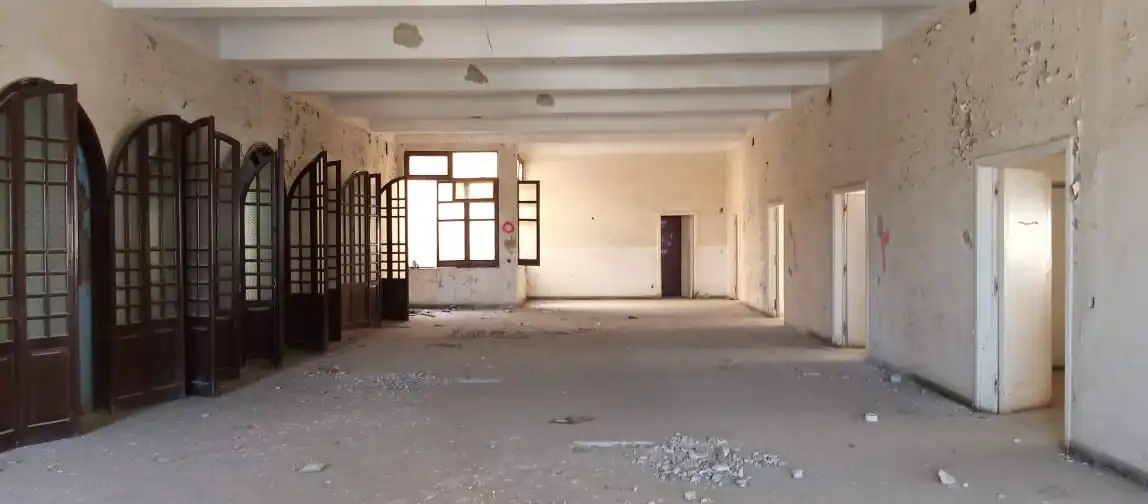
After the Evacuation Agreement of 1954, the building returned to civilian life. It became known to Port Said’s residents by several names, including “Cinema Diana” and later “The American Library.” It regained its cultural role, hosting artistic and educational activities. It remained thus until the 1967 war, when activity ceased. The building entered a period of stagnation, reflected in its deteriorating physical condition.
Restoring Life to the Building
But the space did not surrender to silence for long. In 1987, during Major General Sami Khedr’s tenure as governor of Port Said, an attempt was made to restore life to the building. It was reopened and used as a cultural centre and for artistic activities. It began hosting exhibitions, seminars, and some public events, as if the city was trying to reclaim part of its memory.
This return, however, did not last long. Over time, interest gradually declined, activities diminished, and the building once again entered a cycle of neglect. Its windows closed, and it regained its old silence, standing between two eras: one in which it was a cultural beacon, and another in which it waits for someone to bring back the light.
Architecturally, the researcher explains that the building features a curved main facade giving it a streamlined character. It consists of a basement and three floors, covering an area of approximately 1,305 square meters. Fascist symbols appear at the main entrance in the form of semi-columns shaped like the lictor’s fasces, the emblem used by Mussolini, alongside the “infinity” ornament in the ironwork as a symbol of continuity and immortality.
Repurposing the Italian House
The researcher confirms that the Italian House represents a clear example of the influence of political ideology on architecture, as architectural elements were transformed into a propaganda message. The building also reflects Port Said’s importance in the international conflicts of the first half of the 20th century, serving as a key to both the Mediterranean and the Red Sea.
At the conclusion of the conversation, the researcher stresses the need to preserve the building, repurpose it culturally, and integrate it into the daily life of the city. He suggests using sound and light technology to narrate its history and advocates for its registration as a heritage building.