Egypt’s Hidden Heritage: Two Ancient Minarets in the New Valley Tell the Story of the Oases
Discover the unique architectural treasures of Egypt’s Western Desert. Learn about the Nasr El-Din and Waddah minarets in the Islamic village of Qasr, Dakhla Oasis—ancient structures built from local materials that blend Ayyubid design with Ottoman-era construction.
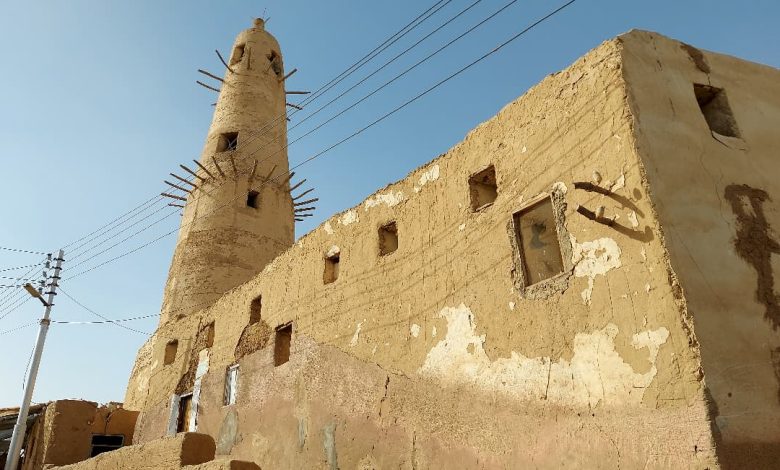
In the heart of Egypt’s Western Desert, the twin minarets of the Nasr El-Din and Waddah mosques stand as silent sentinels over the Islamic village of Qasr in the New Valley Governorate. These ancient structures are far more than religious landmarks—they are rare stone documents, preserving the unique architectural identity of the Egyptian oases and bridging two distinct eras of Islamic history.
The Minaret of Nasr El-Din: A Timeless Architectural Anomaly
The Nasr El-Din minaret is the undisputed icon of Qasr village in the Dakhla Oasis, a settlement that has remarkably preserved its medieval urban layout to this day.
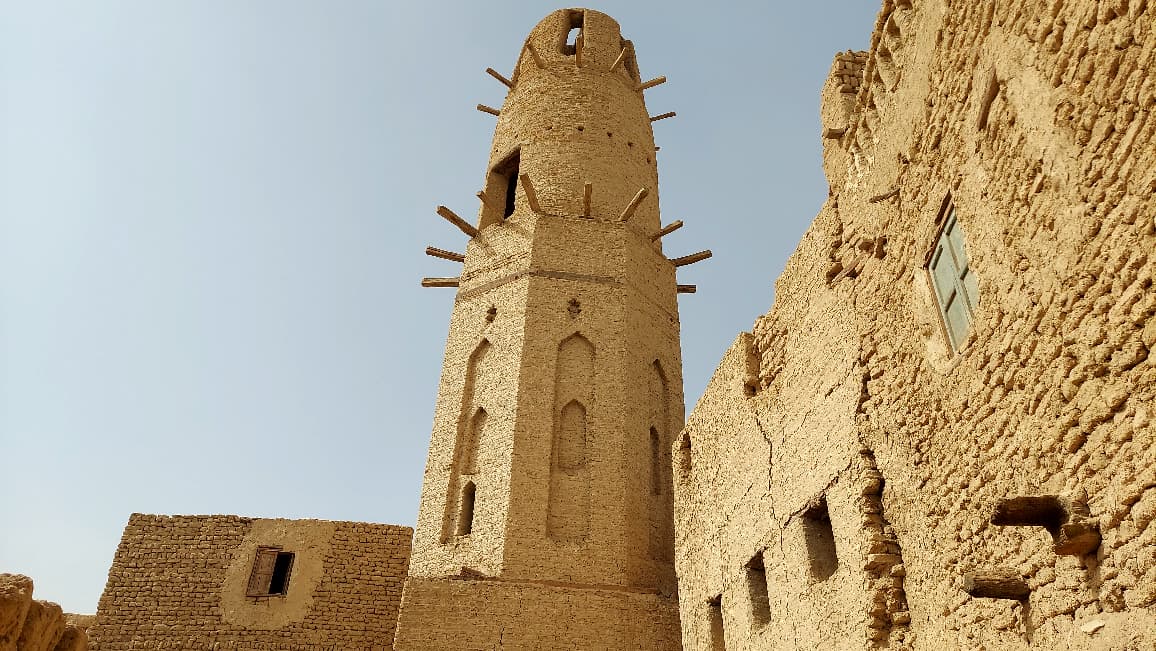
According to Dr Mahmoud Masoud, Director General of Islamic Antiquities for the Dakhla Oasis region, speaking to Bab Masr, the Nasr El-Din minaret holds a distinguished place among Egypt’s thousands of minarets. “It is classified as the oldest surviving minaret in the New Valley Governorate,” he explains. “Although it was constructed during the Ottoman era—likely in the 11th or 12th century AH (17th-18th century AD)—its architectural style is purely Ayyubid.”
This fascinating contrast is what makes the structure so remarkable. Dr Masoud suggests that this blend reflects the independence of the oasis architectural tradition, which remained deeply influenced by ancient local building methods rather than following the imperial styles emanating from Istanbul or even Cairo at the time.
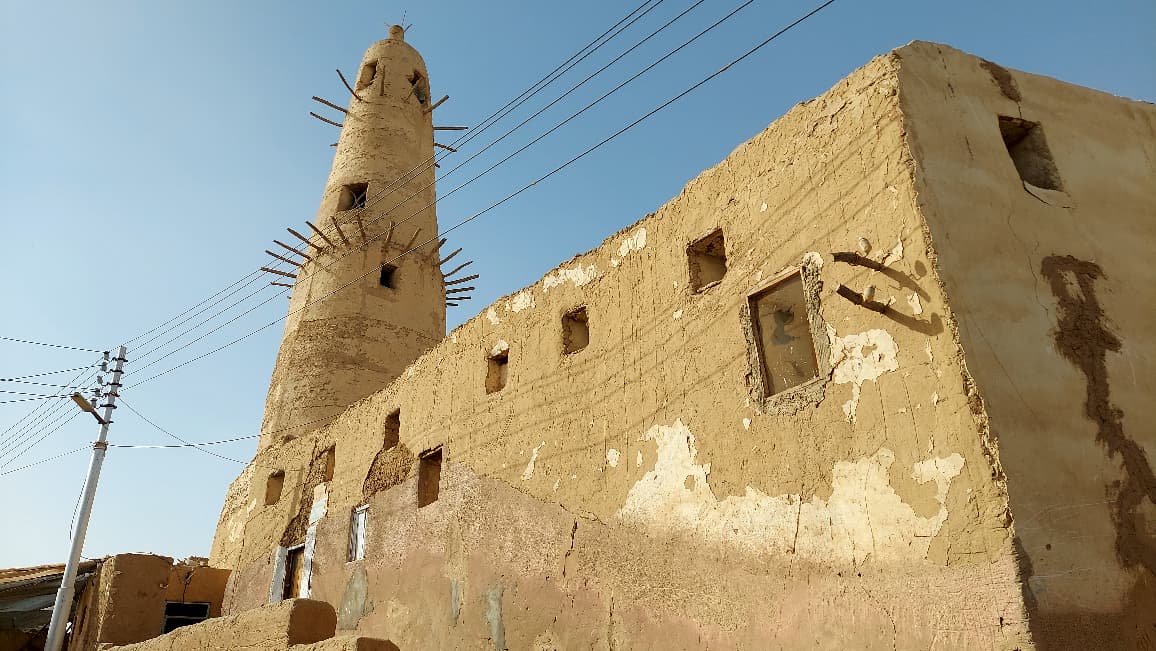
Standing approximately 21 meters tall, the minaret follows the classic Ayyubid blueprint: a square base, surmounted by an octagonal shaft, then a cylindrical section, crowned with a wooden helmet structure known as a jawsaq. This layout, Dr Masoud notes, is definitive proof of the deep architectural roots and enduring traditions of this remote region.
Built from the Earth: Local Materials and Ingenious Techniques
Yasser Hanafi, an Islamic antiquities inspector based in Qasr village, sheds light on the technical and construction methods behind this architectural marvel. He emphasises that both the Nasr El-Din minaret and the adjacent Waddah mosque were constructed entirely from locally sourced materials,primarily mudbrick (toub laban).
“The builders reinforced the mudbrick with palm fronds and dom palm wood, which were used as wooden ties to strengthen the walls,” Hanafi explains. This ingenious technique allowed the structures to withstand both their considerable height and the harsh erosive forces of the desert environment for centuries.
Hanafi also highlights a fascinating dual purpose for the Nasr El-Din minaret. Beyond its religious function of calling the faithful to prayer, it served a critical civic role. “It functioned as a land lighthouse—a visual beacon for trade caravans approaching across the desert trails,” he says. For weary travellers navigating the vast emptiness, the sight of the minaret meant they had reached the safety and rest offered by the village.
The Nasr El-Din School: Education Above the Clouds
Dr Mahmoud Masoud also draws attention to the intelligent functional design of the complex. He points out that a school, or kuttab, was once attached to the Nasr El-Din mosque,a clever architectural feature common in historic Islamic complexes.
“Raising both mosques Waddah and Nasr El-Din to the upper floor served multiple purposes,” Masoud explains. “Most importantly, it provided the quiet necessary for students of religion, away from the noise of the village streets below. It’s worth noting that people still live in this village today, just as they have for centuries.”
There was also a practical climatic benefit. “Positioning the mosques higher up allowed them to capture cooler air currents, helping to mitigate the brutal summer heat,” he adds. This multi-level approach demonstrates a sophisticated understanding of both social and environmental needs.
The Waddah Mosque: The Spiritual Heart
Yasser Hanafi emphasizes the importance of the Sheikh Waddah mosque, which sits adjacent to the Nasr El-Din minaret. Sharing the same Ayyubid architectural character, it is an integral part of the historic fabric of Qasr.
Remarkably, the mosque remains a living place of worship. “The villagers still pray here every day,” Hanafi says. “They are deeply committed to preserving it, viewing it as a precious inheritance passed down from their ancestors.”
Adding to its historical value, the wooden lintels of both the mosque and the minaret still bear clearly readable inscriptions. These carvings include Quranic verses and the original construction dates, serving as undeniable primary documents that allow researchers to accurately trace the evolution of architecture in this unique village.