The Lifelong Odyssey of Egyptologist Hassan Amer Amid Tombs and Papyri
Tracing the three-decade journey of Egyptologist Dr. Hassan Amer as he unearths the Roman tombs, golden mummies, and ancient papyri of Oxyrhynchus.
The archaeological discovery announced early this year by the Spanish mission from the University of Barcelona and the Institute of the Ancient Near East in Oxyrhynchus, known locally as al-Bahnasa, thrust the ancient city back into the global spotlight. This Roman-era tomb, yielding dozens of mummies and stone sarcophagi, represents merely the latest chapter in a long chronicle of discoveries unfolding across recent decades, steadily reshaping our understanding of Egyptian society during the Ptolemaic and Roman eras.
Yet for Dr. Hassan Amer, Professor of Archaeology at Cairo University and director of the mission’s excavations, the story of Oxyrhynchus began long before this recent breakthrough. His name has remained tethered to the site’s excavations for more than three decades, a scholarly voyage that commenced in Luxor, where he came of age among the temples and tombs that forged his early consciousness of antiquity. His path later wound through France for postgraduate studies before he returned to Egypt, dedicating his life to deciphering one of the most vital Egyptian necropolises of the Ptolemaic and Roman epochs. In this conversation, Amer reflects on his origins in Luxor, his formative academic years in France, the defining discoveries unearthed at Oxyrhynchus, and the intimate truths that tombs and papyri reveal about ancient society, while weighing the challenges confronting modern field archaeology.
From the Shadows of Luxor to the Libraries of Paris
Dr. Hassan Amer evokes his earliest memories of antiquity not as abstract history, but as the literal backdrop of daily life in Luxor. Growing up in the historic city, temples and tombs anchored the local landscape, and encounters with foreign archaeologists were commonplace for a child raised in the heart of the world’s most storied archaeological zones. “I was born and raised in Luxor, so entering archaeology felt entirely natural,” he notes. “We lived surrounded by monuments, and from a tender age, I knew several archaeologists working in the city, including François Daumas, then director of the French Institute.” This fleeting childhood acquaintance blossomed into a defining mentorship; years later, Daumas would shape the very trajectory of Amer’s academic life. After completing his undergraduate degree and entering academia, Amer journeyed to France for his doctoral studies at the University of Montpellier, working directly under Daumas.
Before setting foot in France, however, his academic passions leaned toward the New Kingdom. His master’s thesis focused on Tomb 165 on Luxor’s West Bank, a resting place dating to the Ramesside period, before Daumas redirected his scholarly focus. “My master’s thesis centered on a West Bank tomb in Luxor,” Amer says, “but my mentor, François Daumas, guided me toward specializing in the Ptolemaic era. That became the true genesis of my journey, leading to my doctorate under his supervision in Montpellier.”
The Crucible of Scholarship
Amer describes his years in France as an indispensable crucible for his academic development, fueled by an exceptional research environment. What lingers in his memory today is not the sterile lecture halls, but the endless, solitary hours spent immersed in books and manuscripts within the library walls.
“In France, the resources were vast,” he recalls. “I held a key to the library, allowing me to work through weekends, sometimes remaining until eleven at night. This profound access accelerated my work tremendously, complemented by an atmosphere that inherently nurtured deep scholarship.” Zudem, the private library of his mentor, François Daumas, served as an extraordinary scholarly oasis. Given Daumas’s tenure as director of the French Institute for Oriental Archaeology in Cairo, new publications and specialized journals continuously replenished his collection, offering Amer unhindered access to the vanguard of Egyptological research. Yet despite these years abroad, Amer returned home to anchor his career at Cairo University, though his devotion to fieldwork had already taken root during his earliest undergraduate days. “I graduated from the Faculty of Arts, Department of Archaeology, in a cohort of just twelve students,” he says. “From our very first year, our professors immersed us directly in excavation sites, forging an early, unbreakable bond with the field.”
This early immersion transformed his perception of archaeology, reframing it as an active field science rather than an academic exercise confined to university halls. Upon his appointment to the faculty, he joined excavations at Tuna el-Gebel in Minya, a collaborative venture between Cairo University and the University of Munich, an experience he regards as the true prologue to his lifelong field career. “Following my university appointment, I joined the Tuna el-Gebel excavations representing Cairo University,” he says. “Since the early 1980s, fieldwork has formed the very core of my existence.”
Hierarchies of the Dead
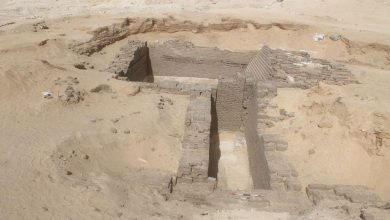
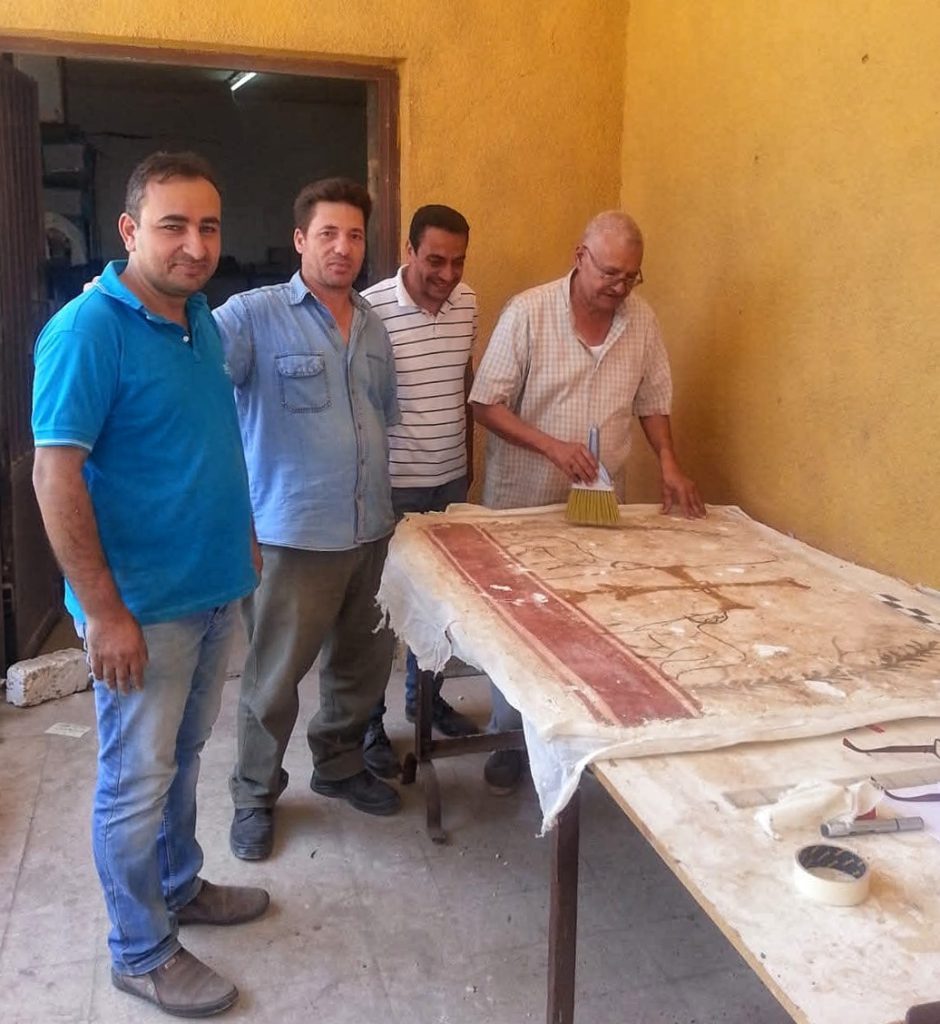
Across more than three decades at Oxyrhynchus, excavations never stalled at the initial tomb that launched the project. With each passing season, the necropolis yielded fresh fragments of the city’s history, gradually emerging as one of the most significant known burial grounds from the Ptolemaic and Roman eras in Egypt. Over these years, discoveries rolled from one sector to the next, eventually bringing the total number of unearthed tombs to approximately 67.
“We are not dealing with a minor, confined site, but an expansive, sweeping necropolis,” Dr. Hassan Amer observes. “As excavations progressed, discoveries emerged season after season, culminating in the 67 tombs we have uncovered so far.” He explains that the historical weight of these tombs varies significantly, dictated by the social standing of their occupants and the wealth available to them in life. “Not all tombs occupy the same tier of significance,” he adds. “Some are stark and simple, while others are monumental, reflecting the formidable power and status of their owners. The archaeological value thus shifts distinctly from one sepulcher to another.”
The Crown Jewels of the Necropolis
Among these discoveries, several tombs stand out as crowning achievements, notably Tombs 1, 3, and 14, alongside Tomb 65, which he extols as one of the most breathtaking sepulchers ever found at Oxyrhynchus. “Tomb 65 comprises three distinct chambers,” he describes. “One of these chambers is entirely covered in vivid reliefs and inscriptions, evoking the majestic tombs of Luxor’s West Bank. The stone walls were coated in plaster, then adorned with painted scenes that still retain much of their ancient luster.”
Amer notes that the exquisite execution and artistry indicate that the tomb’s owner belonged to the wealthy elite or held an exalted rank in society, explaining the immense labor lavished on its construction and embellishment. However, many of these tombs fell victim to plundering in antiquity. “We did not find the customary funerary furniture within,” he laments. “The canopic jars, ushabti (funerary figurines), and other artifacts that typically accompany the deceased were entirely absent. Only the sarcophagi and mummies remained, a clear sign that the tomb was ransacked long ago. Fortunately, the brilliant wall paintings and inscriptions survived untouched.”
The Tapestry of a Cosmopolitan Society
These archaeological treasures offer a transparent window into the cosmopolitan society of Oxyrhynchus during the Ptolemaic and Roman eras, illustrating a profound cultural synthesis between Egyptians and Greeks within a shared urban space. The necropolis hosts resting places for those of purely Egyptian lineages alongside members of the Greek communities who settled in the city during this epoch.
Some tombs remain purely Egyptian in architectural style, ornamentation, and funerary theology, while others tie directly to occupants of Greek heritage. Yet what strikes Amer as extraordinary is that many tombs display entirely traditional Egyptian motifs, even during periods when Greek and Roman rulers governed the land. This devotion manifests clearly in funerary vignettes drawn from the Books of the Underworld, the Book of the Dead, and enduring Egyptian mortuary traditions. This cultural osmosis extended to the names of the deceased; several tombs bear distinctly Egyptian names despite belonging to eras marked by a pervasive Greek presence. “We find tombs belonging to individuals of unadulterated Egyptian lineage, their names and those of their families inscribed clearly inside,” Amer says. “At the same time, Egyptians and Greeks coexisted daily within the city, making Oxyrhynchus an invaluable model for untangling the complex social dynamics of this era.”
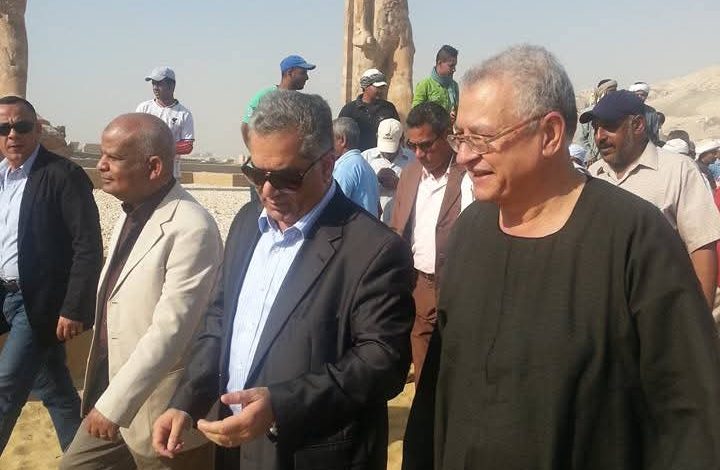
Dr. Hassan Amer alongside the former Minister of Antiquities – Photo: Dr. Hassan Amer’s Facebook page
Golden Tongues and the Toll of Modernity
Among the artifacts that captivated researchers in the latest discovery were the golden tongues discovered inside the mouths of certain mummies, a phenomenon tied to several burial sites from the Greco-Roman period.
Amer demystifies this practice: “In traditional, classical Egyptian theology, placing golden tongues within mummies was not standard protocol. However, the practice gained prominence during the Greco-Roman era, driven by evolving beliefs surrounding the afterlife and the final judgment. Its symbolic purpose was to grant the deceased the eloquence to speak and defend their virtue before the divine tribunal in the underworld.” The mission also recovered mummies preserved in varying states; some remained remarkably intact despite the passage of millennia, while others were reduced to skeletal fragments. “We uncovered pristine, intact mummies alongside scattered remains,” he notes, “yet the embalming techniques themselves remained firmly anchored in age-old Egyptian traditions.”
For Amer, the discoveries unearthed so far represent a mere fraction of what lies beneath. After more than thirty years of labor, Oxyrhynchus remains entirely capable of yielding fresh marvels, from papyrus treasures to hidden chambers, though the work is consistently constrained by funding crises.
While the fame of Oxyrhynchus in recent decades has been synonymous with tombs, mummies, and mortuary discoveries, an equally monumental legacy survives in the thousands of papyri unearthed there since the late nineteenth century. These texts remain a premier source for reconstructing the texture of daily life in Greco-Roman Egypt.
Hassan Amer clarifies that while the current mission excavates within the necropolis, the vast majority of papyrus discoveries emerged from the ancient city center itself, an urban landscape that gradually vanished under the weight of time, agricultural expansion, and environmental shifts. “Our work is anchored in the necropolis,” he explains. “The papyri, conversely, were salvaged from the ancient city itself. That urban sprawl dissolved over the centuries, situated in an agricultural basin subjected to generations of Nile floods and natural alterations, which effectively erased its surface vestiges.”
The name of Oxyrhynchus became immortalized in archaeological lore through the pioneering exploits of British scholars Bernard Grenfell and Arthur Hunt. At the turn of the twentieth century, they orchestrated one of the most celebrated papyrus-hunting expeditions in history, unearthing texts that permanently revolutionized how historians view the classical world.
“More than a million papyrus fragments and intact texts were salvaged from Oxyrhynchus,” Amer notes. “To this day, only a modest portion of this massive archive has been published. Tens of thousands of papyri have been painstakingly studied and translated, but the academic labor remains monumental and ongoing.”
An Unfinished Chronicle of the Ancient World
These papyri illuminate the intimate minutiae of daily life, containing contracts, financial transactions, private correspondence, religious and literary texts, and administrative logs. They allow modern researchers to reconstruct social networks, professional titles, the roles of priesthoods, and the economic machinery of the city.
“Some papyri preserve mundane financial contracts,” Amer says. “Others are intimate letters exchanged between friends, or sacred religious and literary texts. They provide a panoramic view of society, interpersonal dynamics, professional guilds, the priesthood, and the fiscal administration of the city.” Amer argues that the value of these papyri resides not merely in their sheer volume or rarity, but in their unique power to reconstruct human details completely absent from formal temple inscriptions or royal decrees. A dedicated scholar, in his view, can spend an entire career examining a single facet of this material, whether economy, liturgy, administration, or social kinship.
“This is precisely why Oxyrhynchus remains an unparalleled locus for deciphering Egyptian society under Greek and Roman rule,” he asserts. Yet, a portion of this irreplaceable heritage perished before researchers could rescue it, lost to the historic extraction of sebakh (organic agricultural fertilizer). In earlier eras, ancient soil was systematically hauled away for farming, with little understanding of its archaeological wealth, destroying vast troves of historical data.
“There was once a dedicated railway line constructed solely to transport sebakh from Oxyrhynchus to Bani Mazar, and onward to other provinces,” Amer notes with regret. “Countless priceless artifacts vanished during that era, an immeasurable loss. Conversely, today’s archaeological missions in Egypt encounter very few bureaucratic hurdles, and cooperation with state authorities is seamless. The true adversary remains the steep financial cost required to sustain long-term excavations and their attendant scientific studies. University budgets are modest, and as labor, equipment, transport, and lodging expenses climb annually, resources consistently fall short. Excavation projects will always rely heavily on external benefactors and institutional sponsors to ensure continuity.”
The Future of Indigenous Scholarship
Despite these enduring fiscal hurdles, Amer maintains an unyielding optimism regarding the future of archaeological research in Egypt, observing that Egyptian archaeologists are now fully capable of helming major scientific enterprises and achieving world-class discoveries independently.
“In the infancy of Egyptology, foreign researchers spearheaded almost all major excavations,” he reflects. “But that paradigm has shifted entirely. Today, we witness purely Egyptian missions making monumental discoveries in Saqqara, Luxor, Al-Matariya, and beyond. We are the inheritors of this civilization, and we possess an innate capacity to interpret its finest nuances.”
Amer attributes this profound interpretive edge to the cultural and linguistic proximity an Egyptian scholar shares with the material. “When we read or translate these ancient texts, we do not treat them merely as cold academic data,” he concludes. “We engage with them as chapters of a living history whose continuum we inhabit today. Words, idioms, and concepts from antiquity remain deeply embedded within modern Egyptian culture, granting the local researcher an invaluable, intuitive advantage in decoding and contextualizing the ancient world.”