Masterpieces Capturing the Hidden World of Football
New archaeological discoveries at Gabal al-Tayr, Egypt, reveal rare early tombs and a 3,500-year-old burial timeline that rewrites ancient funerary history.
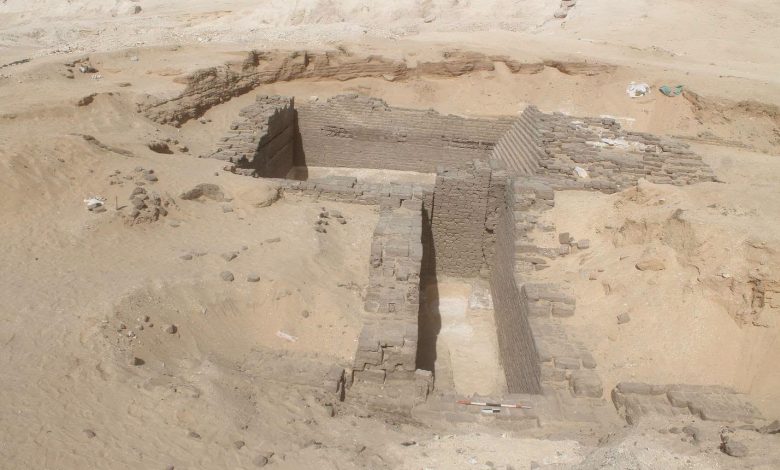
In a fresh archaeological revelation mirroring the richness and sophistication of ancient Egyptian civilization, the Egyptian archaeological mission under the Supreme Council of Antiquities announced the discovery of two tombs in the Gabal al-Tayr (Mountain of the Birds) region of Minya Governorate. The tombs date back to the Archaic Period, alongside several burials originating from the Predynastic and Late Periods.
According to the mission’s statement, the first tomb represents a rare architectural archetype, distinguished by a unique geometric design that reflects the early evolutionary phases of funerary architecture in ancient Egypt. The second tomb largely mirrors the first in layout while retaining an exceptional state of preservation. This discovery underlines the continuous use of the site as a burial ground across distinct epochs, magnifying its archaeological significance and opening new avenues of study to unravel the evolution of funerary rituals and burial methods during these primordial eras.
An Exceptional Archaeological and Historical Anchor
Speaking exclusively to Bab Misr, Dr. Ahmed Fathy, Director General of Antiquities for Minya Governorate, observed that the Deir Gabal al-Tayr (Monastery of the Mountain of the Birds) area in the Samalut district of Minya holds an exceptional archaeological and historical magnitude. It serves not only as a distinct religious sanctuary but also boasts a profound wealth of archaeological layers that command the attention of global scientific expeditions. He explained that discoveries in this landscape yield a significant cumulative impact on Egypt’s archaeological map, recalibrating and updating the known distribution of ancient human settlement and activity from antiquity down to the modern era. The new archaeological find at Gabal al-Tayr, he noted, transforms the historical map from a collection of isolated, disparate points into an interconnected network, offering a lucid window into how civilizations coexisted and evolved in Egypt over millennia.
He added that the Gabal al-Tayr region lies in the heart of Minya Governorate, east of the Nile River, sitting roughly 20 kilometers from the capital city. The historical site of Tehna al-Gabal borders it to the south, while the regional expanse of Bani Khalid lies to its north, alongside the reality that both the Gabal al-Tayr zone and the Monastery of the Virgin Mary endure as monumental archaeological terrains.
Unearthing the Layers of Time
The Director General of Minya Antiquities noted that Gabal al-Tayr stands as a landscape that has witnessed an extensive history of excavations, with the Ministry of Tourism and Antiquities conducting systematic digs during the years 1985, 2007, 2008, and 2010.
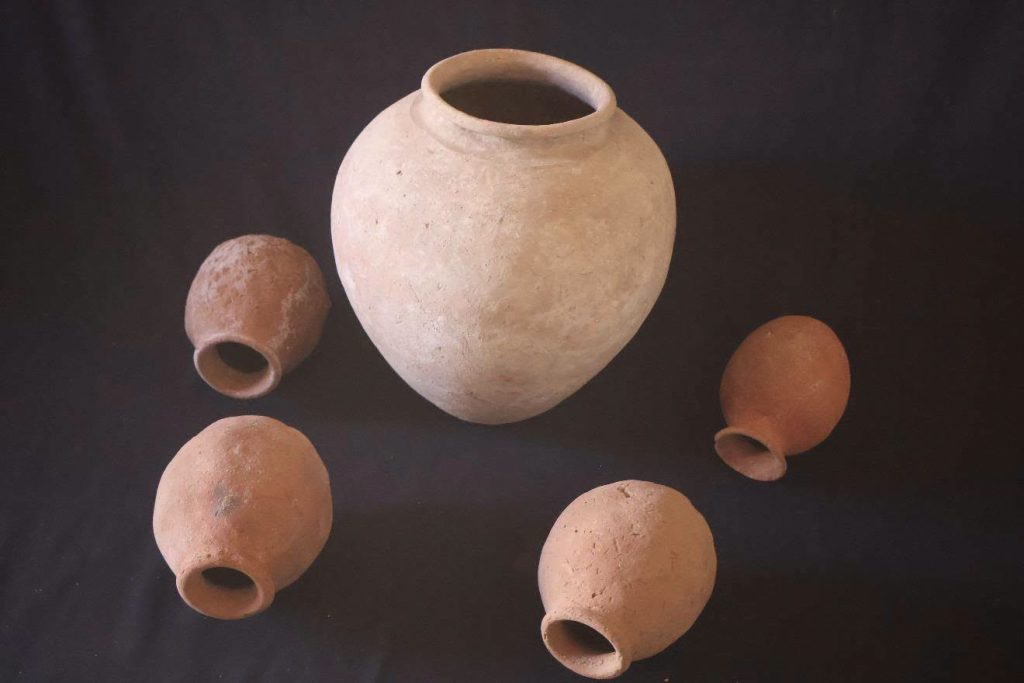
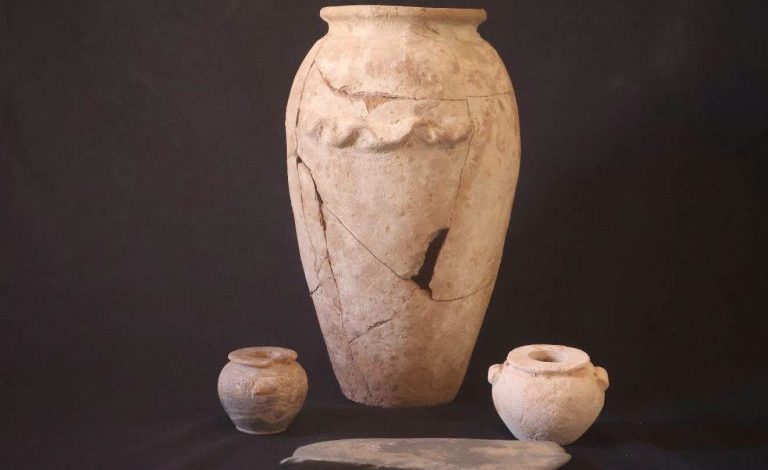
He added that two years ago, a comprehensive strategy was enacted to develop the region, redraw its topography, and chart its natural characteristics. The excavation work executed in previous years reached its culmination as the mission initiated its latest season last year. This year, the digging progressed further, crowning these concerted efforts with success. The results definitively prove that the region remains a highly promising archaeological goldmine, housing a gabana (cemetery) alongside a myriad of burial shafts and ancient artifacts, with each necropolis displaying its own distinct characteristics and archaeological traits. He further stated that this newly uncovered gabana (cemetery) carries profound archaeological importance, exposing burials and pottery vessels that trace back to the Predynastic era, an epoch that archaeologists view as a veritable treasure trove for understanding prehistoric and predynastic times. The site has begun yielding a wealth of knowledge, steering the region into a fresh transitional phase: the migration from prehistoric eras to historical dynasties, specifically the First and Second Dynasties, collectively recognized as the Archaic Period. Analysis of the skeletal remains, architectural structures, sarcophagi, and ceramic vessels reveals that this necropolis did not cease operations after the Archaic Period and the First and Second Dynasties; rather, its usage stretched into the Old Kingdom, the New Kingdom, and the Late Period up to the Twenty-Sixth Dynasty, continuing late into the Roman Period. This implies that the site remained actively integrated into funerary life for approximately 3,500 years.
He emphasized that this gabana (cemetery) ranks among the most crucial burial grounds due to its prolonged, uninterrupted span of utilization, a fact pointing to its intrinsic link with a major settlement hub and neighboring cities. The ancient Egyptians never abandoned this land, anchored by its deep reverence and perceived sanctity, allowing burials to continue uninterrupted through those vast centuries.
The Architecture of Transition
Regarding the unearthed artifacts and structures, Dr. Ahmed Fathy explained that the discovery includes two mastabas (bench-shaped tombs) representing a pivotal evolutionary phase in the funerary philosophy of the ancient Egyptian. In prehistoric times, the deceased was initially laid to rest wrapped in a reed mat inside a simple pit. Over time, the Egyptian began prioritizing the preparation and fortification of the pit, shaping it into a singular chamber or a mastaba (bench-shaped tomb). Later, this chamber expanded into a dual-room layout before ultimately evolving into a fully integrated structure.
He added that this specific epoch witnessed the structural shift from a simple subterranean pit to an engineered underground building. The mastaba (bench-shaped tomb) emerged between the First and Second Dynasties, eventually evolving into the stepped mastaba (bench-shaped tomb). By the Third Dynasty, under the reign of King Djoser, this design culminated in the Step Pyramid, an architectural concept that further matured during the Fourth Dynasty into the true, smooth-sided pyramid, epitomized by the Pyramids of Giza.
He clarified that excavation work will persist at the site during upcoming seasons, driven by the hope of unlocking further discoveries, which may include structures and mastabas (bench-shaped tombs) from other eras extending from the New Kingdom down through the Late Period and the Roman era.
Secrets of the Hallowed Architecture
Mokhaimer Fathy Mohamed, Chief Inspector of Antiquities for Northern Minya, stated that the mission’s findings illuminate the long-hidden secrets of ancient Egyptian funerary architecture and its various developmental stages.
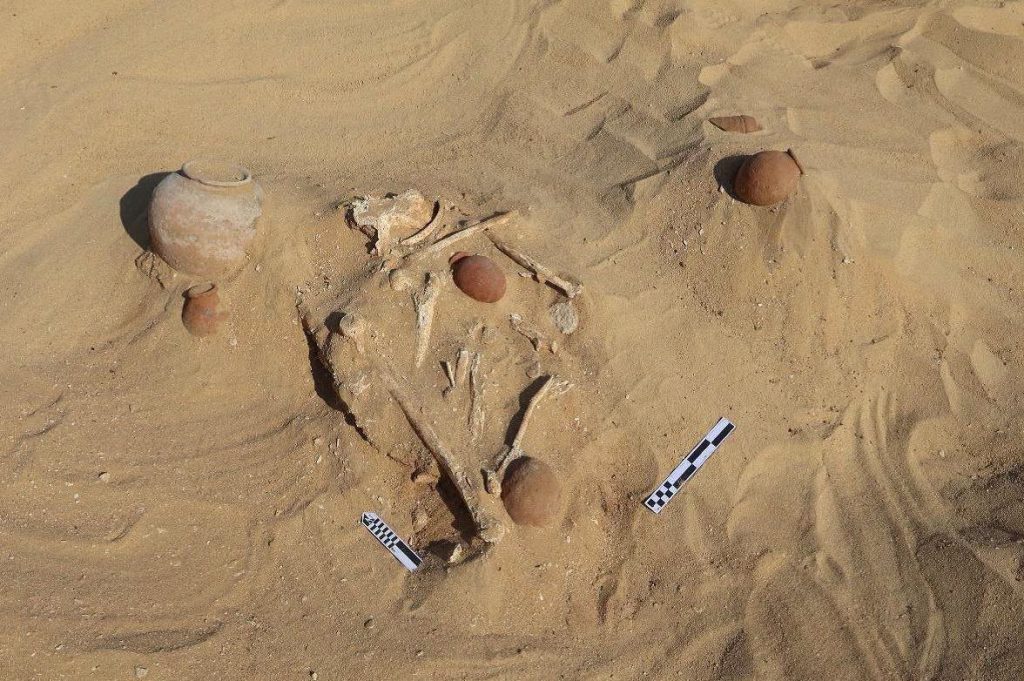
He explained that during the Predynastic era, the ancient Egyptian buried the deceased in a desert pit, placed carefully in the fetal position. By the dawn of the First and Second Dynasties, the practice evolved to place the departed inside an oval-shaped clay coffin, which was then interred within a pit backfilled with small stones.
He added that this methodology later matured into the construction of subterranean mud-brick mastabas (bench-shaped tombs) consisting of two distinct tiers. The upper level housed the funerary goods, while the lower level was dedicated specifically to the burial alongside additional grave goods.
He pointed out the emergence of another architectural style featuring a mud-brick burial chamber surrounded by lateral side-rooms, sometimes numbering up to nine chambers, all utilized to store the personal funerary offerings of the deceased.
The Chief Inspector of Antiquities for Northern Minya explained that these discoveries demonstrate how tombs represented eternal homes to the ancient Egyptian, carrying a weight far greater than the temporary dwellings of the living world, because they immortalized their memory.
He added that the precise method of constructing and carving the tomb, alongside the preserved funerary assemblages within, allows researchers to discern the economic conditions of those eras, as economic shifts reflect transparently upon the grandeur and contents of the tombs.
Portals to Eternity
Dr. Mohamed Fakhry, Director of the Department of Excavations and Expeditions in Minya, added that these discoveries confirm that death acted as a portal to eternal life for the ancient Egyptian. Consequently, rituals and tombs evolved across centuries from simple pits into monumental architectural edifices that mirrored highly sophisticated religious and intellectual paradigms.
He noted that the necropolises illustrate the evolution of funerary architecture during the Old Kingdom, famously known as the Age of the Pyramids and the deification of kings. Tombs transformed from modest pits into mastabas (bench-shaped tombs) and stepped pyramids, serving as a celestial stairway for the king to ascend to the heavens, in accordance with the prevailing beliefs of that era.
He highlighted that certain discoveries dating back to the Late Period, as well as the Greek and Roman eras, reveal an exquisite cultural synthesis of architecture and art. This manifests in the harmonious blending of Pharaonic artistic elements with their Greek and Roman counterparts, proving that the evolution of Egyptian funerary architecture was never a mere alteration in physical form, but rather a profound reflection of the intellectual and social metamorphosis experienced by ancient Egyptian civilization throughout the ages.