Egyptian Artist Appointed VP of Global Arts Organization: “We Need True Talent, Not Just Ambition”
Dr Ahmed Mohi Hamza on bridging Luxor’s ancient heritage with Contemporary global art networks
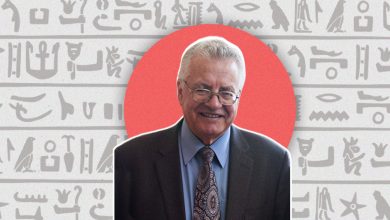
Dr Ahmed Mohi Hamza, Dean of the Faculty of Fine Arts in Luxor, was recently appointed Vice President of the OMC ART international organization, headquartered in Spain, for a five-year term. The appointment crowns a distinguished career spanning cultural and artistic work inside and outside Egypt, following his previous role as head of African and Asian affairs for the organisation.
Hamza brings exceptional artistic and academic credentials through participation in numerous local and international exhibitions, alongside holding prestigious academic positions and receiving Arab and international awards. In this conversation, he discusses his artistic journey, the nature of his new international position, and his vision for the visual arts in supporting cultural identity.

Building Bridges Between Continents
Can you tell us about OMC ART and its fundamental objectives?
OMC ART is a recently established global cultural organisation founded in Spain. It aims to support visual artists and creators in cultural and artistic fields, activate international agreements, establish cooperation protocols with ministries of culture, and encourage artists and intellectuals to participate in international art competitions.
Has the organisation already begun establishing international partnerships?
Yes, the organisation recently signed international agreements with Morocco. Preparations are also underway at the official level to establish cooperation protocols between the Egyptian Ministry of Culture and the organisation, as well as with Luxor University. These protocols aim to develop Upper Egypt culturally and regionally within Egypt by hosting international or Arab visual artists from other countries in Egypt, or sending Egyptian artists abroad, achieving an exchange of different experiences and cultures.
Are there previous examples of these experiences within the Faculty of Fine Arts in Luxor?
Yes, similar to the Silver Jubilee celebration of the Faculty of Fine Arts, during which we hosted several Arab artists and academics from Arab art colleges in Luxor. The goal was to benefit the Luxor community, Fine Arts students, and the Egyptian state generally through official channels. International relations represent great importance when managed within an official framework and under an institutional umbrella, given the positive impact on artists, talented individuals, and intellectuals.
What role does OMC ART play in enriching Egypt’s visual arts movement?
The organisation’s role extends to both global and regional levels. We strive to organise events, conferences, and art exhibitions that allow artists and students to integrate early into artistic life. For example, last week we organised a visual arts exhibition in Luxor at the House of Poetry, with participation from all students and several academics and intellectuals. We also ensure hosting poets and intellectuals within the college’s art exhibitions to enrich Luxor’s cultural movement, alongside Fine Arts students’ participation in the Masar program in Luxor Governorate to develop their personal skills.
How does the organization work without partnerships with official institutions?
In reality, OMC ART cannot work in isolation from the ministries of culture and higher education in various countries to enrich the artistic and cultural movement. Partnership with governmental institutions is essential, alongside civil society and community organisations, so it can perform its cultural role toward society. Government institutions need support to achieve their desired artistic goals, such as the National Sector for Visual Arts, the General Authority for Culture Palaces, and even hotels, to integrate the system and elevate the cultural and artistic community. The organisation has already signed agreements with Morocco and will soon sign agreements with Egypt to support the artistic and cultural movement within the country.
The Luxor Advantage and Challenge
What is your assessment of Egyptian institutions and academies’ role in supporting the global artistic movement?
This thinking is not sufficiently widespread in Egypt, but it’s applied here in Luxor due to our personal relationships with various community institutions like the House of Poetry and some hotels, and other institutions that support students through awards and material and moral support. This happens continuously within the Faculty of Fine Arts in Luxor.
The role of these institutions in Luxor is effective because we ensure the Faculty of Fine Arts is not merely an academic institution but a cultural focal point and creative beacon from which art and civilisation radiate into society. Students in Cairo are close to major artistic events and activities like Zamalek galleries, the Egyptian Museum, and the Opera House. Meanwhile, we lack these events in Luxor regarding modern visual arts and cultural seminars.
How do you compensate for this gap for Fine Arts students in Luxor?
When students interact with different artists, they develop artistic awareness. So we provided alternatives within the college by involving visual artists in exhibitions on campus and creating an integrated artistic and cultural climate for students. We provide them with inspiring cultural and artistic engagements through cooperation with various institutions. Especially since we have the largest exhibition hall among Egypt’s art colleges. We’re preparing to host major African, Arab, and Egyptian artistic festivals in the coming period.
Evidence of this experience’s success is that our students win advanced prizes in sculpture, graphic arts, and photography in competitions and art exhibitions, reflecting the distinction of the college’s graduates and their ability to compete in the job market, which represents real success for the college.
A Career Built on Authenticity
You’ve participated in numerous solo and group exhibitions. What about those exhibitions and their artistic themes inside and outside Egypt?
My first complete solo exhibition was an important turning point in my career as a promising visual artist in 1999. Former Minister of Culture Farouk Hosny attended, and I was then the youngest artist to receive first prize in graphic arts.
I subsequently participated in a solo exhibition at the Arts Complex in Zamalek, one of the oldest and most important artistic venues, attended by the Minister of Culture. I also held a solo exhibition at the Egyptian Culture Centre in Rome, Italy, and another at the Gezira Arts Center in Zamalek. I participated in a solo exhibition for the Silver Jubilee celebrating Youth Salon stars, which addressed our artistic experiences and narrated our expertise in visual arts. This exhibition was documented in a book currently at the Ministry of Culture.
I also held solo exhibitions in Heliopolis, the Diplomats’ Hall in Zamalek, and the Faculty of Fine Arts in Luxor, attended by the former governor. These exhibitions included collections of engraving, drawing, and painting works. Most of these experiences addressed themes with philosophical, abstract, and expressive depth. Over time, I began employing technology with elements from ancient Egyptian civilization and rural and social life.
Until now, I’m still working in my studio on paintings expressing different social issues, and I find my true happiness among my paintings and colors, in a constant attempt to express society honestly.
Decentralising Egyptian Art
How can this position contribute to presenting contemporary Egyptian art to the world more fairly and deeply?
Arts in Egypt benefit from excellent governmental policies but require more financial investment and actual implementation on the ground. As artists, we’ve raised many issues and problems, and it’s become necessary for these proposals to translate into tangible results. For example, the National Sector for Visual Arts has its headquarters in Cairo with halls and activities in Cairo and Alexandria. But it’s illogical for it to be a national sector yet artists in all governorates don’t benefit from it.
In contrast, the General Authority for Culture Palaces performs well through its presence in different governorates, where it addresses local communities and encourages culture and local identity. Therefore, I see the necessity of having the National Sector for Visual Arts in all governorates, not limited to Cairo and Alexandria only.
Artistic participation is an essential element in encouraging intellectuals and making them luminous examples within their communities. When artists are present, they become motivation for others, creating healthy cultural and artistic competition. I emphasise that artists belonging to their local environment and geographical location are most capable of representing their community because they understand the place’s specificity.
A Message to Emerging Artists
What message would you like to direct to young artists and art students in Upper Egypt?
My message to them is to be honest in talent and serious in work. Artists who possess true talent work day and night to reach their goal. I always tell them: “Continue, exhaust yourselves, struggle. As long as you have real talent, you’ll arrive.”
How do you assess the state of policies supporting visual arts in Egypt?
Any organisation working to support visual arts in Egypt carries a fundamental and noble goal of serving art and artists, encouraging creativity and innovation, discovering new talents, and supporting existing talents. This is achieved by activating these bodies’ roles and enhancing their cooperation with different government ministries, contributing to developing artistic techniques and creating a supportive environment for artistic and cultural movement in Egypt.
The challenge remains translating vision into reality, ensuring that Egypt’s rich artistic heritage and contemporary creativity reach beyond Cairo and Alexandria to empower artists throughout the nation, while building the international networks that allow Egyptian art to claim its rightful place on the global stage.