From Holy Water to Used Clothes: The Surprising Legacy of Port Said’s Saint Eugenie Church
Built in 1890, the Church of Saint Eugenie in Port Said stands as a monument to the city’s multicultural past. A recent student visit uncovered its history, its architecture, and its surprising connection to the secondhand clothing trade.
By Osama Kamal
In Port Said, the Church of Saint Eugenie stands as one of the city’s oldest religious and historical landmarks. Its origins are tied to the earliest days of the multicultural community that formed with the opening of the Suez Canal. The church is an architectural and historical testament to the presence of foreign communities and their role in shaping Port Said over the decades.
A recent visit by students from the Faculties of Tourism and Hotels and the Department of History offered a chance to explore this heritage. Father Samuel guided them through the church’s halls, recounting its history and architectural details.
Europe’s Face Looking Out at the World From Port Said
Father Samuel began by explaining that the church is located in the Sharq district, once known as the European quarter. Its main facade faces northeast toward Ahmed Maher Street, while its southeastern side faces Ramses Street at the Manshiya Square.
This location, he noted, looked out at the world with a European face and Egyptian features. Here begins the story of one of the city’s oldest churches, in fact, the first church built in Port Said. A witness to an era born with the canal and settled into the memory of the place.
The current church was built in 1890 on land donated by the Suez Canal Company to the Franciscan fathers. A small wooden church had stood on the same site in 1875, consecrated by Bishop Luigi Ciurcia under the name of Saint Eugenie. As the foreign communities grew, the new stone church was built and consecrated by Bishop Guido Corbelli.
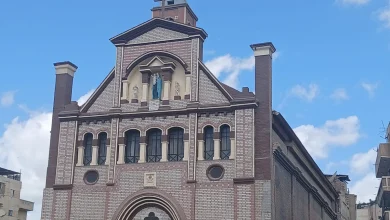
The design was entrusted to Italian engineer Eduardo Sepec, who worked in the basilica style derived from Roman basilicas, one of the oldest forms of church architecture in Europe.
A Church That Served Arab Communities
Father Samuel noted that the church was established to serve the Italian and Greek communities, along with Arab nationalities from Lebanon, Syria, and Jordan. At its peak, more than two hundred families lived around the church for many years, before most returned to their home countries after 1956. The church kept their names in silence, preserving the memory of their human presence at the heart of the city.
The church covers about 912 square meters and has a rectangular floor plan. It is divided into three aisles by semicircular arches resting on square stone pillars. The central aisle is the widest and tallest, ending in the main apse. There are no windows in the walls; instead, the architect addressed this by adding two lanterns for ventilation and lighting in the ceiling of the sanctuary. The sanctuary faces south, following Catholic tradition.
Four Tuscan columns with smooth cylindrical shafts and simple capitals stand at the entrance. Above them is a semicircular marble arch with multiple frames, topped by a circular window with geometric and floral metal decorations. Above that is the coat of arms of the Franciscans of the Holy Land. Visitors ascend six marble steps to a rectangular wooden door with vertical panels.
Six Altars and Fourteen Wooden Icons
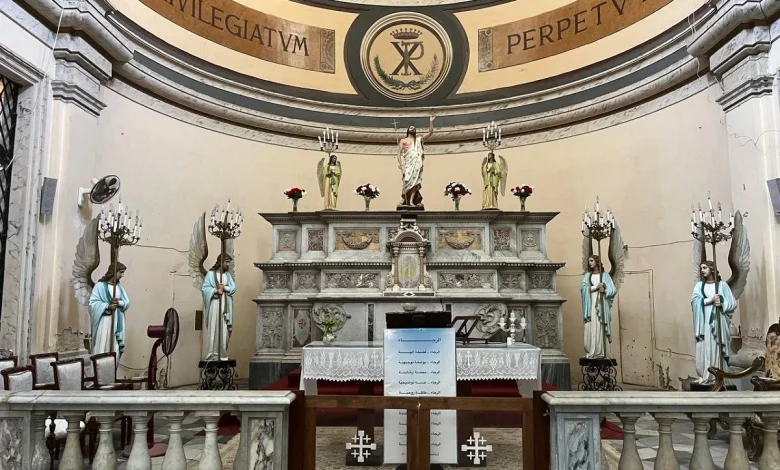
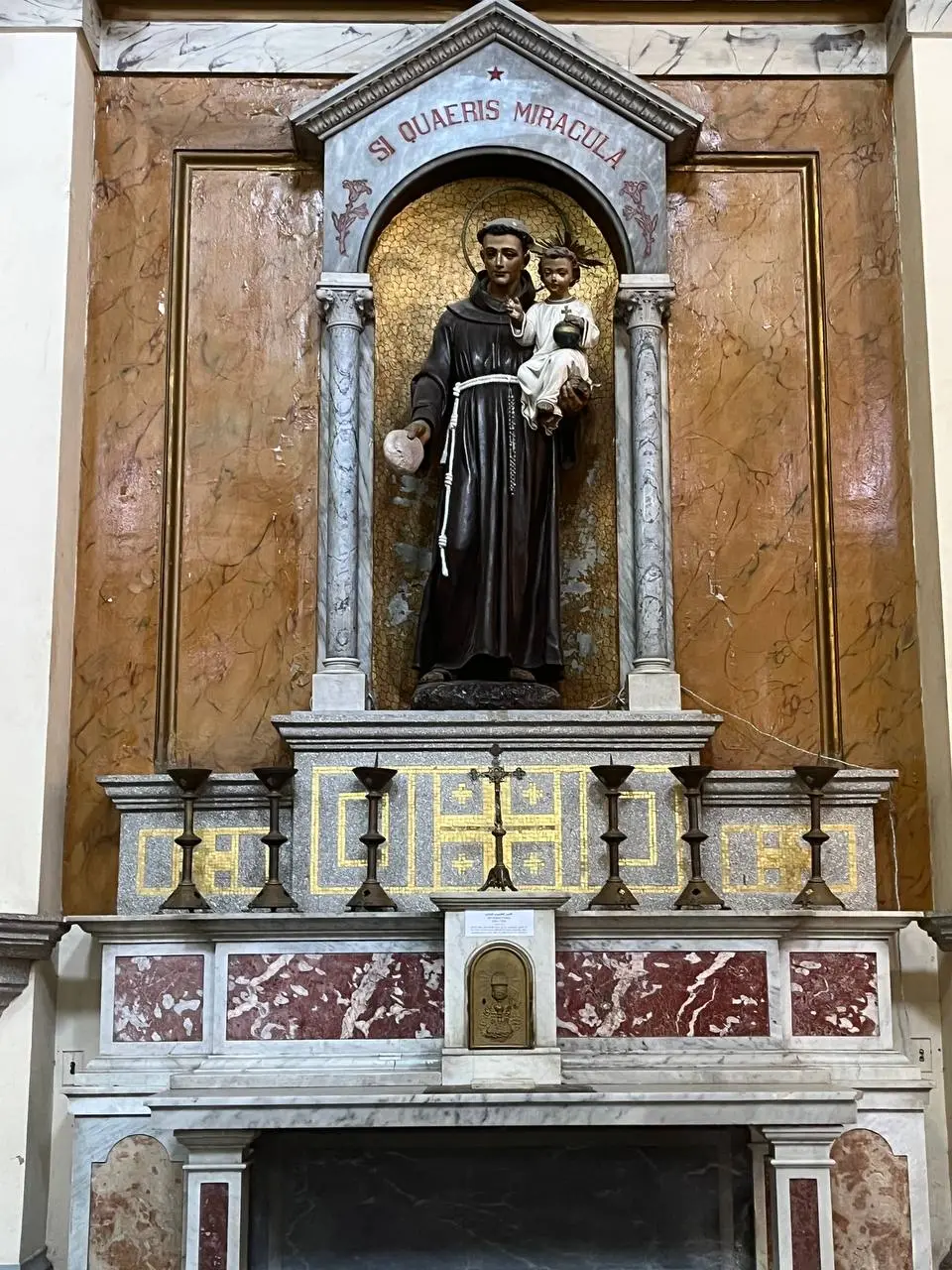
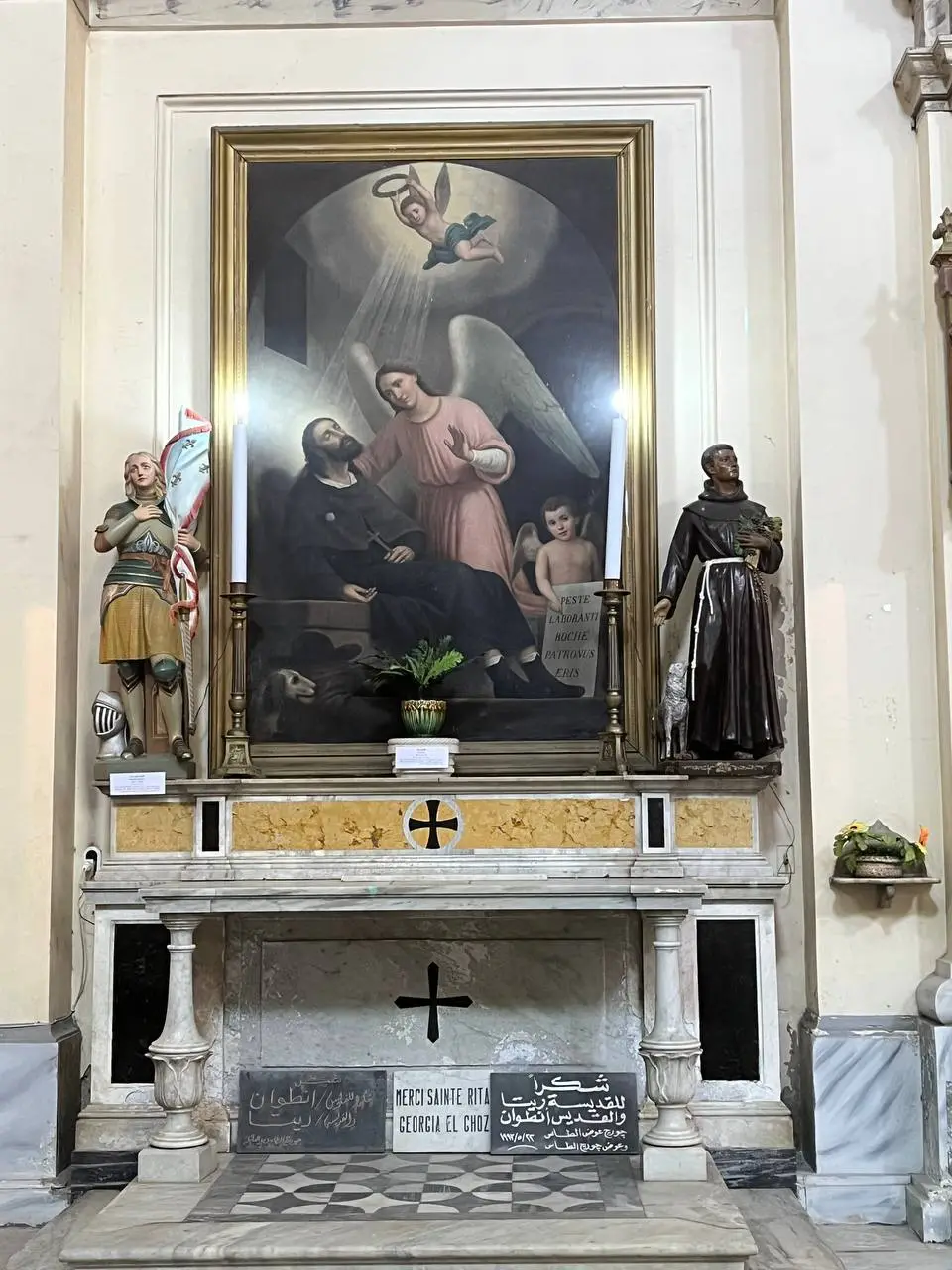
Father Samuel explained that the altars are distributed throughout the church. In the western aisle are the altars of Mary Magdalene, Our Lady of the Rosary, and Saint Lucia. In the eastern aisle are the altars of the Sacred Heart, Saint Anthony of Padua, and Saint Roch.
On the pillars and walls are fourteen prominent wooden icons depicting the stages of Christ’s trial. Above the entrance is the choir loft, which houses the oldest organ in any church in Egypt and the Mediterranean basin. There are also original paintings and rare statues dating to the nineteenth century.
The church tower rises from a square base eleven meters high, topped by a floor with a rectangular balcony. Above that is a conical peak ending in a Latin cross. The church is built of stone and brick, with marble floors and concrete ceilings supported by metal beams. The tower is accessible through the western courtyard.
In 2015, an official decision was issued to register the church as part of Egypt’s Islamic and Coptic antiquities, in accordance with Antiquities Protection Law No. 117 of 1983 and its amendments. The decision was published in the official gazette, making the church a national monument and a historic landmark visited by residents and tourists alike.
The Story of Saint Eugenie
Father Samuel spoke about Saint Eugenie, the church’s namesake. She was a Roman virgin born in Alexandria in 245 AD, the daughter of Philip, the Roman governor of Egypt. She received a philosophical and literary education, secretly loved Christ, and disguised herself to seek a life of consecration.
Church sources record that she was falsely accused and stood before her father, the judge, who sentenced her to death. She revealed her true identity to him, and he converted to Christianity. She was then persecuted and martyred by beheading for refusing to worship idols. Her name means “noble birth,” and her feast day is celebrated on December 25.
Father Samuel also noted that the Franciscan order oversees the church. The order was founded by Saint Francis of Assisi, who came to Egypt in 1219 and met Sultan Al-Kamil in Damietta in the first human dialogue between Islam and Christianity. The Franciscans’ relationship with Egypt was strengthened from the seventeenth century onward, and they have contributed to pastoral, educational, and interfaith work.
A House of Tolerance and Beauty, Part of the City’s Soul
During the visit, the students engaged closely with Father Samuel’s explanations. Karim Osama said the church clearly reflects the cultural diversity for which Port Said is known. He noted that the place offers a practical image of tolerance between Muslims and Christians. The church was never isolated from its surroundings, but rather part of the city’s fabric.
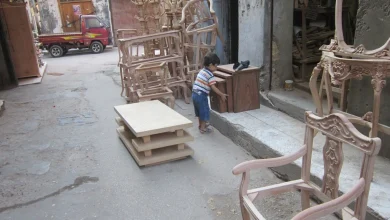
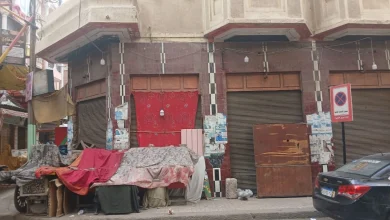
One striking piece of information, he added, was that the church was for a long time a place where clothing sent from foreign countries was distributed to the poor without discrimination. It was an act of humanitarian aid. From this practice came the idea of secondhand clothing, which merchants later adopted. It left the church and over time became the “bala” (used clothing market) for which Port Said became famous, a thriving trade since the 1970s, especially with imports from countries like Belgium and Italy.
The Spirit of Mediterranean Culture and Its Aesthetic Qualities
Student Ahmed Medhat observed that the church’s architecture bears a clear mark of Mediterranean culture. The basilica style, the columns, and the decorative details reflect the meeting of multiple architectural schools. The church seems like an extension of the Mediterranean cities that share a common architectural and human spirit.
Student Mohamed Hussein said that through the church’s history, Port Said appeared to him as a crucible that brought together every nationality of the Mediterranean. Italians, Greeks, and Arabs lived together in one environment. The children of the sea, he noted, all belong to the same sea and share a love for change and openness to others.
Noha Mohamed added that coexistence was not only between Muslims and Christians but also among different Christian denominations. This diversity, she said, gave the city a cultural and human richness still present in its memory.
Salma Ali, a history student, said that the church represents a living model of Mediterranean culture in Port Said. Architecture intertwined with social life and human history, creating a city that celebrates change and embraces difference. This diversity, she noted, is one of the secrets of Port Said’s uniqueness.