In the Footsteps of the Holy Family: A Journey Through the Ancient Churches of Minya
Discover the sacred echoes of the Holy Family’s journey through Minya. From the rock-hewn wonders of Gebel al-Tayr to the ancient desert basilicas of Deir Abu Hannes, explore the architectural grandeur and spiritual endurance of Egypt’s Coptic heritage.
By Asma Montaser
The Minya Governorate stands as a premier sanctuary for Egypt’s ecclesiastical heritage, sheltering a vast collection of ancient churches that command profound religious and historical reverence. This is particularly true of the sites anchored along the Path of the Holy Family, which serve as a primary destination for religious tourism. Currently, these hallowed grounds are undergoing continuous structural and aesthetic revitalizations, a concerted effort to preserve their archaeological soul while preparing them to welcome visitors from across the globe.
The Church of the Virgin at Jabal Al-Tayer
Along the enchanting banks of the Nile in Minya lies the Church of the Virgin at Jabal Al Tayer (Bird mountain), a captivating destination steeped in the fragrance of history and the grandeur of its evocative design. Its prestige derives not only from its sacred weight but also from an architectural vista that reflects the artistry and civilization of a sanctified era. It remains a steadfast witness to human history, enduring for millennia.
Magdy Abdullah Zein, Director of the Menia Antiquities District, observes that the Church of the Virgin at Jabal al-Tayer inspires deep devotion among the local populace. This reverence peaks during the annual Season of the Virgin (Mawlid al-Adhra) in late May, when the region transforms to welcome upwards of two million pilgrims. The monastery itself sits on the western edge of Gebel al-Tayr village, perched atop the mountain east of the Nile.
Empress Helena, mother of Emperor Constantine, commissioned the ancient church within the monastery in 328 AD. Carved directly into the living rock, the sanctuary was dedicated to the Virgin Mary. The structure is a marvel of subtraction: a single rock mass hollowed out to form four stone walls, with a nave supported by ten monolithic pillars. In 1938, the church’s second and third tiers underwent significant renovation and expansion.
The Monastery of the Virgin Mary at Jabal Al-Tayr – Samalut
Director Magdy Abdullah Zein adds that the ancient Church of the Virgin at Deir Gebel al-Tayr in Samalut, within the North Minya Antiquities region, was officially registered under Decree No. 10357 of 1951, as published in the Egyptian Gazette in November of that year. The sanctuary’s boundaries are precisely defined: 8 meters to the north, 11 meters to the south, and 20 meters each to the east and west.
Tradition holds that the Holy Family traveled from al-Bahnasa to the city of Cynopolis near Samalut, eventually crossing the Nile to the eastern bank where the monastery stands today. Situated at the zenith of the cliff adjacent to the Nile, it is considered the most significant stop on the Holy Family’s trail following the Al-Muharraq Monastery. The name Gebel al-Tayr (Mountain of the Birds) pays homage to the migratory flocks that frequented the site, specifically the white Bughayus (cattle egret). During the tenure of Bishop Sawiris, Metropolitan of Menia and Ashmunein, parts of the church were restored and a second floor was added in 1938.
Architectural Description
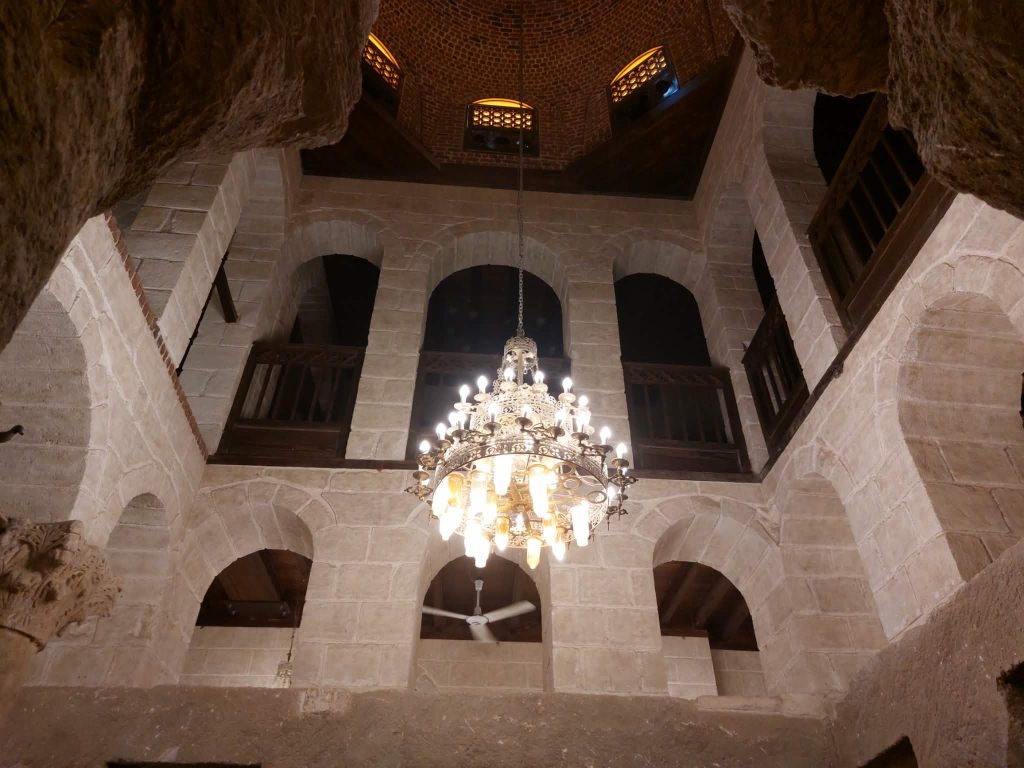
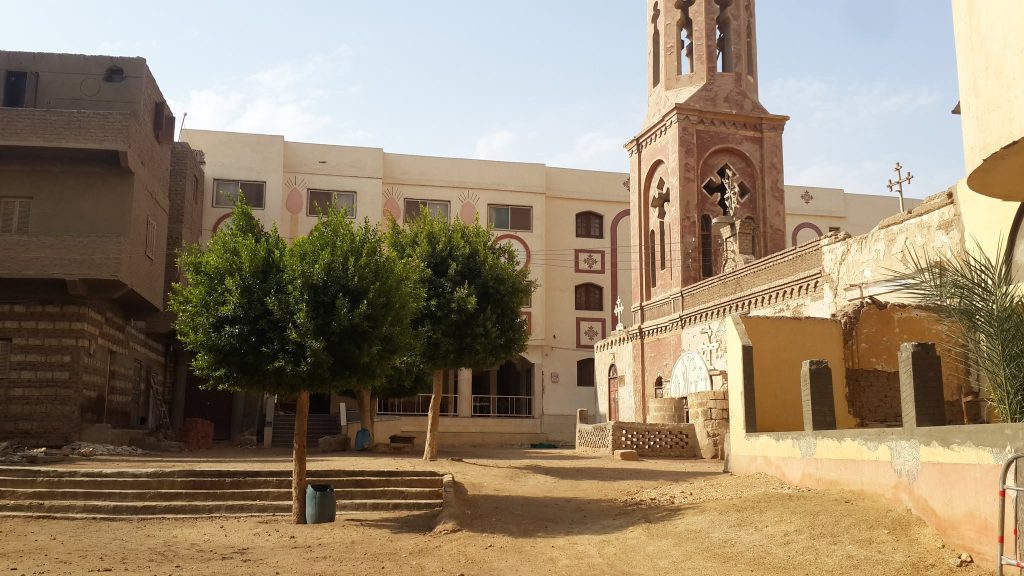
The Director of Minya Antiquities describes the church as a triumph of rock-cut engineering, noting that it likely originated as a Pharaonic or Roman tomb before its conversion into a Christian sanctuary. Covering an area of 20×25 square meters, the western entrance leads into a rectangular space where the bell tower rises in the northern section. The tower comprises three distinct parts: the base, a square shaft topped by four semi-circular arches, and a dome area resting upon eight columns.
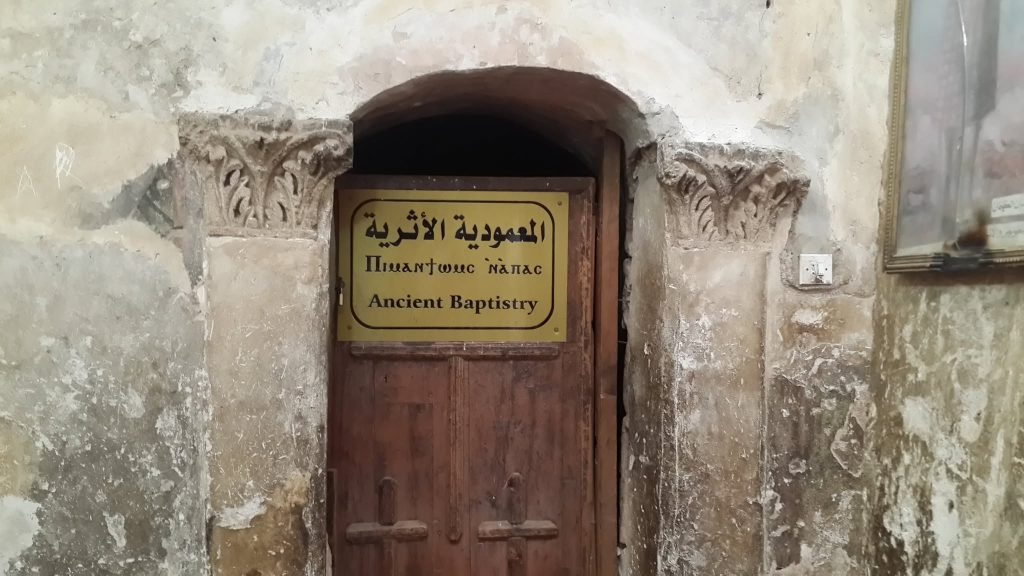
To the right of the entrance lies the ancient baptistery, hewn directly into one of the massive stone pillars within the nave. At the center of the nave sits the Laqan (epiphany basin), a circular feature level with the floor and adorned with intricate carvings.
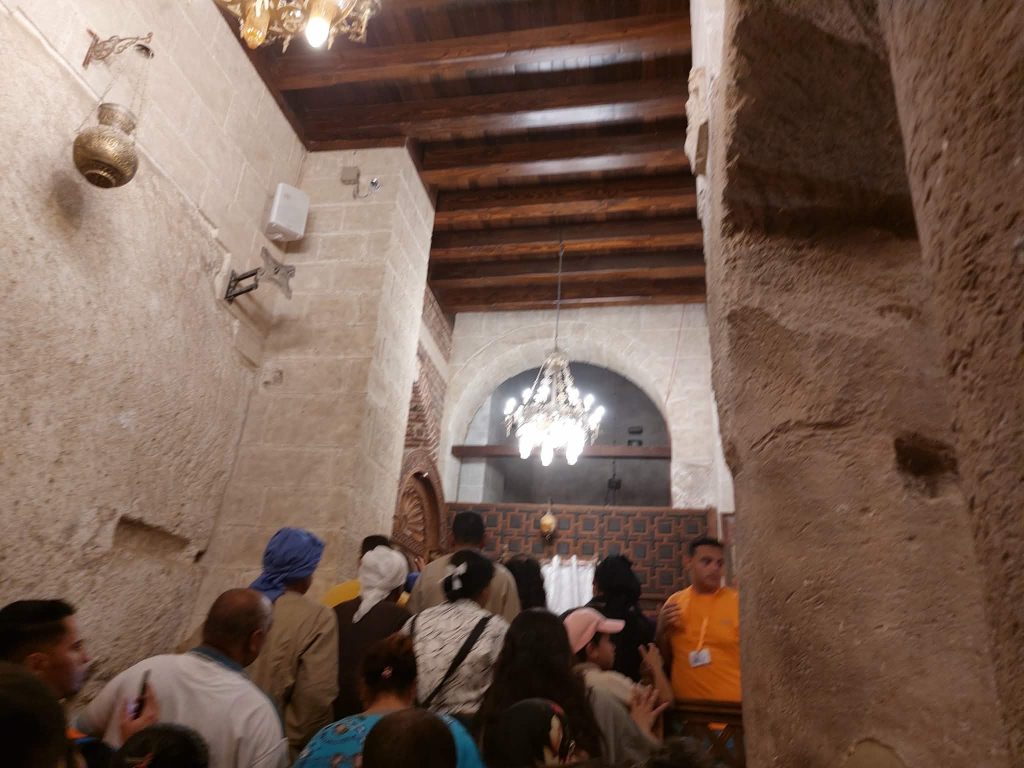
The nave features 12 rock-cut columns surrounded by northern, southern, and western aisles, creating a courtyard formation with square-shouldered piers. These columns consist of three primary elements base, shaft, and capital and are interconnected, save for the two front columns at the rear of the nave. The columns preceding the deacons’ choir are circular, crowned with distinctive capitals.
The Nave and Sanctuary
The dome at the center of the nave was constructed in 1938, coinciding with the addition of the church’s second floor. The deacons’ choir precedes the nave, elevated by approximately three feet. This leads to the iconostasis (icon carrier) crafted from turned wood (khart), which dates back to 1938. However, the original stone screen remains a carved rock face bearing Roman inscriptions, floral and faunal motifs, and the Ankh (Key of Life) symbol.
The iconostasis stands before the Heikal (sanctuary), which houses the altar. At the rear is the eastern apse, known as the “Father’s Bosom” (Hodn al-Ab), a sacred hollow in the eastern wall. In the southern portion of the sanctuary lies the cave where the Holy Family is said to have sheltered for three days. The church also safeguards three ancient icons: the Virgin Mary, Saint George, and Saint Damiana.
Restoration and Development
Regarding the preservation of the Monastery of the Virgin, Magdy Abdullah Zein explained that the foundations have undergone both structural and architectural reinforcement. The southern narthex was restored, and a mosaic depicting the Holy Family’s journey was installed. Concrete ceilings were removed and replaced with traditional wooden beams (baratim) in the southern and western narthexes and the corridors.
The project also encompassed the restoration of the southern corridor’s second floor and the installation of wooden ceilings. The cave area was restored and repaved, and the bell tower received structural and architectural maintenance. Zein added that the brick vaulting on the second floor was dismantled and rebuilt, along with the sanctuary domes and the main nave dome. A steel fence now protects the church from visitor interference, while new wooden shrines house the ancient icons and museum vitrines display 16 stone artefacts.
To ensure contemporary comfort without compromising antiquity, a central air conditioning system was installed. Stone flooring interspersed with glass panels now reveals the Laqan and the ancient wells beneath. Heritage-style wooden umbrellas were erected at the entrance, and the roof was tiled and insulated with stone gutters to manage winter rainfall.
The Ancient Church of Deir Abu Hannes
An architectural masterpiece that has stood resilient for centuries, the ancient church of Deir Abu Hannes in Mallawi is known locally as the Church of John the Short (Yuhannis al-Qasir). It is named after Saint John, the Hegumen born in 349 AD, who founded the church in 386 AD. The current structure dates to the first quarter of the 5th century.
Dr. Mohamed Ghazali, Director of Southern Minya Antiquities, states that the church was registered as an Islamic and Coptic monument by Ministerial Decree No. 10351 of 1951. The plan follows the classic Coptic style, featuring a central nave flanked by northern and southern aisles that open through massive pillars punctuated by small square apertures for ventilation and light.
The church houses three significant icons in Coptic art history: “The Crucifixion and Life of Christ” (15th-16th century), Saint John the Short (16th century), and Saint John the Short with Saint Macarius (16th century).
The Hall of Mummies
South of the ancient church lies the Hall of Mummies, a rectangular chamber containing three Coptic mummies recovered during excavations by the Supreme Council of Antiquities in the ancient city of Antinoöpolis. The first, belonging to a small child, was discovered in 1993-1994, while the remaining two were unearthed in 2007. The hall is meticulously equipped with glass and wood vitrines to ensure their preservation through periodic examination.
Dr Ghazali emphasized that the ancient church of Deir Abu Hannes has been the subject of several decrees by the Permanent Committee for Islamic and Coptic Antiquities regarding risk mitigation and restoration. Critical works have already been completed, including surface cleaning, the strengthening of domes and semi-domes, and the maintenance of rainwater drainage systems.
Coordination is currently underway with the Bishopric of Mallawi to finalise the procedures for a comprehensive restoration of the ancient church. This work will be conducted under the supervision of the Antiquities District and the Projects Sector of the Supreme Council of Antiquities, funded by the Bishopric of Mallawi in accordance with Article 30 of the Antiquities Protection Law.