Breaking the Cult of Personality: A New Way to Understand Arab Musical Heritage
Breaking free from the “saviour myth” in Arab music. A critique of imitation, canned improvisation, and why true authenticity is innovation, not replication.
By Ayah Samalosy
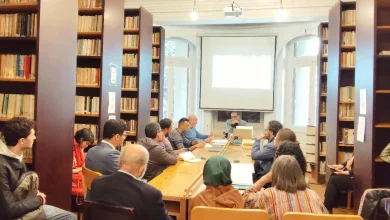
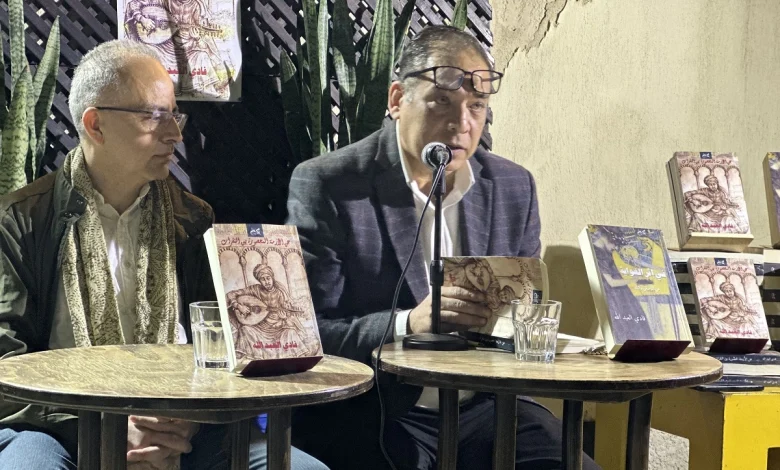
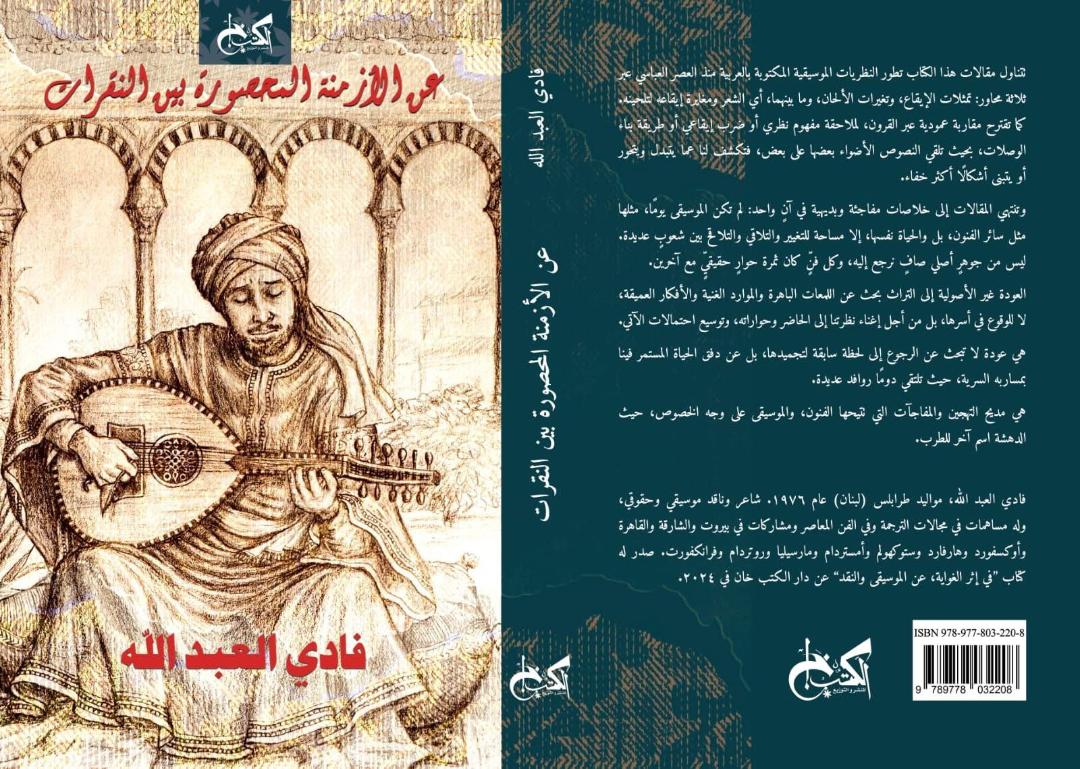
If music is a history of continuous transformation, how do we free ourselves from the “prison of imagined authenticity” to reclaim our ability to innovate without falling into the trap of distortion or mere replication? That might just be the central question a recent seminar sought to answer while discussing the book On Times Confined Between Beats. The book is by Lebanese researcher and musician Fadi Abdallah, published by Dar El Kotob Khan, which hosted the seminar at its premises in Cairo’s Maadi district, moderated by researcher and critic Haytham Abouzeid.
Authenticity Between Innovation and Replication
Haytham Abouzeid began his intervention by highlighting the core crisis that the book addresses, noting that the constant attempt to make contemporary composition a carbon copy of the old is an effort that lacks a deep understanding of evolutionary mechanisms. He explained that Fadi Abdallah provides living examples of how to benefit from ancient maqamat (musical modes) and systems without falling into the trap of replication, citing a previous lecture by the author on “the meaning of rhythm” (al-darb), and how old singing is rich with sophisticated techniques such as ornamentation (zakharef), “arab” (vocal microtonal inflections), and “burning” cadences (qafalat harra’ah).
Abouzeid gave the example that the greatness of Umm Kulthum was manifested in her exceptional ability to employ these techniques even in her later compositions with Mohamed Abdel Wahab and Baligh Hamdi, as she never once abandoned the “arab” or the qualitative stress on consonants and the cadences that distinguished her vocal school.
The Crisis of the Current Musical Reality
Abouzeid moved on to sharply critique the current musical reality, describing what happens today at “Kulthumiyat” and “Wahabiyat” concerts as “artistic hell” that tears apart historical and modal coherence. He explained that you find a program starting with a solemn poem by Sheikh Abul Ela Mohamed, immediately followed by the song “Zalamna El Hob” in a state of chaotic “baz’aka” (slang for aimless, noisy playing) that lacks the conscious coordination that defined the old “wasla” (suite) system.
He clarified that what’s needed is not embalming the past or replicating muwashshahat note for note, but rather finding a temporal or rhythmic link that ties the selections together, instead of perpetuating a state of “half-talent” that the audience applauds out of necessity due to the lack of alternatives. In a related context, Abouzeid attacked the issue of “canned improvisation” among some young musicians trying to return to heritage by replicating the taqsim and improvisations of the greats and memorizing them as if they were mute sheet music. He gave a sarcastic example: a reciter imitating Sheikh Mustafa Ismail literally, arrogantly asking his listeners, “Which performance would you like me to mimic?” forgetting that the Sheikh’s genius lay in his spontaneity, which is never repeated.
Art as a Commodity
Abouzeid sarcastically noted that this artificiality turns art into a soulless, counterfeit “Chinese” commodity. Just like the singer who replicates Umm Kulthum’s specific “sighs” from a particular recording, repeating an improvisation eleven times simply because “El Set” did it that one night. Thus, the original spontaneity, in the hands of these imitators, turns into a cold, mechanical ritual devoid of the essence of creativity.
Art and Visual Design
Speaking about the book, Abouzeid said it is not among the easy books you read once. Rather, it demands intellectual humility from the reader in the face of the precise historical tracing of tones and modal intervals, which the author proved were not fixed across the ages. He asked indignantly about the secret behind limiting the concept of “authenticity” to only going back a hundred years. He affirmed that if the measure were simply age, it would be more fitting to go back three hundred years. This, he argued, warrants caution when making judgments about “development and renewal,” a tendency some arts journalists fall into too easily, content with covering celebrity news, personal lives, and marriages, while critical analysis of the artist’s craft and musical performance remains absent.
Deconstructing the “Saviour” Myth
For his part, author Fadi Abdallah responded to this line of discussion by clarifying the contemporary aims of his book. He affirmed that the epistemological goal is to examine the “myths” that weigh down the mind and prevent it from innovating freely. He pointed out that shedding the “surplus of myths” opens up space for hybridization and cross-pollination with other cultures, citing Avicenna’s saying that tarab is “the strongest cause of pleasure the feeling of sudden congruity” that surprise occurring in a fitting context that produces wonder.
Abdallah stressed that the arts are a space for encountering the “other,” not merely repeating oneself. He explained that the musical repertoire changes and disappears at a rate of up to 90% every fifty years, proving that the speed of change is art’s primary engine.
He deconstructed the “savior” myth that claims Egyptian music was miserable until Abdo El Hamouli or Sayed Darwish appeared. He affirmed that music was always in a state of evolution with its own aesthetics, and that what happened was a natural “change,” not a “rescue.” He explained that El Hamouli was influenced by Ottoman influence, while Sayed Darwish was influenced by Italian opera, and both were open to the other—debunking the idea of a “pure,” unmixed identity.
Authenticity to the Self
Abdallah affirmed that true “authenticity” is not returning to an imagined past time, but rather “authenticity to the self the artist’s ability to express their own era and life circumstances sincerely. He noted that everything we consider an “origin” is actually the product of previous cross-pollination, such as Hejazi singing, which was influenced by Persians and Byzantines, and the musical theories based on the Greek scale.
On a practical level, Abdallah reviewed what the book offers musicians and researchers, particularly in understanding the “deep structure” of rhythm. He explained that through his study and development of the “pentameter” (mukhammasat) table, he found that the basic structure of rhythm within the Arab and Persian framework has been fixed since the era of Ishaq Al-Mawsili, and that only the surface ornamentation changes.
He argued that teaching rhythm through this deep structure makes it easier for the student and composer to understand the relationship between melody and rhythm, thereby raising the level of musical enjoyment for the listener, who then perceives how a composer like Zakariya Ahmed manipulates rhythmic stresses as “anchors” to which the melody returns.
Breaking Free from Common Moulds
Abdallah also pointed to the need to break free from the captivity of common moulds like the taqtouqa (light, strophic song form) and return to exploring the aesthetics of forgotten forms like al-dour, al-muwashshah, and the vocal bashraf, not for the sake of imitation, but to draw inspiration from the profound ideas latent within them.
Haytham Abouzeid concluded by stressing that meticulous examination of Arabic writings over more than eleven centuries, as Fadi Abdallah has done, is the only way to critique the entrenched musical discourse that has become unaccountable. He clarified that the authenticity the book seeks is one where the artist is the “original,” not the imitator, and that true tarab is that wonder born from the “fitting surprise” that breaks the monotony of the familiar and gives music a continuous surge of life, far from the embalming and freezing attempts practiced by some artistic and educational institutions in the name of preserving heritage.