Where Taha Hussein and Anwar Sadat Once Sat: The Legendary Egyptian Café That Fell Silent
For decades, the Masiri Café in Damanhour was Egypt’s most important literary salon outside Cairo. Tawfiq al-Hakim wrote there. Anwar Sadat visited. Now it is closed, and a generation mourns what was lost.
By Mahmoud Dueir
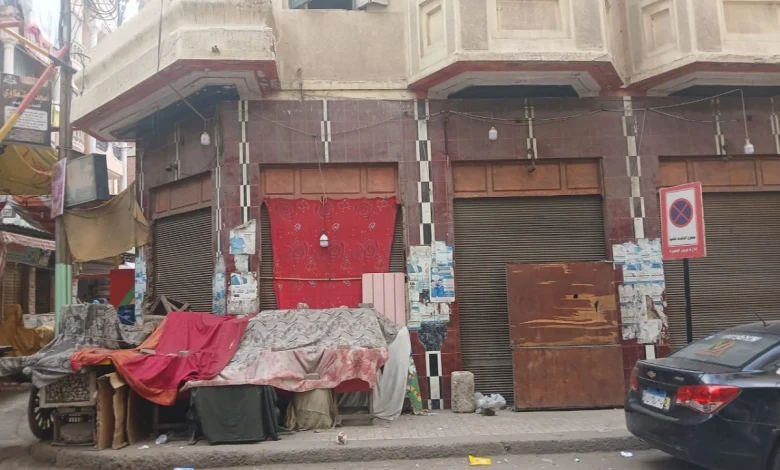
The Masiri Café in Damanhour was once one of Egypt’s most significant cultural gathering places. It was not merely a spot to drink tea or coffee. It was a space where writers, thinkers, and artists from across the political and artistic spectrum came together. Its sessions became informal seminars that enriched cultural life for decades. The café’s name became inseparable from a rich history of literary activity. It was a destination for some of Egypt’s greatest intellectuals. Then it was closed by its new owners.
The Writer-Café Owner and a Gathering Place for Egypt’s Thinkers
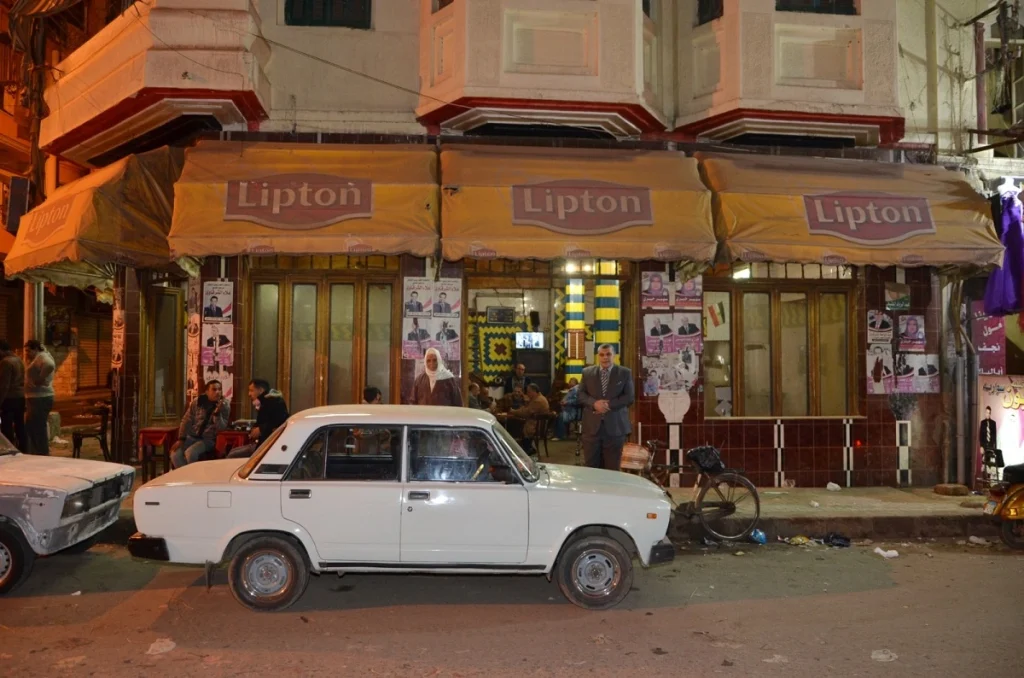
Researcher Khaled Maaroof explains that the famous Ramses Café, known as the Masiri Café, was located on Princess Fawzia Street, now known as July 23 Street. It was owned by the Masiri brothers and was one of the city’s most important landmarks, a meeting point for Egypt’s intellectuals.
The café’s fame was tied to the name of writer Abdel Muti al-Masiri, known as the “writer-café owner.” The café was opened by Mohamed al-Masiri in the 1920s. But it was Abdel Muti al-Masiri, the café’s true founder, who transformed it from a place for drinking tea and coffee and conducting business deals into a source of cultural, intellectual, and literary radiance. Its reputation rivalled that of Cairo’s grandest cafés, and it became a gathering place for giants of literature, journalism, politics, and art.
It was a meeting place for pioneers of thought, literature, and culture in Damanhour and Beheira Governorate, and it played an important role in the national movement against British occupation. It also served as a collection point for donations to support the Egyptian army during the first Palestine war in 1948.
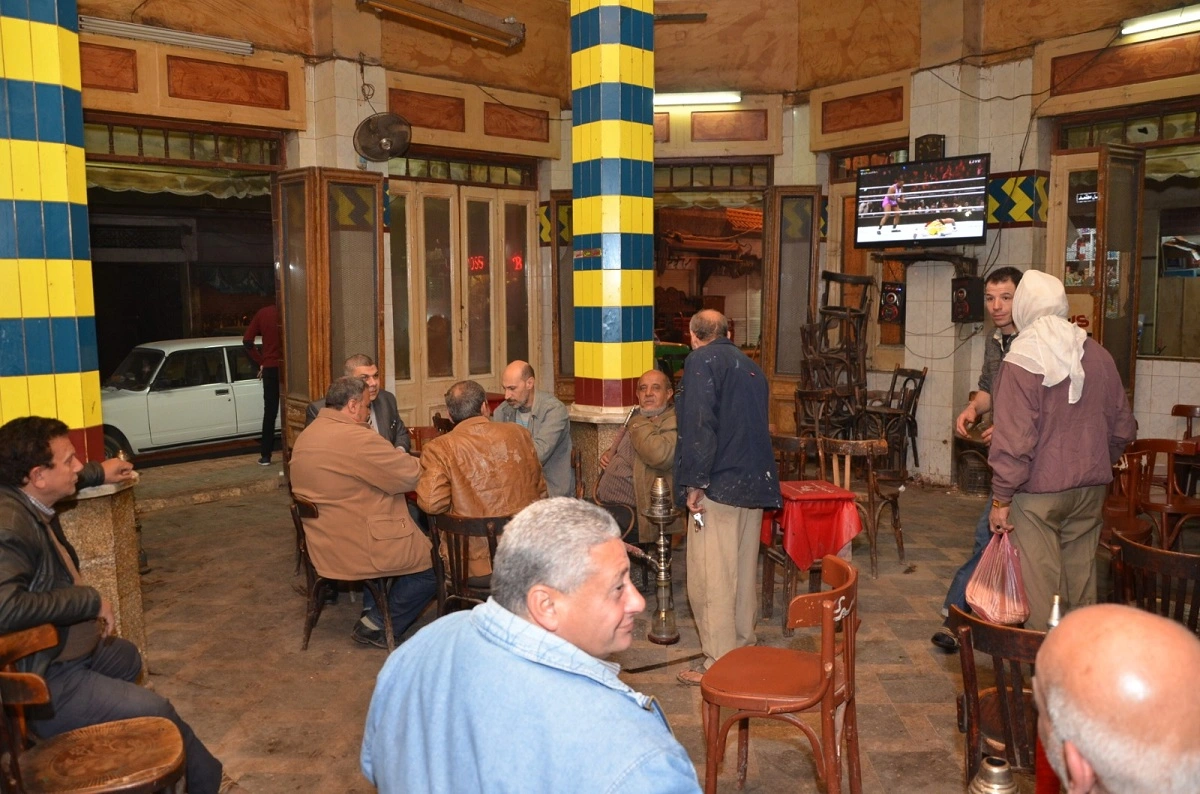
Anwar Sadat and Tawfiq al-Hakim at the Masiri Café
The café was one of the most important sources of cultural and literary radiance in Damanhour from the 1930s through the 1960s. Literary and cultural seminars and meetings were held there. It also witnessed the founding of the Damanhour Writers’ Association in 1957, with Anwar Sadat attending as a representative of President Gamal Abdel Nasser. This came after Abdel Muti al-Masiri sent a letter to the president demanding attention be paid to spreading culture in the provinces and that the capital not be the sole focus of the state’s efforts.
Khaled Maaroof adds that the Masiri Café was visited by a number of literary giants, journalists, and pioneering storytellers. They sat within its walls and drew inspiration from its characters and patrons for their ideas and writings. Among the most notable visitors were Yahya Haqqi, Tawfiq al-Hakim, Zaki Mubarak, Anwar Sadat, Mahmoud Amin al-Alim, Amin Youssef Ghurab, Khairy Shalaby, Ragab al-Banna, Yassin al-Fil, and Youssef al-Qaeed.
Researcher Kamel Rahouma says he became interested in the Masiri Café after learning about it through the writings of Dr. Abdel Wahab al-Masiri. He affirms that its impact on Arab culture is profound and significant, noting that its most distinctive feature was its owner and founder, the “writer-café owner” Abdel Muti al-Masiri, a self-taught man who became one of the most important writers of his generation.
The Birth of “The Diary of a Country Prosecutor”
Regarding the café’s transformation from a simple coffeehouse into one of the most famous cultural cafés, Rahouma explained that this was due to al-Masiri’s acquaintance with Tawfiq al-Hakim, who was then working as a deputy prosecutor. Al-Hakim would sit in the café writing his novel “The Diary of a Country Prosecutor.” Through the relationship that developed between al-Masiri and al-Hakim, a significant shift occurred in Abdel Muti al-Masiri’s consciousness and in the character of the café itself.
Rahouma adds that the Masiri Café was a comprehensive school in literature, culture, and politics. Among its most prominent patrons were Omar Batisha, Ismail al-Habrouk, Ali Shallash, and Amin Youssef Ghurab. Its influence extended through generations, reaching Sayed Imam, Salah al-Laqani, and Reda Imam. He noted that the café closed in recent years and expressed his regret, considering the closure a result of attitudes that do not value beauty and culture, and the dominance of unthinking capital, which was directly responsible for ending the café’s role under the pretext of modernization.
Author Mohamed al-Laboudi notes that the Masiri Café’s impact on cultural life was tied to the historical context of that era, when formal cultural spaces were scarce. Literary gatherings were often held in the homes of prominent writers and intellectuals. He added that the café served as an available alternative and continued to play an important role until Waguih Abaza, the first governor of Beheira after the July 1952 revolution, helped establish the Writers’ Association, creating the first private institution with official support to bring writers together in the governorate.
Its Role in the Wars of 1956 and 1967
Al-Laboudi notes that the Masiri Café’s role extended beyond the literary to social, cultural, and political dimensions. This became evident during the events of 1956 and 1967. He points out that cultural cafés had a significant influence during that period, before there were cultural institutions that brought writers together. He explained that the nature of cafés later changed, becoming more crowded and noisy, no longer suited to playing a literary and cultural role.
Mohamed Mustafa al-Basyouni, director of the Beheira Culture Branch, says the Masiri Café represents a rich history in the city of Damanhour. It brought together symbols of culture and literature in Egypt for decades. He added that in a later period, it transformed from a cultural café into an ordinary café frequented by merchants and craftsmen. He noted that at the beginning of 2003, the Beheira Culture Branch established a cultural library within the café containing about 5,000 books, which continued for three years. It hosted one cultural event featuring Dr. Osman Asal, the former governor of Beheira, and journalist Ragab al-Banna, moderated by the late writer and translator Sayed Imam. But it did not last due to the significant change in the café’s clientele.
Naguib Mahfouz, Louis Awad, and Mohamed Mandour
Regarding the café’s role and its impact on cultural life, journalist Ragab al-Banna says the Masiri Café was not a traditional café in the usual sense. He notes that its founder, Abdel Muti al-Masiri, has not yet received the recognition he deserves. Although he had little formal education, he was a prominent writer who published articles opposing Taha Hussein and al-Aqqad.
Al-Banna added that he first encountered Naguib Mahfouz, Yahya Haqqi, Louis Awad, and Dr. Mohamed Mandour at the Masiri Café. These major figures frequented the café because they felt Damanhour was home to a distinctive cultural experience and a new generation of writers and thinkers. He confirmed that he was one of its patrons, noting that the cultural ferment the café created within Damanhour has not been replicated since.
Abdo al-Boulaqi, a resident of July 23 Street, recalls the era of Haj Saeed al-Masiri, son of the late Abdel Muti. He explains that the café brought together the city’s leading figures and elite, alongside a number of writers and intellectuals. Former governor Waguih Abaza was a frequent visitor.
Jamal Asafir, another Damanhour resident, says the Masiri Café was one of the city’s landmarks. Because of its importance, the General Authority for Cultural Palaces established a library inside the café, assigning staff to provide cultural services to neighborhood residents. This continued for several years. Asafir expressed his sadness at the café’s closure after the heirs sold the building, bringing to an end stories and memories that remain alive in the hearts of those who witnessed that beautiful era.