“Between One Stop and the Next”: Artists Bear Witness to the Final Journey of Alexandria’s Tram
As Alexandria’s historic tram halts operations ahead of redevelopment, fourteen artists respond with “Between One Stop and the Next,” a photography and video exhibition exploring what the city stands to lose: not just a mode of transport, but a living archive of memory, community, and identity.
By Yehia Khalil
As Alexandria’s historic tram prepares to halt operations on 1 April ahead of a planned redevelopment, fourteen artists gathered to ask what will be lost alongside it: the songs, the images, the stories, and the unhurried rhythms of a city in motion. Their answer took the form of “Between One Stop and the Next,” a group exhibition of photography and video that recently closed at B’sarya Arts Space on Fouad Street, just minutes from Raml Tram Station.
The exhibition opened in early February, timed to coincide with the beginning of the tram’s partial suspension. That suspension is part of a broader wave of urban development decisions that have reshaped Alexandria over the past decade, each one provoking fierce debate about the city’s historical and aesthetic identity. For many Alexandrians, the tram is not simply infrastructure — it is memory, and its imminent disappearance has been met with grief and anger.
A Visual Journey into Living Detail
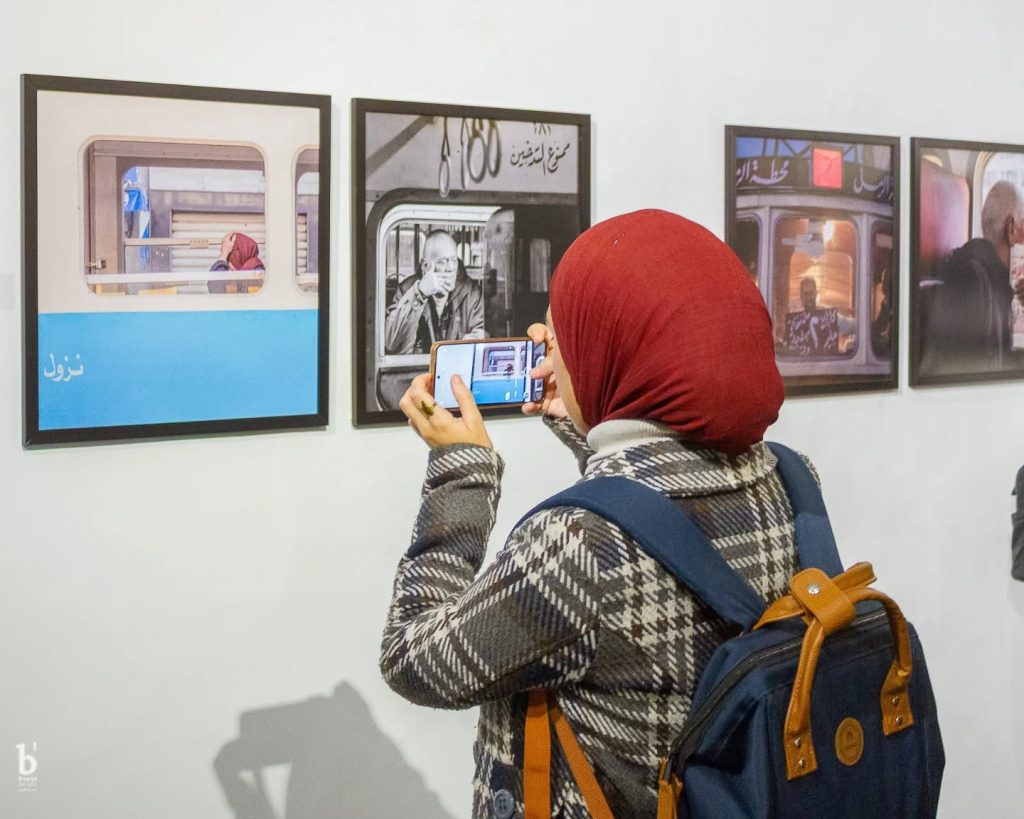
The exhibition offered a meditative visual journey into what was, calling up a world still vivid in the tram’s movement, its form, and its stops. It captured people’s lives, social exchanges, and daily experiences through moments that were never incidental: the texture of waiting and motion, the murmur of stories and silence, conversations between strangers, private moments of distraction, boredom, and the quiet dream of reaching the next stop.
The fourteen participating artists were: Amina Mohi El-Din Hassan, Ahmed El-Nagdy, Osama Ashoush, Ziad Ahmed El-Dawi, Ziad Hassan, Sara Zaki El-Sheikh, Shimaa Fadlallah Khalil, Salah El-Din Shaban, Tarek Abdel Latif Mahmoud Tammam, Omar Nassar, Mohamed Magdy, Marwan Khair El-Din, Mariam Shaban, and Melanie Salguen.
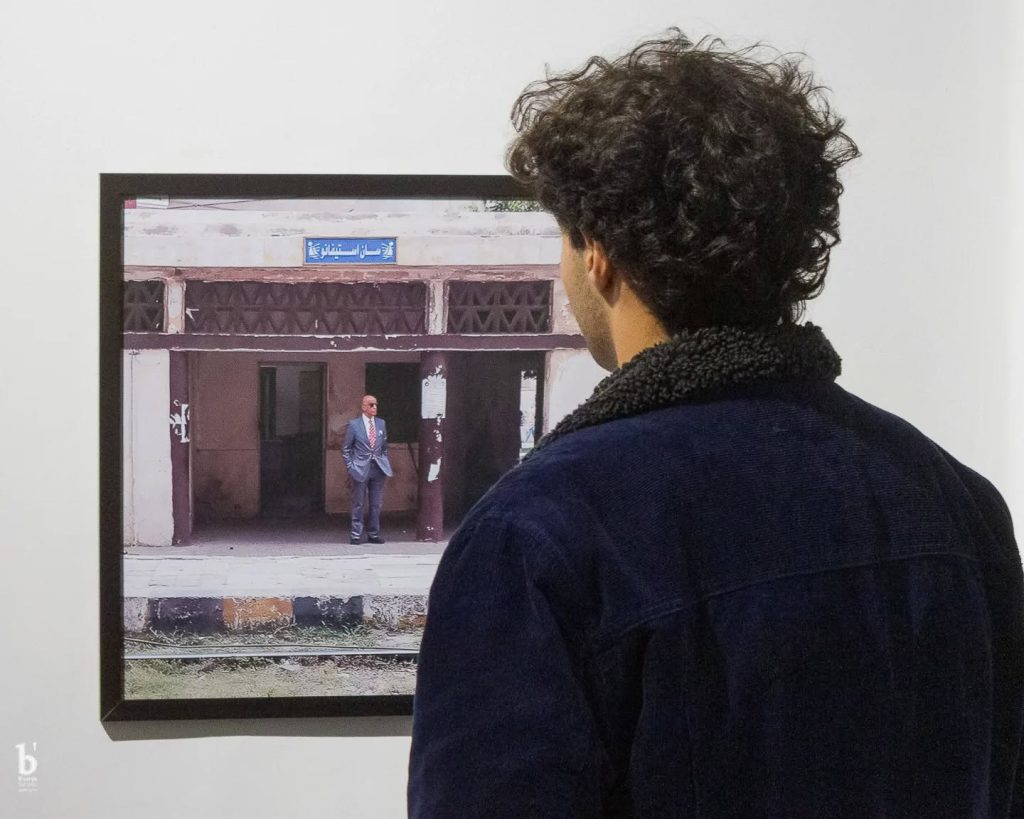
Photographs and video screens shared the gallery walls like consecutive stops along a single line, each presenting a fragment of a visual story that was both separate and connected — mosaic pieces that, together, reflected a whole. Their collective message: the treasure is in the journey.
A Ride for Those Who Want to Savour the Journey
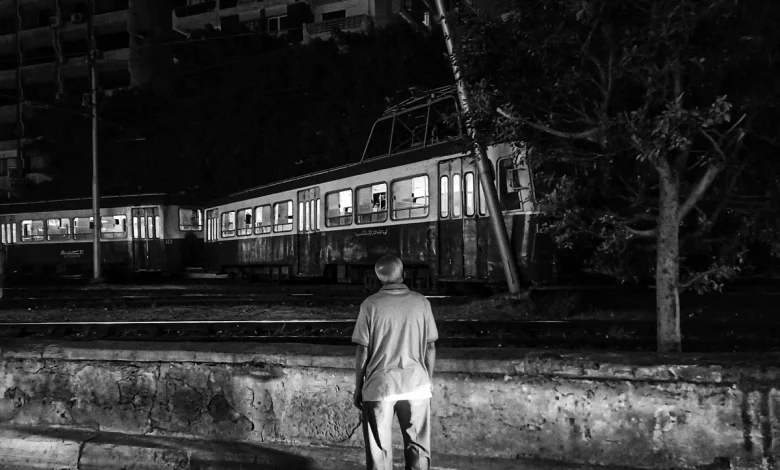
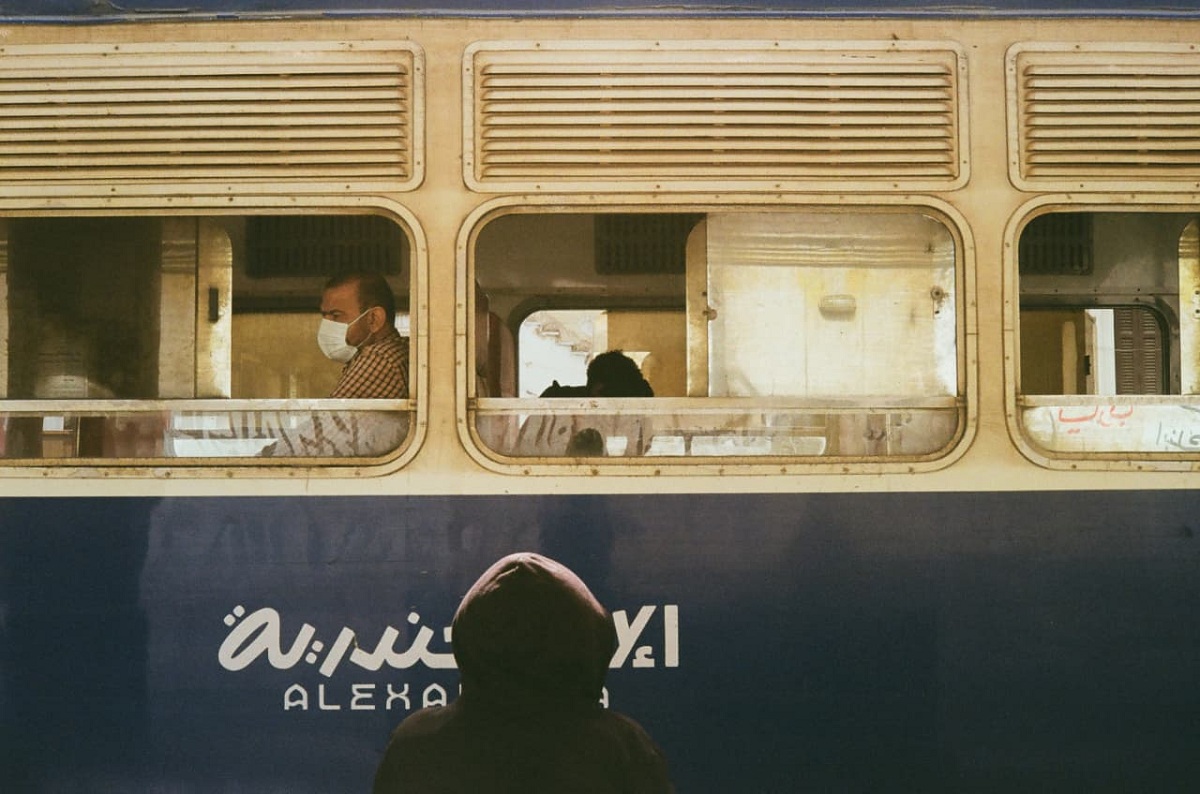
The tram was never for those in a hurry. It is slow in traffic, tedious for anyone measuring time in minutes, yet it knows its destination. It moves along its own track, arriving late sometimes, but always arriving, for those who value contemplation and understand the stories that ripen slowly. Those who know it at midnight, when the city quiets and the tram sheds its slowness, become addicted to that particular quality of watching, as though discovering the city’s secrets in a moment of flight.
Through its open windows, life becomes a long film reel, each stop a new scene. The tram passes through the city’s geography: schools and universities, hospitals, churches and mosques, cemeteries and squares as though carrying all of Alexandria’s history from one station to the next.
From outside, photographers raise their cameras and wipe the farewell from their lenses, trying to fix these moments as memories before they dissolve. In a city whose rhythm is quickening and whose urban fabric is being transformed, the tram is bidding its passengers toward a new chapter.
Tarek Abdel Latif: “I Started Taking Sad Frames Without Realising It”
Photographer Tarek Abdel Latif’s involvement in documenting the tram predates the exhibition by years. He had long been recording its carriages, its stations, and the faces of the workers and passengers who inhabit it, an act of documentation before dissolution, a record of a truth that might otherwise fall into a perforated memory.
In his photographs, the tram emerges as a small social space where the city’s stories intersect. Tarek draws close to the details that a hurried eye might pass over: passengers sitting in silence, faces fixed on the world outside the window, and class differences legible in small things, the shoes people wear, the way each passenger grips a pole or rests a hand on the window frame as they look out.
He reflects on the tram’s seating: “There’s an intimacy that brings passengers together. There’s a necessity for interaction, even if it’s just a gesture or a shift of the body to let someone pass. It creates a kind of warmth people talk, especially the elderly, who make up the largest share of passengers.” Through these small moments, fleeting relationships between strangers take shape, revealing class and cultural differences held together within a shared space. Tarek sees this daily experience as a rare opportunity to encounter other kinds of people and to sit with that diversity.
He speaks with sadness about the approaching suspension and the way it has infiltrated his visual choices: “I feel like I’ve started taking sad frames without realising it. Frames with something of a departure in them. As though everything on the tram is saying goodbye to us: the carriages, the workers, the passengers, the stations, the green on both sides of the tracks.”
What will be lost with the tram, he argues, is not just a mode of transport but a whole pattern of daily relationships: the intimacy between passengers, the bonds formed at stops and with conductors, and the urban landscape itself, including the ancient trees that line most of the tram’s routes.
He sees a faster, more individualistic collective consciousness taking shape in the city in the tram’s absence: “The new Ukrainian tram has seats in rows. each seat on its own, no connection to the person beside you. That’s the future.”
He ends with a personal note: “For me, the tram is bound up with its own biography and its awareness of the city. As a child, there was no transport as safe as the tram. Culturally, I see it as a core part of Alexandria’s image: it shaped my consciousness and introduced me to all kinds of people. Have you ever seen a promotional video or a film about Alexandria without the tram and the sea? Even the governorate’s advertisements are still running on screens along the seafront to this day, there’s no way they don’t include the tram.”
Without it, he fears, the city risks becoming a distortion of itself: “Over time, you’re turning the city into something unrecognisable. nothing left to express its identity or its memory.”
If the tram could speak, he says, it would tell a long story of deliberate neglect: “It would tell a sad story about how we let it go and did nothing to stop it. How we failed to keep it running as a vital artery in the city’s life. It would tell of its glories and every journey it made, from the days of horse-drawn carriages, to steam, to the electric tram. It would tell of every passenger it sheltered and saved, of conductors and workers who gave their lives to it, of all the students it carried with their school bags, until they grew old and rode for free because they were over seventy.”
Sara Zaki: When the Tram’s Sounds Become Astonishing Music
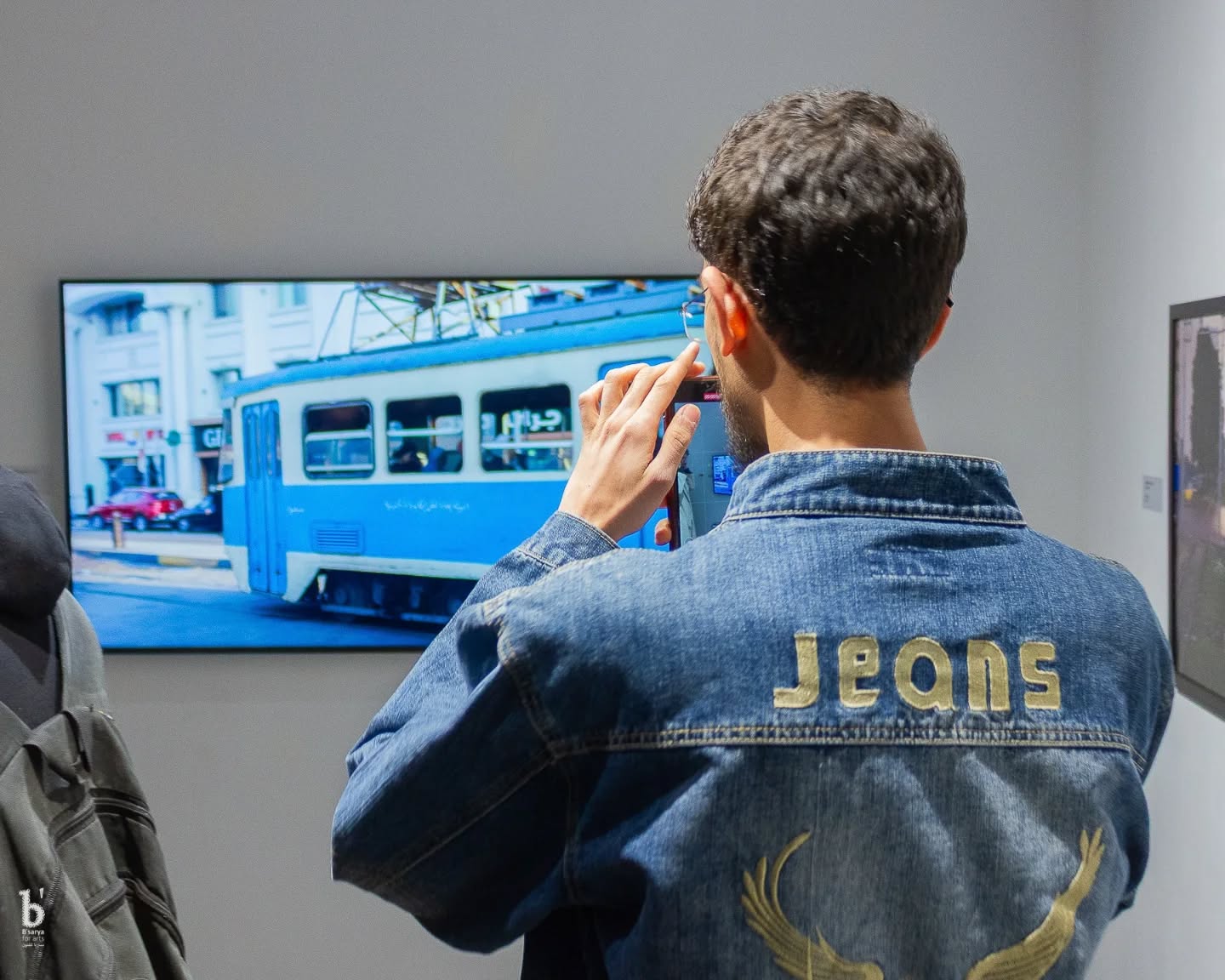
Visual artist Sara Zaki contributed a video work that sought to combine documentation with experimentation. She describes one of her key scenes: “There’s a moment where the sound of the tram moving blends with the sound of a girl scraping her foot back and forth on the carriage floor. I wanted to focus on that interaction. In another scene, children from among the street vendors are playing a balancing game on a pole. I can’t think of any other form of transport where people would be that comfortable.”
She used the tram’s own sounds to build a musical track with the help of AI, the tram’s whistle, for instance, was transformed into the sound of a harp.
Sara studied at the Faculty of Art Education and focuses her practice on video art that addresses feeling over technique. In the video she contributed to the exhibition, she reflects on her relationship with the tram as an outsider: “I’m not originally from Alexandria. I used to think of the tram as a distinctive tourist landmark. No city I’d ever lived in had one. So it held enormous value for me.”
Having lived in fourteen cities across several countries, she has been based in Alexandria for seven years. Over the last two, she has been documenting her time there in preparation for her eventual departure. She is preserving her memories, just as she is preserving the tram that will leave like her.
Sara sees the tram as a gathering space for different classes and nationalities, a witness to countless stories. She recalls one moment: “I was on the tram once, and a Sudanese family was telling wonderful stories about when they first came to Egypt. how they had lived in the Haram area, and what things they were bringing home.” She adds: “I’m drawn to simple human details.”
On her attachment to the double-decker tram, she says: “Whenever it passes in front of me, I get on it even if I have no reason to. I love sitting in it for several stops.” She also points to how other cities celebrate historic modes of transport, the mountain cable car in Lebanon, the double-decker bus in Georgia, and wonders why Egypt has not sought ways to preserve the tram rather than suspend it.
Mariam Shaban: How Will We See Alexandria Without the Tram?
“What could Alexandria’s character possibly look like without the tram?” That is the question with which photographer Mariam Shaban opens the documentary video she contributed to the exhibition.
“In the context of the constant disfigurement of Alexandria, my favourite city, not because it is where I was born, but because it is genuinely unlike any other city or governorate I have visited or will visit. The tram was the last straw.”
Mariam chose video because she believes its combination of image and sound carries a deeper emotional charge. She notes, “I noticed how affected people were by the scenes. Some viewers were in tears after watching.”
She began documenting the tram more than a year before the exhibition, filming different stations at different times and in different circumstances, then collaborating with editor Ahmed Ismail to shape a cohesive story. Her approach was non-interventionist: she encouraged workers and passengers to share their own stories and feelings about the tram, its merits and its flaws. without directing them.
In her visual choices, she focused on fine detail: words written on the doors, the textures of roads and stations, the different colours of the tickets. She collected a wide range of opinions. One description stayed with her: “Alexandria without the tram is like a bride without a wedding procession.” Another passenger jolted her with his pragmatism: “Heritage is for people with nothing to do. I want to get on and get to work, I’m not going to wait a quarter or half an hour for the sake of heritage.”
The range of views, between those who mourned the tram and those who had long tired of it, struck Mariam deeply. Whatever her interviewees felt, she held on to one wish: that the decision to suspend and redevelop the tram had been delayed by several years.