Why Did Egyptian Quran Recitation Dominate the Islamic World? A New Book Explains.
In 1934, Egyptian radio began broadcasting. What followed was the creation of a new art form: a style of Quranic recitation that combined rigorous scholarship with musical genius. A new book explores how it shaped taste, identity, and a nation’s soul.
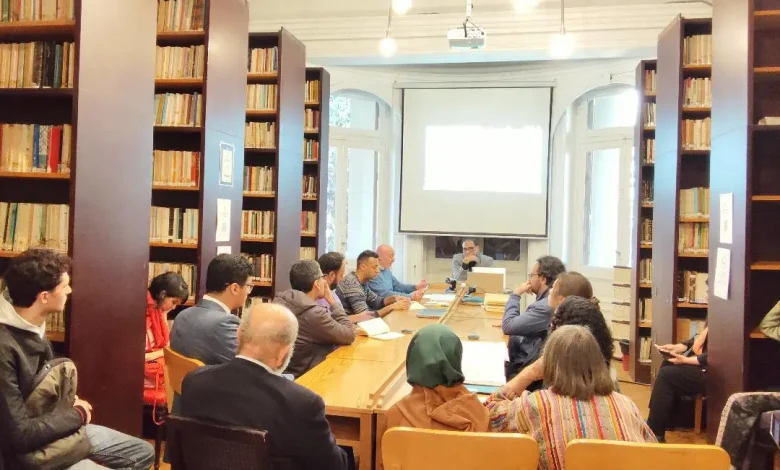
How can Quranic recitation be understood as a “state”? Can a reader’s voice become a system with its own rules, authority, and lasting influence? These questions opened the seminar discussing the book “Egyptian Recitation” by researcher Haytham Abu Zaid, published by Dar Al-Ain. The event was held as part of the “Monday Seminar” at the Sidag Center for Studies and Social Research in Cairo, organized by Ahmed El-Sarougy, with participation from Professor Frédéric Lagrange, drawing an audience deeply interested in auditory heritage.
From the start, it was clear that the seminar did not treat recitation as merely a religious performance. It was examined as a cultural phenomenon with its own history and transformations.
From “Here Is Cairo” to Shaping Taste
Haytham Abu Zaid began by returning to a foundational moment: the launch of Egyptian radio in 1934. The voice of Ahmed Salem announced “Here is Cairo,” followed immediately by a recitation from Sheikh Mohamed Rifaat. Abu Zaid explained that this was not simply the opening of a radio station. It was the beginning of a complete auditory sensibility taking shape.
He pointed out that Egyptian recitation was not spontaneous or simple. It was built on a complex network of rules, combining the science of Quranic readings on one hand with musical sensibility on the other. This allowed it to establish itself both within Egypt and across the Islamic world.
Abu Zaid noted that May 31, 1934, was not just the date of a new media platform’s launch. It was a pivotal moment in shaping public taste and consolidating Egyptian cultural dominance. He explained the uniqueness of the Egyptian school of recitation through its ability to combine scholarship, represented by precise tajweed and careful Quranic verification, with art, represented by maqam mastery and melodic improvisation.
He added that the precision of tajweed in Egypt was not optional. It was supervised by leading scholars of Quranic readings, who reviewed the Qurans themselves. This ensured that reciters adhered to the highest standards without artificiality, achieving a brilliant balance between the rigidity of the written text and the fluidity of vocal performance. They excelled at using musical maqamat to reveal the character of the Quranic text, not only to convey meaning but also to break monotony and astonish listeners through constant improvisation, as if hearing the verse for the first time.
The Golden Age and the Pioneering Generation
Abu Zaid moved on to what he called the “Golden Age” or “the Generation of the Giants.” These were the reciters who established the foundational structure of Egyptian recitation between 1934 and 1954. He named Sheikh Abdel Fattah Al-Shaashai, Sheikh Ali Mahmoud, Taha Al-Fashni, and Abu Al-Ainain Shuaish, emphasizing that each had his own distinctive vocal signature and independent approach.
Then came the generation that carried recitation to the world stage. Chief among them were Sheikh Mahmoud Khalil Al-Hussary, who produced the first recorded mushaf with tartil (slow, measured recitation), and Sheikh Abdel Basit Abdel Samad, whom he described as the “Ambassador of the Quran.” Also Sheikh Mohamed Siddiq Al-Minshawi, whom he considered the final master of this style of innate genius.
Abu Zaid devoted special attention to Sheikh Mustafa Ismail, describing him as the greatest figure in Egyptian recitation and the one with the widest performing range. He explained that Ismail was not simply a reciter but a “mobile artistic institution.” He was distinguished by his remarkable ability to build ascending structures in recitation, beginning with solemn quiet, then rising until he reached the peak of melodic performance, leaving listeners in a state of indescribable emotion.
He attributed this uniqueness to Ismail’s reverence for his art. He would repeat a melodic phrase if it did not satisfy him. He preferred long recitations lasting two hours, where he could interact with the audience, considering place and time part of the “engineering of emotion.” The studio, by contrast, constrained this interaction.
Radio Standards: Guarding Public Taste
Professor Frédéric Lagrange offered a critical historical reading, focusing on the “behind-the-scenes of the artistic altar” and the standards for approval at Egyptian radio. He explained that radio was a bastion of strict aesthetic values, thanks to the presence of guardians of refined taste such as Mohamed El-Shogaa.
He noted that those in charge of radio had a legitimate fear of declining standards. Listening committees sought genius, not merely acceptable voices. He pointed out that signs of decline began to appear in the mid-1960s, with what he called “infiltration under the name of renewal.” Some good voices emerged, he said, but they moved away from the carefully crafted closures inherited from the great masters, leading to the appearance of “loose closures” that lacked discipline.
He warned that this deviation ultimately produced the “market closure,” which robbed recitation of its cultural dignity and borrowed a style reminiscent of popular singing. This stripped certain majestic maqamat, such as Nahawand, of their sacred aura.
Civilizational Recitation Versus Rural Rawness
Lagrange explained the essential difference between what he called “civilizational recitation” and “rural character.” He emphasized that the vast majority of great reciters came from villages, but they delivered a refined, disciplined performance. A civilizational reciter, he explained, decorates the vocal phrase with elegance and deliberation. A reciter influenced by rural character, by contrast, tends toward excessive shouting and misplaced embellishments, turning beauty into its opposite.
Lagrange stressed that radio standards required a particular kind of auditory dignity and artistic discipline not always found in styles reliant on loud popular improvisation. For this reason, major figures like Sheikh Sayyid Al-Naqshabandi were rejected as reciters (though not as munshids, singers of religious poetry) on radio. Lagrange considered this a point of pride for radio, a victory for artistic standards over any other considerations, even endorsements from the head of state.
Technology and Changing Modes of Reception
The seminar continued analyzing the impact of technology on reception. Speakers explained that the cassette player brought a fundamental shift. Listening moved from collective, attentive gatherings in mosques and grand halls to individual, casual consumption in cafes and on public transport.
Abu Zaid explained that this transformation affected content itself. The market began to demand voices suited to quick, easy listening. This led to the decline of schools that required deep listening and melodic analysis. He added that the collapse of the “radio filter” and the loosening of approval committees allowed imitative voices to seep through, becoming the auditory background of daily life, replacing quality standards with those of commercial popularity.
The Aesthetics of Constraint
Abu Zaid returned to the philosophy of “aesthetics of constraint” in Egyptian recitation, explaining that a reciter’s greatness lies in the ability to create within a strict framework of tajweed rules, elongation, emphasis, and attenuation.
He compared the creative reciter to a player who skillfully bypasses defenders to reach the goal. These constraints, he insisted, are what give the art its value, whereas a munshid has greater freedom that may cost the recitation its sacred dignity.
Restoring Recitation’s Prestige
At the seminar’s conclusion, researcher Abu Zaid stressed that studying this heritage is not about placing it in a museum or presenting it as artifacts under the label “Melodies of the Past.” The goal is to find natural space for this living art to return to people’s consciousness.
He affirmed that Egyptian recitation is “the art of aesthetic difficulties,” combining the highest degrees of scholarly discipline with the loftiest horizons of melodic freedom. Preserving this heritage requires an awareness of the nature of collective listening, which once raised the aesthetic awareness of the simplest listener, allowing them to instinctively recognize moments of genius in the voice of Sheikh Mustafa Ismail or Al-Shaashai.
The seminar concluded with the affirmation that the battle for aesthetic consciousness begins with restoring the prestige of the “radio minaret.” What Egypt gave the world in those twenty golden years was a human and artistic miracle, worthy of being guarded and studied. So that Egyptian radio may remain the faithful guardian of the cradle of recitation genius