Egypt’s Heritage at a Crossroads: The Controversial Delisting of a Historic Villa in Manfalut
An official decision has sparked widespread debate, removing a historic villa from the heritage registry while adding another, raising questions about the fate of Manfalut’s architectural memory.
In a move that has sent ripples through Egypt’s heritage conservation community, an official ministerial decision has redrawn the map of protected architectural landmarks in Manfalut, a city in the Assiut Governorate. The decision has simultaneously removed the historic Mohamed Gamal El-Din Ayoub Villa from the official registry while adding the House of Daniel Maximus to the list of legally protected buildings. This dual action has raised a host of pressing questions about the fate of the city’s architectural identity and memory.
A Pivotal Decision
On February 15th, the Ministry of Housing, Utilities, and Urban Communities issued Decision No. 56 of 2026, published in the official Egyptian gazette, Al-Waqa’i’ Al-Masriya. The resolution mandates the removal of a property on Post Office Street, a branch off Gamal Abdel Nasser Street in Manfalut, from the governorate’s registry of buildings with distinguished architectural style. This property, widely known as the Villa of Mohamed Gamal El-Din, has been a listed building since the 1998 architectural heritage inventory. Conversely, the same decision officially added the “Daniel” property on Ahmed Maher Street, directly opposite the Manfalut train station, to the protected registry.
This stark contrast has opened a Pandora’s Box of questions: How can a building that has stood as a listed heritage site for decades simply be removed? What are the technical and legal criteria that justify such a decision? Does this signify an irreversible loss for Manfalut’s architectural memory? And if the villa fell into disrepair, who bears the responsibility for a building that was supposedly under the ministry’s protection? Why was restoration not undertaken before its condition became critical? Finally, will the newly protected House of Daniel Maximus be left to suffer the same fate in the future?
The House of Daniel Maximus: A Silent Witness
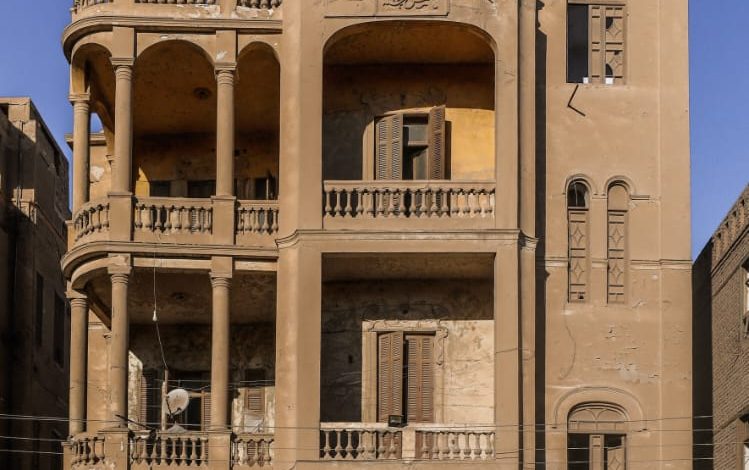
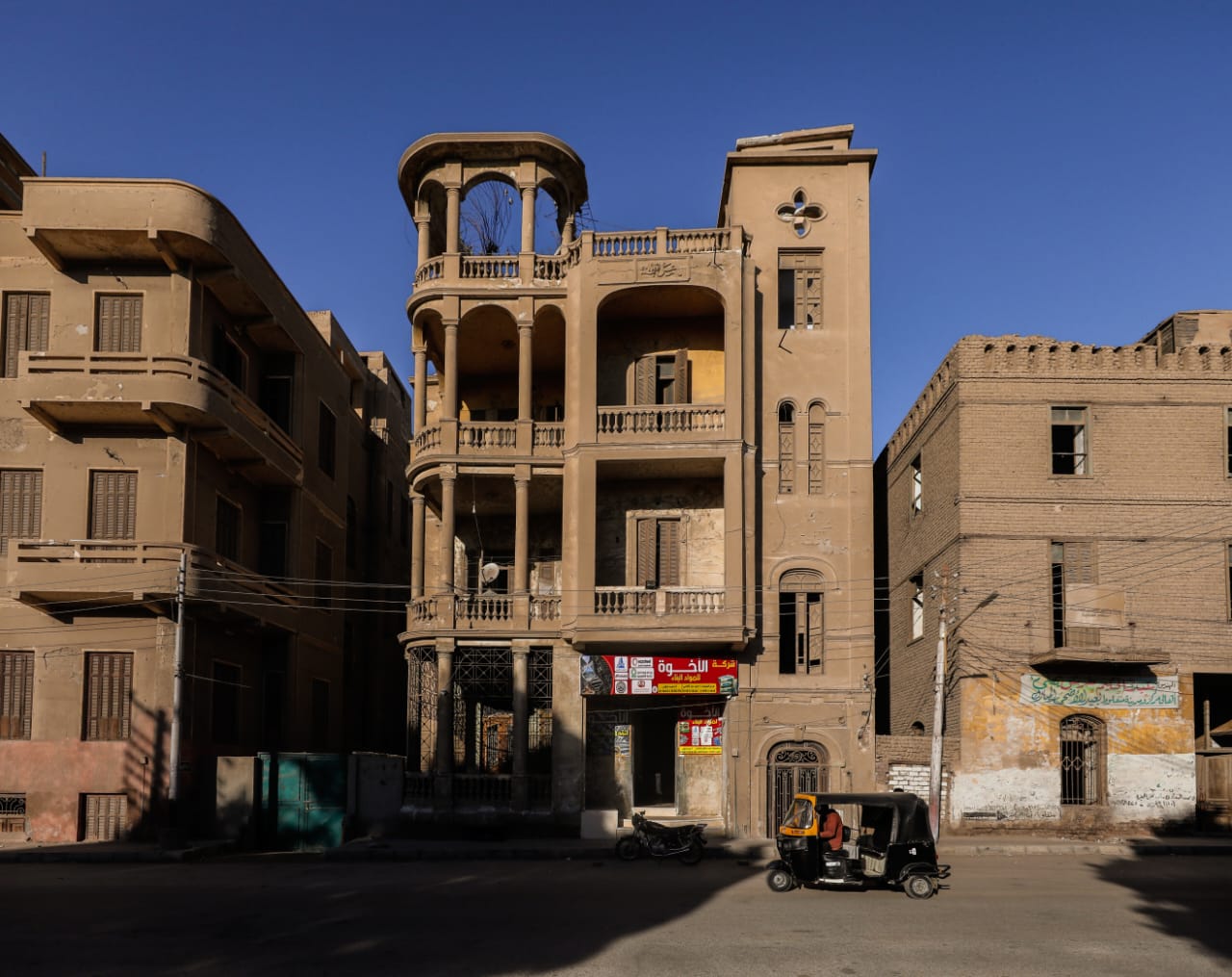
Just steps away from the Manfalut train station, the House of Daniel Maximus has stood for over a century, a silent sentinel against the passage of time. It is a living testament to the rich history of Manfalut, a city that has witnessed significant political and social transformations over the decades. Separated from the station by a street no more than six meters wide, the building now feels infinitely further from the bustle of modern life.
From the outside, the building is silent. Its windows are shuttered, and a layer of grime coats its walls, a tangible symbol of the neglect it has endured. While passersby hurry past, often oblivious to its presence, the house remains a quiet witness to a bygone era, once a proud landmark of the neighbourhood.
A Legacy in Local Memory
According to Bahaa El-Din Hussein, a 48-year-old local employee, the late Counselor Daniel Maximus was a prominent legal figure in Assiut Governorate. He belonged to the distinguished Maximus family, renowned for producing several notable legal minds, including the lawyer Samaan Maximus and his son.
Hussein explains that Counselor Maximus was not only a legal luminary but also a key social and political figure. He was considered one of the notables who helped shape the history of Manfalut. The Maximus family had a strong public presence, with members serving on the Wafd Party’s committee in Assiut, including the lawyer Maher Wasfi Maximus.
“Since my childhood, I’ve seen this building standing tall in the heart of Manfalut,” Hussein recalls. “Despite its silent walls, it has lived through every moment of our lives. It’s like a history book, its pages holding hundreds of stories.” Constructed in the early 20th century by its original owner, Daniel Maximus, the building is an architectural gem. Hussein notes that it features a basement, a ground floor, and two upper floors, all connected by a central staircase made of “luxurious mosaic.” A rooftop “roff” once served as an evening gathering place for the family.
Prime Location, Left to Decay
The house occupies a prime location. To the south lies “Maximus Alley,” to the north a neighbor’s house, to the west it overlooks the main station street, and to the east is the Manfalut Children’s and Maternity Hospital.
Hussein continues, “The area around it is never still, but the irony is that the house itself has been empty for years. Daniel’s descendants moved to Assiut city, and their visits became increasingly rare.” This prolonged absence has taken its toll, with the walls gradually showing the unmistakable signs of neglect.
He points out that over time, cracks and structural flaws have appeared, leading some to call for it to be declared a dilapidated and dangerous building. “Many unregistered heritage buildings in Upper Egypt cities fall victim to a kind of bureaucratic limbo,” Hussein adds. “They don’t receive full legal protection as antiquities, nor do they get the attention given to modern residential buildings. They fall between two stools, and the story often ends with a demolition order.”
The Legal Framework: Now Under Protection
According to a source within the Department of Coptic, Islamic, and Jewish Antiquities and a member of the Permanent Committee in Assiut, who spoke on condition of anonymity, the inclusion of the Daniel Maximus House on the list of buildings with distinguished architectural style grants it full legal protection.
Egypt’s Building Law No. 119 of 2008 explicitly prohibits the demolition of such buildings or any substantial alterations without prior referral to and approval from the relevant authorities. The law confirms that listing a property effectively blocks the issuance of any demolition permits, unless a formal decision is made to delist it.
The source further explained that the Antiquities Protection Law No. 117 of 1983 and its amendments criminalise any actions that harm buildings of historical or architectural value, whether through direct action or willful neglect that leads to their deterioration. Penalties can include imprisonment and heavy fines if deliberate vandalism or severe damage is proven.
A Ministerial Shield
The source clarified that the Daniel Maximus building was added to the Assiut Governorate’s heritage registry by a decision of the competent Permanent Committee, which was then formalised by a ministerial decree. This gives it an official protected status, safeguarding it from demolition or any significant changes to its character without government oversight.
Interestingly, the source also revealed that the building’s poor condition is not solely due to natural aging. He alleged that it has suffered from deliberate acts of vandalism, reportedly carried out by the property’s owners, which have accelerated its structural decline. This, he said, has raised serious concerns within heritage conservation circles. Any intervention in a registered building must follow strict legal procedures, and tampering with its architectural elements or leaving it vulnerable to decay could expose those responsible to legal accountability.
The Villa of Mohamed Gamal El-Din Ayoub: A Story Etched in Walls
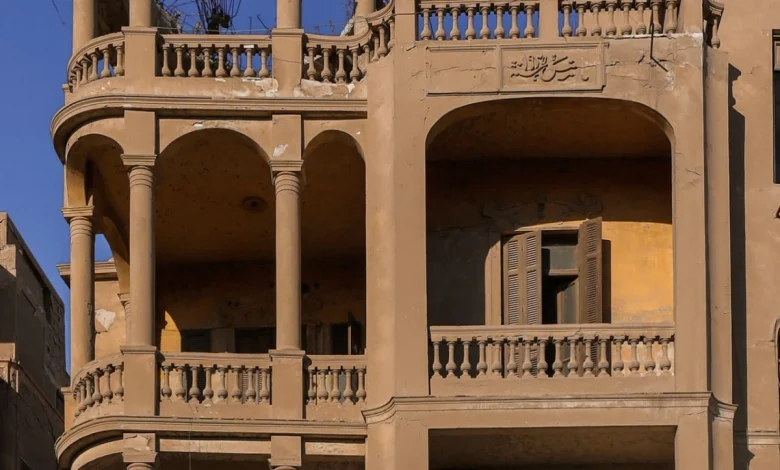
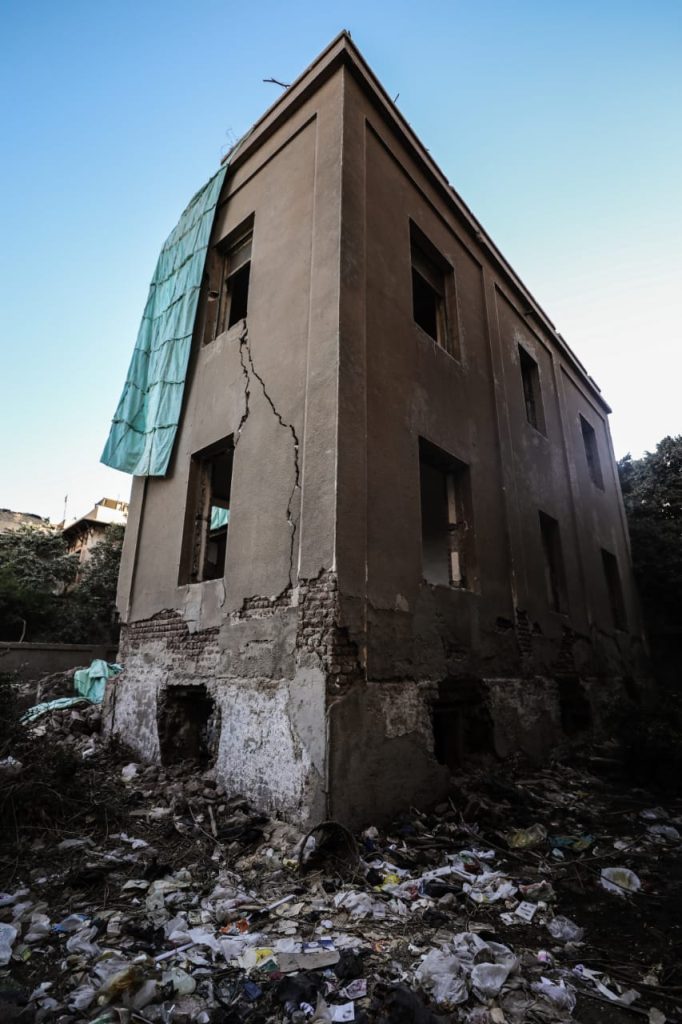
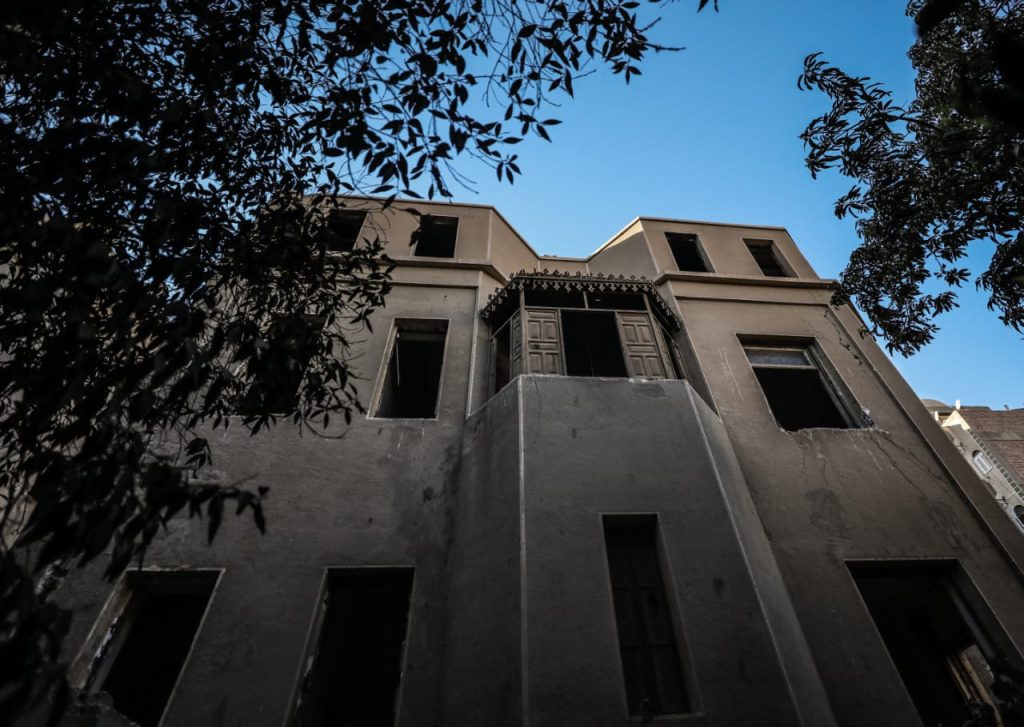
On a street in the Qaysariya district of Manfalut stands an ageing two-story villa, its walls holding over a century of stories. Built in the early 1900s, it was far more than just a family home for the Gamal El-Din Ayoub family, who have Turkish roots. It represents the legacy of a family that played a significant administrative and political role in the region once known as the “Manfalutiya Province.”
Qutb Mahmoud Mohamed Shalaby, a former undersecretary of the Ministry of Culture in Assiut, told Bab Misr that the villa belongs to the historically influential Gamal El-Din Ayoub family. He explains that Mohamed Saleh Gamal El-Din Ayoub is the son of Saleh Gamal El-Din, who oversaw the endowments (awqaf) of Prince Ali Gamal El-Din Ayoub, the governor of the Manfalutiya Province and a contemporary of Egypt’s ruler, Mohamed Ali Pasha. Historically, this province stretched from Manqabad in Assiut to the Deir Mawas district in Minya.
Shalaby points to the writings of historian Abdel Rahman El-Jabarti, which document political events in the region during that era. Notably, it was Ali Gamal El-Din Ayoub who arrested Ali Bey El-Kebir and Abu El-Dhahab, survivors of the Citadel Massacre, and handed them over to Mohamed Ali Pasha,a testament to the family’s political clout and proximity to the ruler at the time. Following the administrative reorganisation of Egypt’s provinces, Ali Gamal El-Din Ayoub was appointed as its governor.
A Villa that Embodied Social Status
Saleh Gamal El-Din built the villa in the early 20th century as a family residence befitting their status. The two-story structure reflects the style of upscale residential architecture of the period and has witnessed the transfer of ownership across generations.
Mohamed Saleh Gamal El-Din Ayoub inherited the villa after his father’s death. His daughter married Mahmoud Barakat, who served as the Undersecretary of the Ministry of Education in Assiut during the tenure of Governor Zaki Badr in the 1980s, and the couple lived there for years. One of the grandchildren still resides in the villa today. Mohamed Saleh’s son, Major General Adel Mohamed Gamal El-Din, moved to Cairo for work, leaving the villa to his sister and her children. He never returned to live there before his death, though the property is still registered in his father’s name.
Between Structural Integrity and Architectural Memory
Hossam Ali El-Manfalouti, a 40-year-old employee, sees the villa as a cornerstone of the city’s history. The recent decision, he argues, raises a critical question: “Is a building’s structural condition the sole criterion for erasing it from the heritage registry? Was the possibility of restoration thoroughly explored before resorting to demolition as the only solution?”
He emphasizes that the villa is more than just cracked walls. “It is a witness to a pivotal administrative and political chapter in Manfalut’s history, and to a family whose name is intertwined with managing endowments and governing a province that once stretched for miles.”
He adds, “Demolition might solve an engineering problem, but it forces us to confront deeper questions about our mechanisms for preserving historically significant buildings, especially those linked to families who played central roles in shaping the region.”
The Committee’s Decision: Natural Aging, Demolition is the Solution
Amidst this rich history, the controversial decision arrived. The Ministry of Housing officially removed the villa from the Assiut Governorate’s architectural heritage registry (the 1998 inventory).
According to an official from the Permanent Committee for Non-Dilapidated Buildings with Distinguished Architectural Style in Assiut, who also wished to remain anonymous, the villa suffers from clear cracks in its walls. Following a field inspection, the committee members concluded that demolition was necessary and that the property should be delisted.
The source confirmed that the technical report attributed the cracks to natural ageing and the passage of time, with no direct intervention by the heirs. Subsidence in the land beneath the structure was also cited as a contributing factor. The decision was based solely on the building’s structural condition as documented in the official inspection report. Following the decision, the Ministry of Housing, through the minister, announced the delisting, citing the need to ensure the safety of the residents and those in the surrounding area.
A City’s Memory on the Line
Today, the villa stands at a crossroads. On one side is an official decision that views its cracks as sufficient grounds to end its life. On the other is the collective memory of a city that sees it as an irreplaceable piece of its social and political fabric. Will this chapter be quietly closed under the banner of public safety, or will there be a reconsideration of the fate of a building that may be one of the last tangible remnants of the Manfalutiya Province era? The villa still stands, but the lingering question is: for how long?