Upper Egypt

Abu Zeid: The Last Traditional Sherbet Seller of Fayoum and the Vanishing Art of Ramadan Street Drinks

In Egypt’s Fayoum Oasis, Abu Zeid keeps alive the fading tradition of the “sherbet seller,” offering handmade Ramadan drinks and preserving a centuries-old street craft.

A Living Memory on a Fayoum Street Corner

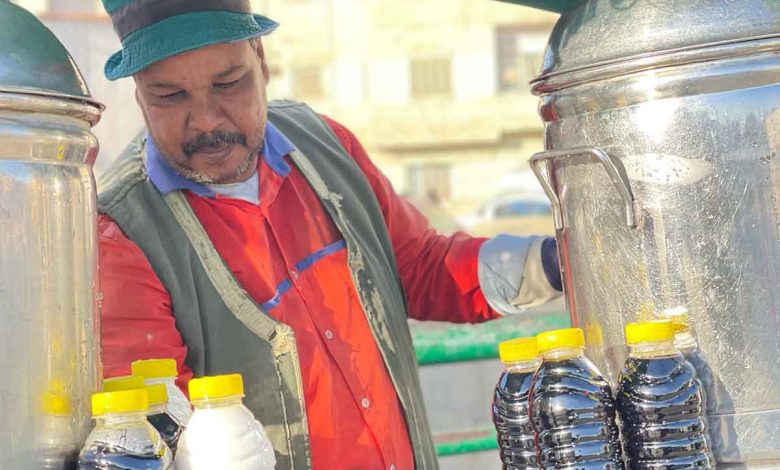
Every evening, as the sun sinks low and anticipation builds for the call to prayer that marks the breaking of the fast, Abu Zeid stands behind his modest wooden cart, arranging rows of gleaming metal jugs filled with traditional Ramadan drinks. His presence is a familiar and comforting sight in Fayoum, a lush oasis city southwest of Cairo.

For decades, men like Abu Zeid,known as sharbatliyya, or sherbet sellers,have quenched the thirst of fasting Egyptians in markets, mosques, and bustling squares. Though the profession has nearly vanished, replaced by juice shops and industrial beverages, Abu Zeid remains one of its last living embodiments.

sharbatli1
Ramadan drinks on display. Photo:Manal Mahmoud

The Ancient Roots of Egypt’s Sherbet Sellers

The profession of the sharbatli dates back to Egypt’s Islamic era and flourished under Mamluk and Ottoman rule. The word itself comes from the Persian-Turkish term sharbat, meaning a sweetened beverage. During this period, sherbet sellers became essential figures in urban life, specializing in freshly prepared drinks made from natural ingredients such as licorice root, tamarind, carob, and dates.

Traditionally, these vendors roamed Egypt’s streets carrying large copper or clay vessels strapped to their backs. They wore distinctive attire: loose galabiyas, turbans or fezzes, and wide leather belts equipped with small coin pouches and cup holders. With practiced rhythm, they poured drinks into polished copper cups, serving crowds gathering before sunset, particularly during Ramadan.

At a time when refrigeration did not exist, the sherbet seller was indispensable. Entire neighbourhoods depended on him for refreshment after a long, sun-drenched day of fasting.

Sharbatli2
Ramadan drinks on display. Photo: Manal Mahmoud

From Cultural Icon to Rare Sight

Over time, the profession evolved. Elaborate costumes replaced simpler robes, and copper vessels gave way to glass containers. By the early twentieth century, mechanical juicers, bottled beverages, and modern juice bars gradually pushed sherbet sellers to the margins of urban life.

Today, only occasional licorice vendors dressed in traditional garb can be spotted in Cairo’s historic squares, offering a nostalgic echo of a disappearing craft. In most cities, the role has all but vanished.

Except in Fayoum, where Abu Zeid still stands his ground.

Ramadan’s Distinctive Egyptian Drinks

Unlike many Arab countries, where dates and milk dominate iftar tables, Egypt boasts a rich array of unique Ramadan beverages. Among the most iconic are licorice, tamarind, carob and sobia, a coconut-and-barley-based drink.

Throughout Ramadan, vendors like Abu Zeid appear across Egyptian streets, particularly in working-class neighbourhoods and small towns. Many work only during the holy month, when tradition, nostalgia, and community spirit revive demand for these handmade refreshments.

Sharbatli3
Abu Zeid serving customers. Photo: Manal Mahmoud

Abu Zeid’s Journey

Now in his late fifties, Abu Zeid Mohamed Ahmed migrated from Sohag in Upper Egypt to Fayoum in the 1980s, seeking better opportunities. He began as an apprentice licorice vendor in Alexandria before eventually striking out on his own.

“For more than fifteen years, I carried the heavy metal container on my back and walked through the streets,” he recalls. “But my back started failing me, and I couldn’t continue that way.”

With his savings, he purchased a small cart, which has since become his stationary post along the canal of Bahr Youssef, one of Fayoum’s most historic waterways. Here, in the neighborhood of Refaat Azmi, he has become a familiar Ramadan fixture.

“I only leave Fayoum in December and January to visit family back in Sohag,” he says. “The rest of the year, this street is my home.”

Crafting Flavor by Hand

Every drink Abu Zeid sells is prepared from scratch using time-honored methods. Licorice root is soaked overnight, fermented naturally with baking soda, and strained at dawn. Tamarind pods are boiled for hours before being filtered. Sobia requires careful blending of barley extract, coconut, and warm milk, then left to ferment for several hours.

“These drinks need patience,” Abu Zeid explains. “Nothing here is rushed. Each flavor takes its time.”

The result is unmistakable: earthy, refreshing, deeply aromatic drinks that carry the essence of Ramadan itself.

Sharbatli4
Abu Zeid serving customers. Photo: Manal Mohamed

More Than a Living, A Way of Being

“I love the street,” Abu Zeid says quietly. “I love standing here, watching people pass, feeling the pulse of life. I cannot sit inside closed shops. This is where I belong.”

Despite dwindling demand and fierce competition from commercial juice bars, he remains committed to preserving the spirit of his craft. His greatest wish is simple: good health, steady work, and the chance to see his daughters married and settled.

Holding Onto a Vanishing Heritage

Though the profession of the sherbet seller is rapidly fading, Abu Zeid’s cart stands as a living museum of Egyptian street culture. His shining vessels, hand-prepared drinks, and quiet dedication embody centuries of tradition that might otherwise vanish unnoticed.

In his daily ritual of pouring sweet relief into waiting cups, Abu Zeid preserves more than refreshment. He preserves memory, craftsmanship, and a fragile thread of cultural continuity.

Related Articles

Back to top button
BabMasr