Upper Egypt

Palm-Frond Lanterns: A Ramadan Tradition That Refuses to Fade in Luxor

Discover how palm-frond lanterns continue to light up Ramadan in Luxor, preserving Egypt’s handmade craft traditions despite modern mass production.

By Amani Khairy

Natural vs Plastic Lanterns

As the holy month of Ramadan approaches, Egypt’s streets come alive with glowing lanterns or fanous, in countless shapes, colors, and materials, from plastic and metal to wood and fabric. Yet in the villages and rural centres surrounding Luxor, one traditional craft endures: lanterns handmade from palm fronds, woven carefully by local artisans using techniques passed down through generations. Despite modern manufacturing and shifting consumer tastes, these natural lanterns retain a quiet but powerful presence, cherished by families who still place them outside their homes each year to welcome Ramadan.

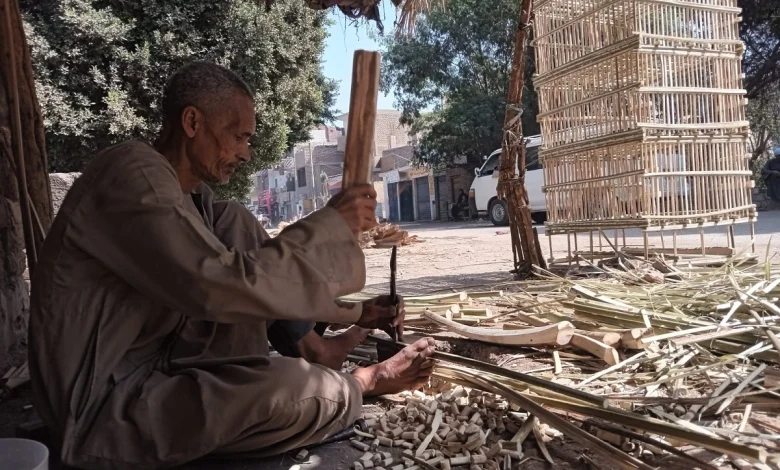
In a small workshop in the village of Al-Aqalita, near Qurna in southern Luxor, 57-year-old Ahmed Abdel Rahim has spent more than three decades crafting furniture and lanterns from palm leaves. Although the profession was not inherited from his family he and his brother embraced the trade early on, turning it into their sole source of income and livelihood.

فانوس 2
Constructing a Fanous. Photo: Amani Khairy

“I’ve raised all four of my children through this craft,” Abdel Rahim says proudly. “This work put food on our table, thank God. My children grew up, and I even married off two of them.”

Rising Costs, Diminishing Demand

Abdel Rahim sources his raw palm fronds from the nearby village of Qamoula. Over the past decade, however, rising costs have taken a toll. “The price of a thousand palm fronds has climbed to nearly 3,000 Egyptian pounds,” he explains, noting that both material quality and affordability have declined. “The fronds used to be stronger and cheaper. Now everything costs more.”

Once a bustling seasonal trade, Ramadan lantern-making has witnessed a steady drop in demand. “I used to make nearly a hundred lanterns each year for Ramadan,” he recalls. “Now, I only sell around ten to fifteen before the season begins.” Children increasingly favor plastic lanterns, which are lighter, more colorful, and easier to carry. Larger decorative lanterns, meanwhile, are often purchased in metal or fabric versions, reflecting shifting aesthetics and mass production trends.

Timeless Craftsmanship

Yet the craftsmanship behind palm-frond lanterns remains intricate and precise. Abdel Raghim explains that lanterns are made in various shapes and sizes, depending on customer preference,open-frame designs, spiked “sunburst” styles, or layered triangular patterns. “Each lantern takes between one and two hours to complete,” he says. The palm fronds are carefully cut into thin vertical strips, bound together with strong wire or thread to form the upper frame, while the base is shaped using smaller segments to create distinctive geometric forms.

After completion, the lanterns may be wrapped in colorful cellophane to enhance their visual appeal, with some customers requesting internal lighting for nighttime illumination. These lanterns are typically displayed at doorways, balconies, or inside living rooms, transforming domestic spaces into glowing sites of celebration and reverence.

فانوس 4
Semi-complete Fanous. Photo:Amani Khairy

Prices, however, have surged dramatically. “In the past, lanterns sold for five to ten pounds,” he explains. “Today, prices range between forty and fifty pounds, mainly because of rising material and transport costs.” Still, buyers continue to seek them out, not merely as decorations but as expressions of cultural memory.

An Artisanal Heritage That Will Never Disappear

Beyond lanterns, Abdel Rahim also produces handcrafted palm-frond furniture, including chairs, beds, and tables. These items are especially popular among Egyptians and foreign residents living in Qurna and Al-Bairat, many of whom prefer traditional furniture over modern designs. Positioned in homes overlooking the Nile, these pieces embody a rustic elegance that reflects Upper Egypt’s deep artisanal heritage.

“The market for palm furniture will never disappear,” he insists. “As long as people value tradition, this craft will survive.”

Despite competition from plastic, metal, and wooden lanterns, some of which now include musical features and LED lighting, he remains confident. “Yes, palm-frond lanterns have been affected,” he acknowledges, “but they will never vanish. This is heritage. Each generation finds its own way back to it.”

In a world increasingly dominated by mass production and digital spectacle, these handmade lanterns endure as quiet symbols of craftsmanship, continuity, and celebration — reminding communities in Luxor, and beyond, that tradition still flickers warmly in the palm of a careful hand.

Related Articles

Back to top button
BabMasr