Lower Egypt

Writing Against Erasure: Bassem Khandaqji on Prison, Imagination, and Palestinian Identity

Palestinian writer Bassem Khandaqji speaks in Alexandria about prison, imagination, identity, and writing his Booker Prize–winning novel from captivity.
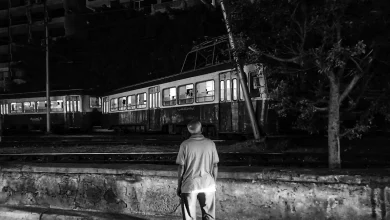
Palestinian writer Bassem Khandaqji was hosted at the Jesuit Cultural Centre in Alexandria for an open discussion with the public. Moderated by Egyptian writer Hind Jaafar, the conversation extended beyond his Booker Prize–winning novel “A Mask the Colour of the Sky “to address a wide range of literary, artistic, and political questions.

Jaafar introduced Khandaqji as a Palestinian writer born in 1983 in Nablus. In November 2004, he was arrested by Israeli occupation forces and has since spent 21 years in prison—without allowing captivity to extinguish his literary voice. She noted that Khandaqji has published numerous critical studies in leading Arab journals and described “A Mask the Color of the Sky “as a landmark novel that rearticulates the Palestinian narrative in a way the world urgently needed, especially in the aftermath of October 7.

“The Sea Made Me Feel Free”

Opening his remarks, Khandaqji expressed his joy at being in Alexandria, saying: “Although this is my first visit to the city, I have always imagined it. This is also the first time in 25 years that I have seen the sea and listened to its waves, which made me feel a true sense of freedom.”

He added that the city differed from his imagined version, shaped by the writings of Osama Anwar Okasha, yet remained deeply beautiful, expressing a desire to spend more time discovering it. His visit to the Bibliotheca Alexandrina, he said, was particularly moving and deeply personal.

Khandaqji spoke with pain about how conditions for Palestinian prisoners deteriorated after October 7, turning prisons into sites of near-total annihilation. Previously, inmates had access to notebooks, pens, books, and libraries comparable to those of universities—hard-won gains achieved through years of struggle and hunger strikes. Some prisoners were even able to pursue academic degrees or smuggle limited means of communication. All of this, he said, was obliterated after October 7, when books were burned and libraries destroyed entirely.

Bassem two
Palestinian writer Basem Khandaqji signs his novel for the audience. Photo: Doaa Abdelhamid

Prison as the Source of Literary Creation

Khandaqji explained that his life sentence, equivalent to 300 years under Israeli law, meant moving between prisons across the country for over two decades. Writing under these conditions was a formidable challenge, forcing him to compress time, write rapidly, and adapt constantly. Yet he acknowledged that while prison stole his freedom, it also became the crucible of his literary creation.

Speaking of “A Mask the Color of the Sky” winner of the International Prize for Arabic Fiction (Booker), Khandaqji said his primary motivation was never the award, but rather writing as an act of freedom. Prison, he explained, became a balcony from which he could address the world and confront it,without falling into shallow depictions of suffering.

He described the secrecy surrounding his writing: guards could not see him, nor could fellow prisoners. He rose daily at five in the morning to write, hiding his pages inside his cell or in others. “Imagination was my loyal companion,” he said. “I dreamed and envisioned scenes so vividly that I described Cairo’s Al-Azhar and Al-Hussein neighbourhoods without ever having visited them. When fellow Palestinian author Marwan Barghouti read those passages, he confirmed their astonishing accuracy.”

Persecuted for Winning the Prize

Khandaqji recalled learning of his Booker Prize win indirectly. Upon making the shortlist, Israeli intelligence intensified its surveillance and interrogations, signalling to him that something extraordinary had happened. The interrogations were exhaustive, probing every detail.

Under extreme pressure, he confessed all his pent-up emotions, telling his interrogators: “If I had known my writing would anger you this much, I would have written dozens of books.” Despite the suffering, he felt victorious; their fear, he said, was proof that his writing preserved Palestinian identity, which the occupation seeks relentlessly to erase.

Wearing the “Zionist Mask”

Khandaqji defended Palestinians who are sometimes forced to assume Israeli identities to survive, stressing that such acts do not compromise their essential Palestinian identity. He explored this theme in his fiction, particularly in relation to Palestinians of 1948,those living within Israel’s borders,whose lives he described as a daily confrontation with occupation. Denied full rights and treated as second-class citizens, they remain deeply rooted in their land and constitute, he argued, the greatest demographic threat to Zionism.

Writers Who Shaped His Voice

Khandaqji spoke fondly of Egyptian pocket novels, particularly the works of Nabil Farouk and espionage series like Adham Sabri and Raafat El-Haggan, which he later purchased in bulk at the Cairo International Book Fair. He also read Hebrew literature during his imprisonment, mastering the language in the process.

Among the writers who most shaped him, he named Elias Khoury, whose death affected him profoundly, along with Sonallah Ibrahim, Ziad Rahbani, and Ghassan Kanafani, whom he described as among the last great cultural figures of the Arab world.

He concluded by revealing that two offers are currently under discussion to adapt “A Mask the Color of the Sky“into a feature film. While declining to share further details until the project takes clearer shape, Khandaqji that his ultimate hope remains unchanged: that storytelling can continue to breach walls, disrupt erasure, and reclaim the human face of Palestine.

Related Articles

Back to top button
BabMasr