Lower Egypt

Between Memory and Neglect: Inside Rashid’s Last Ottoman Bathhouse

Hammam Azzouz, Rashid’s last public bath, remains closed despite restoration promises, revealing the fragile fate of Egypt’s forgotten architectural heritage.
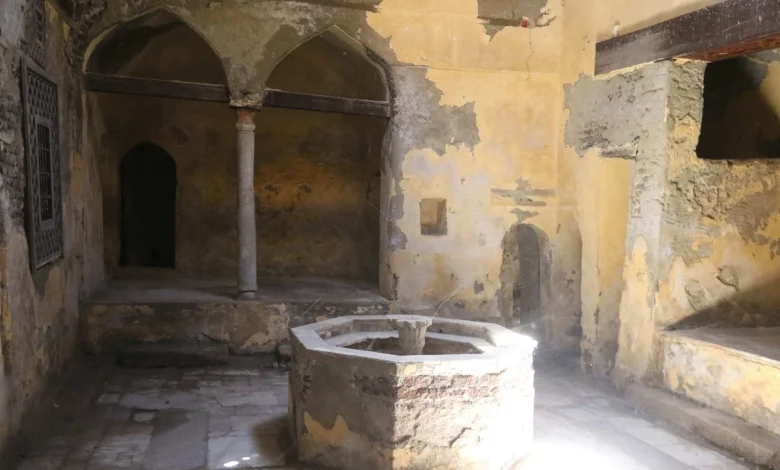
In 1982, the furnace of Hammam Azzouz in the historic city of Rashid (Rosetta) was extinguished for the last time. That same year, ownership of the bathhouse was transferred to the Antiquities Authority and the building was registered as a protected monument, with plans for restoration. More than four decades later, however, Hammam Azzouz remains shuttered and neglected, despite its inclusion in a national project aimed at transforming Rashid into an open-air architectural museum for global tourism.

The historical value of Hammam Azzouz cannot be separated from the wider context of Rashid itself. During the 17th century, Rashid was Egypt’s primary Mediterranean port and a central hub connecting trade routes between the Delta and the sea. Established as a charitable endowment for the nearby Zaghloul Mosque, Hammam Azzouz emerged during this period as both a public service and a social gathering space, reflecting the city’s prosperity and cultural dynamism.

As trade flourished, public bathhouses became essential institutions, serving not only hygiene needs but also acting as centres of leisure, social exchange, and community bonding.

azoz door
Hammam Azouz.Photo: Mohamed Awad

Restoration Promises

In December 2024, the Rashid Local Council issued a statement confirming continued efforts to restore the city’s historic monuments in coordination with the Rashid Antiquities Department. The statement specifically highlighted Hammam Azzouz, located adjacent to the iconic Zaghloul Mosque.

The announcement reaffirmed the state’s commitment to preserving Rashid’s archaeological heritage, citing presidential directives to safeguard historic cities of global significance. It also quoted Ahmed Habbala, Director of Rashid Antiquities Inspection, who confirmed that Hammam Azzouz is part of the Ministry of Antiquities’ long-term plan to transform Rashid into an open-air museum and a global tourist destination within three years — a project originally commissioned in 2017.

Despite these declarations, tangible restoration work has yet to begin.

The Last Surviving Public Bath

Mahmoud Saad Al-Hashash, Heritage Awareness Officer at the Rashid Antiquities Department, explains that the city once had seven public bathhouses, of which only Hammam Azzouz remains today.

“Like many of Rashid’s historic homes, the bathhouse took the name of its last private owner in the 1950s,” he says. “It later became state property by royal decree under King Farouk, before being officially registered as a monument in 1982.”

azozz front
The street where Hammam Azouz is located in Rashid. Photo: Mohamed Awad

A Charitable Architectural Masterpiece

Hammam Azzouz dates back to the early 11th Hijri century (17th century CE) and was founded by Abd al-Rahman ibn Hijazi, known as Ibn Gamea. More than a commercial enterprise, the bathhouse functioned as a charitable endowment, with its revenues allocated to maintaining Zaghloul Mosque.

Architecturally, the bath follows a Mamluk-inspired design despite its Ottoman-era origins. Its layout skillfully balances privacy, spatial efficiency, and thermal control, reflecting remarkable architectural ingenuity.

The structure consists of two levels: a ground floor dedicated to bathing rituals and an upper floor once used as the owner’s residence, enabling continuous supervision of the furnace and water system.

شارع حمام عزوز
The street of Hammam Azouz.Photo: Mohamed Awad

The bathhouse operated through a hierarchy of specialised workers, including the nazourgi, who monitored the entrance and regulated access, the waqqad, responsible for heating the water, the makkasati, who performed massages, and the madoulbati, tasked with safeguarding visitors’ belongings. Bathing followed a carefully structured thermal progression, beginning in the maslakh, or changing hall, where visitors undressed and rested, followed by the warm room to prepare the body, and culminating in the hot chamber, the heart of the hammam, crowned with a perforated glass dome that allowed sunlight to filter through without losing heat, creating a gradual and restorative bathing experience.

Sustainable Water and Heating System

Water was drawn from a waterwheel installed on the nearby Rashid branch of the Nile, lifting water into a rooftop reservoir before channelling it to the heating chamber. The furnace was fueled not only by firewood but also by household waste collected from surrounding streets, simultaneously serving sanitation and energy functions.

The resulting ash was reused for cooking and incorporated into construction materials, giving Rashid’s distinctive dark brick its signature hue.

Over time, however, this once-innovative system became a liability. Accumulated waste buried parts of the bathhouse façade, accelerating decay and obscuring decorative features, particularly as restoration plans remained stalled between 2017 and 2025.

Architectural Documentation

In The Rosetta Encyclopedia: Urban Heritage (Volume II), Dr Mahmoud Ahmed Darwish presents a detailed architectural study of Hammam Azzouz, exploring the philosophy behind Rashid’s vernacular architecture, one that merges functionality, aesthetics, and environmental adaptation.

He notes that Hammam Azzouz is not unique in Rashid but is also the last fully intact Ottoman bathhouse in Egypt’s northern Delta. The use of breathable brick and lime mortar allowed the building to withstand high humidity, while its shallow domes, punctured with colored glass openings, created a form of light therapy that transformed bathing into a multisensory experience of healing and tranquillity.

A Living Memory

Across from the bathhouse entrance, Fathi, a blacksmith in his sixties, pauses from work to recall his childhood memories. “I remember seeing the hammam operating in the late 1970s,” he says. “My father told me stories of its golden days in the 1950s and 60s.” Tourists still stop by to peer through its windows, and officials frequently inspect the site, yet restoration remains elusive. “Like many historic homes here,” Fathi adds, “we keep hearing promises. Maybe one day, the hammam will breathe again.”

Today, Hammam Azzouz stands suspended between memory and neglect, a fading witness to Rashid’s former vitality and a fragile remnant of Egypt’s urban heritage. As official statements continue to promise restoration, the bathhouse quietly succumbs to time and decay, raising urgent questions about how long such monuments can survive on declarations alone, and whether Rashid’s architectural legacy will be rescued before it disappears entirely.

Related Articles

Back to top button
BabMasr