Upper Egypt

Nubian Houses: Sustainable Architecture That Cools the Heat and Preserves Nature

Discover the beauty of Nubian houses in Aswan, where sustainable architecture, natural cooling, vibrant colours, and rich cultural traditions create eco-friendly homes that attract travellers seeking authenticity and tranquillity along the Nile.

By Amani Khairat

In Aswan, Nubian houses rely on natural, eco-friendly materials such as mud brick and Nile silt, crowned with semi-circular domes that insulate against heat and humidity. This architectural style creates living spaces that remain warm in winter and cool in summer, without the need for modern cooling systems. Simple yet remarkably efficient, this sustainable design has preserved the identity of Nubian architecture, transforming these homes into a haven for travellers seeking serenity and closeness to nature.

Natural Materials: Mud Brick and Nile Silt

Nasreddin Abdel Sattar, known locally as “Uncle Nasser,” owns a traditional mud-brick house on Gharb Soheil Island overlooking the Nile. Inherited from his ancestors, the house reflects the classic Nubian style. Its walls, made of mud brick mixed with Nile silt, animal manure, and straw, reach up to 40 centimetres in thickness, while the dome above is about 30 centimetres thick. This structure naturally regulates temperature, keeping the house warm in winter and cool in summer. The walls are coated with Nile silt extracted directly from the river, enhancing both insulation and humidity control.

This construction method increases indoor moisture levels, eliminating the need for fans or air conditioning. Even the floor retains a cool dampness that allows residents to sit comfortably during hot summer days.

Nubian house
Nubian house. Photo: Amani Khairat

Natural Ventilation and Energy Efficiency

Ahmed Magued, a resident of Aswan who has owned a similar mud-brick house on Hessa Island since the 1990s, notes that his home remains structurally sound, with no cracks despite decades of exposure to harsh weather. Another house inherited from his father, built in the 1970s, stands in equally pristine condition. Today, both homes attract tourists seeking peaceful nights by the Nile and immersion in Aswan’s natural beauty.

He explains that the domed roofs enable continuous airflow through two ceiling openings: air enters through one and exits through the other, creating constant natural ventilation. During winter, the lower opening is closed to preserve warmth, while in summer it remains open to cool the interior. With most Nubian houses relying on this passive cooling system rather than electrical devices, they significantly reduce energy consumption.

The main entrance of these homes typically faces the Nile, reflecting the Nubian reverence for the river as the source of life. Consequently, many Nubian villages were built directly along its banks.

Nubian house
Nubian house. Photo: Amani Khairat

A Palette of Joy: The Symbolism of Nubian Colors

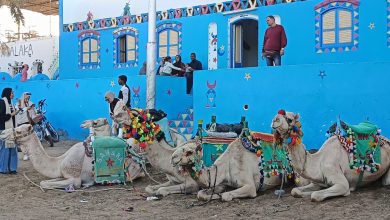
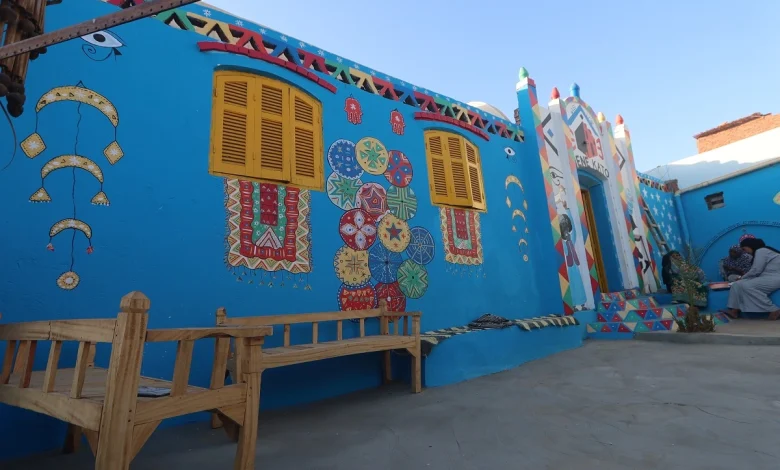
The vibrant colors of Nubian houses are more than decorative. Traditionally, homes were painted in white and yellow, or coated with lime, to reflect sunlight and reduce heat absorption. Today, facades burst with bright shades of blue, green, red, yellow, and white, each carrying symbolic meaning. Yellow represents desert sand, green symbolizes nature, and blue evokes both the sky and the Nile.

Walls are adorned with murals inspired by Nubian heritage and daily life, depicting Nile boats, playful children, and returning pilgrims, transforming homes into living canvases of memory and identity.

Eco-Friendly Furniture and Interior Decor

Sustainability extends beyond architecture into everyday living. Nubians traditionally craft furniture from palm fronds and date leaves, creating chairs, mats, and tables from locally sourced materials. In some houses, palm fronds are even used for roofing, valued for their durability under intense sunlight.

Inside, decorative palm-leaf ornaments hang on walls, sometimes painted in bright hues. Women of Nubia skillfully create simple handmade decorations, while traditional water jars are either left in their natural form or painted in soothing colors, adding warmth and authenticity to interior spaces.

Some families also display small stuffed crocodiles outside their homes, a folk tradition believed to ward off evil and summon protection.

Nubian house 3
Nubian house. Photo: Amani Khairat

Upon entering Gharb Soheil village, visitors are greeted by radiant homes that have gradually transformed into vibrant tourist destinations. These houses now host travelers, offering traditional food, henna painting, and evening cultural gatherings animated by Nubian music and dance.

Hasaniya Othman, whose home is among the most visited in the village, recalls how the steady arrival of tourists inspired her family to convert their house into a cultural guest space. After repainting the walls in vivid colors, they added palm-frond shades in the courtyard, built separate restrooms for visitors, expanded seating areas, and created shaded terraces overlooking the Nile.

They also constructed small enclosures for young crocodiles, carefully supervised to ensure visitors’ safety while allowing memorable photo opportunities. The crocodiles are fed meat, chicken, and fish, their preferred diet, though they eat sparingly.

Nubian house 5
Tourists being photographed with crocodile. Photo: Amani Khairat

Traditional Cuisine: Distinctive Flavors

At one of the Nubian restaurants in Gharb Soheil, Rouhiya Abdel Fattah explains that visitors often seek out traditional dishes, particularly Nubian-style molokhia prepared from pea leaves and seasoned with dried okra and fennel. Typically served in winter, it offers a flavor distinct from Upper Egyptian molokhia.

Other popular dishes include vegetable casseroles with okra, potatoes, peas, and zucchini, prepared daily by local women beginning early each morning. Desserts such as Om Ali and rice pudding are also favorites. Tourist activity peaks during winter, when the moderate climate brings increased demand and a lively rhythm to village life.

A Lasting Beauty

Through their harmonious blend of nature, craftsmanship, and cultural memory, Nubian houses stand as living evidence that sustainability is not a modern invention, but an inherited wisdom. In their mud walls, vibrant colours, and open courtyards, these homes preserve a way of life rooted in respect for the land, the river, and the rhythms of the seasons, offering visitors not merely shelter, but a rare encounter with enduring beauty and quiet resilience.

Related Articles

Back to top button
BabMasr