Lower Egypt

Alexandria’s Historic Tram System: A Journey Through Time (1863-2026)

Explore the 163-year history of Alexandria’s iconic tram system, Africa’s oldest streetcar network, as the Egyptian city prepares to bid farewell to its yellow and blue carriages in 2026.

By Merna Gohar

The End of an Era for Alexandria’s Tram

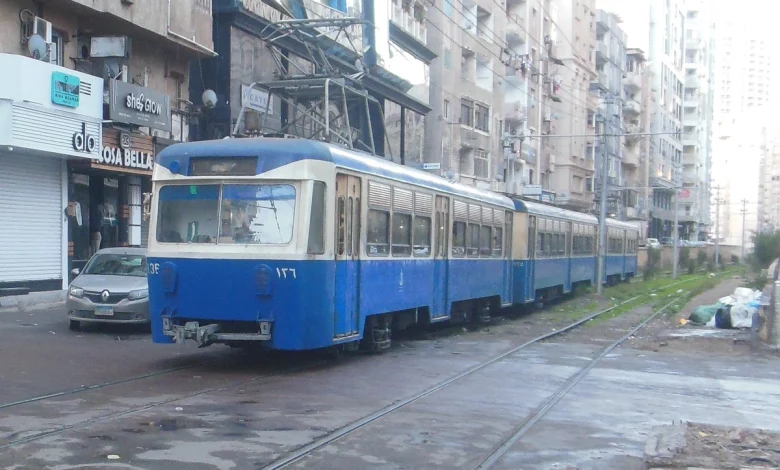
In just a few days, Alexandria will bid farewell to its iconic tram system, featuring distinctive yellow and blue carriages, a transit network that has served the city since 1863. As the oldest tram system in Africa and the Middle East, Alexandria’s streetcars were far more than simple passenger transport. They became a visual icon and an inseparable part of the city’s identity.

Alexandria Tram History: A Visual Record

Historical photographs of Alexandria showing Saad Zaghloul Square and Safiya Zaghloul Street clearly reveal the tram tracks that once crisscrossed these areas. Old city maps from before the 1950s and 1960s show tram lines extending through streets where today it’s difficult to imagine the metallic sound of moving carriages once resonated.

This exploration of the Alexandria tram’s history isn’t meant to oppose modern development, but rather to understand the past: How was Alexandria formed? How did it expand? And how was it shaped by a vehicle originally invented not for passenger transport, but for mining operations?

tram 1
A picture from inside the tram,Photo by: Merna Gohar

Riding the Alexandria Tram: A Journey Through Time

Step aboard the tram, purchase a ticket from the conductor in the distinctive blue suit, and if you’re fortunate, find a seat by the window. As the iron wheels screech against the tracks, preparing to move, your journey begins.

Like a storyteller, the Alexandria tram carries passengers through diverse scenes: the Mediterranean coastline, historic buildings, traditional cafes, horse-drawn carriages, residents, newspaper kiosks, and traffic officers managing street movement. Through this window, riders experience not just spatial movement but time travel through the city’s living theatre spanning over a century.

This raises an essential question: What was Alexandria like before the tram transformed its streets?

Alexandria Before the Tram System (Pre-1860s)

According to The Development of Internal Transport and Communications in Egypt during the British Occupation 1882-1914, Alexandria’s tram story began in 1860 when Sir Edward St. John secured a concession to establish a railway line connecting central Alexandria to the Raml area.

Early Alexandria Urban Geography

At that time, “Alexandria” referred specifically to its historic core around Al-Manshiya and Raml Station—areas concentrated with administration, commerce, and residential housing. Eastern areas remained suburbs and summer resorts outside the main urban fabric.

First Tram Line Construction (1860-1863)

The project aimed to facilitate Alexandria’s eastern expansion. After two years of construction, the line began operations in 1863 using steam power instead of horses, running from Raml Station toward the Sheikh Ismail area (now known as Bolkly). The Alexandria and Raml Railway Company was simultaneously established.

tram 2
A map of Alexandria from 1938 showing the extension of the tram line on Sultan Hussein Street, one of the routes that later disappeared from the city. Image: Bibliotheca Alexandrina

Evolution of Alexandria’s Tram Network

Horse-Drawn and Steam Era (1869-1890s)

In 1869, Alexandria’s first horse-drawn tram opened between the city center and the Shots area to the east. Lines later extended to San Stefano and Zizinia, utilising both horse-drawn and steam-powered carriages.

Electric Tram Era Begins (1890-1903)

By the late nineteenth century, a British company assumed operation of the network in 1890 and initiated plans for electrification. In 1903, the electric tram officially launched on the Alexandria-Victoria line, spanning approximately 14.5 kilometers.

According to Tram and Trolley in Africa, the network expanded in multiple directions during this period. Parallel tracks were established in areas like Sidi Gaber, and new carriages were introduced to serve the growing city.

Network Expansion and Changes (1900s-1960s)

Historical maps and archival photographs clearly show tram lines once extended through streets like Sultan Hussein and Safiya Zaghloul,routes where no trace remains today. Throughout subsequent decades, lines were interconnected, separated, and reconnected. The system saw construction of short tunnels and repeated updates, with some lines being cancelled during the 1950s and 1960s.

These tram lines represented more than transportation infrastructure—they were pathways through which the city grew inward, connecting previously separate places into one unified urban entity.

The Tram’s Urban Impact on Alexandria

How Trams Shaped Alexandria’s Development

When riding the Alexandria tram today, passengers see not only the city through its windows but also witness how urban routes are sometimes shaped independently of residents’ input.

When development plans are announced with new maps and proposals, details often remain unclear to daily tram users—workers, students, employees, and others who depend on this transportation. Between paper plans and lived reality, ordinary users remain observers rather than partners in discussions, despite the tram’s central role in every urban transformation Alexandria has experienced.

Transportation as an Urban Planning Tool

In Alexandria, the tram wasn’t merely transportation—it was the catalyst for city expansion and the emergence of new neighbourhoods. Transportation infrastructure fundamentally shapes daily life, determining distances between home and work, and between people themselves.

Therefore, developing the tram system is essential. However, concerns arise not from development itself, but from implementation methods: Will improvements genuinely ease commuting, or will they create new congestion points?

Understanding History to Build the Future

History’s importance doesn’t stem from nostalgia or mere remembrance, but from its value as a tool for understanding and learning. What we consider natural and obvious today originally resulted from specific decisions, investments, and political choices.

Related Articles

Back to top button
BabMasr