Alexandria’s Shallalat Gardens: Historic Park Faces Neglect Amid Development Fears
120-Year-Old botanical treasure caught between abandonment and controversial redevelopment plans

The Shallalat Gardens in Alexandria, Egypt’s second-largest city on the Mediterranean coast, are suffering from ongoing neglect despite a rich history spanning over 120 years and containing rare trees and plants. Among its unique features is the “Umm al-Shour” or “Tarzan” tree, whose branches cascade to the ground, resembling flowing hair, making it a distinctive symbol of this historic park.
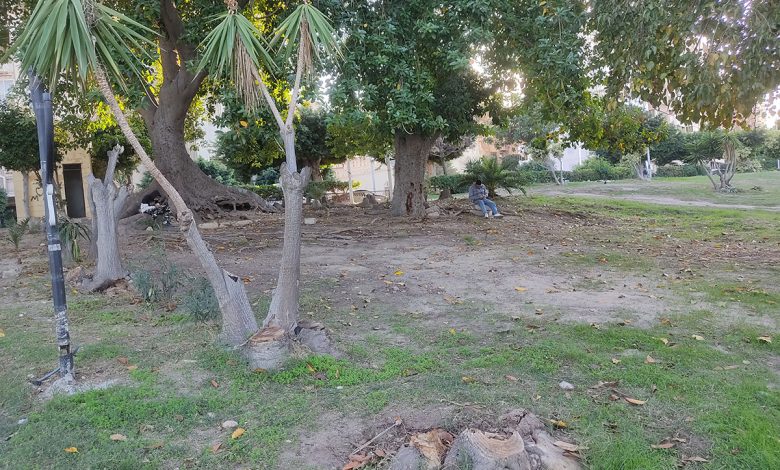
Despite the garden’s prime location in the heart of the city within the Latin Quarter, once Alexandria’s most prestigious neighbourhood, and its free admission, accumulated garbage and lack of maintenance have led to declining visitor numbers. The artificial lakes and waterfalls that once graced the garden have dried up, leaving behind empty basins and crumbling infrastructure.
From Wedding Destination to Abandoned Space
The garden was previously a favourite destination for weddings and memorial photography for newlyweds, set among lush greenery, with no cost or financial burden. This was especially significant after photography session costs at the Montazah and Antoniadis gardens exceeded 1,000 Egyptian pounds (approximately $20 USD) following their renovation. The Shallalat Gardens also hosted numerous wedding receptions in its equipped halls, but these have now been closed and left without maintenance. Adding to the deterioration, some rare trees have been cut down with sections left scattered on the ground, reflecting an absence of expert care and oversight.

Ancient Fortifications Beneath the Gardens
Dr Islam Asem, Professor of Tourism Guidance, explains the historical significance: “The Shallalat Gardens are divided into sections, originally called the Eastern and Western Moat Garden, and the Ptolemaic Garden or ‘Keeper of Secrets.’ These gardens began taking shape in the early 20th century when a road named after Hussein Kamel was opened. The area contained remnants of Alexandria’s ancient city walls, which were part of military barracks under the control of the War Ministry at that time. Part of this area was later transformed into gardens while preserving the archaeological components.”
These walls represent sections of the city fortifications that still exist today, built during the Greek and Roman periods, then the Islamic era, and later the modern period. The area also includes the Nahhasin Fort, a historic defensive structure from the Ottoman period. Due to the historical importance of this location, a Greek archaeological mission currently conducts excavations in part of the garden. According to Dr. Asem, there is auspicious news about important discoveries found in this area, giving the Shallalat Gardens dual significance: first, its archaeological character with ancient walls still standing, despite some sections being relocated during the construction of the Suez Canal Road; second, its cultural character and popular heritage among Alexandrians.

Development Plans Spark Controversy
Regarding the garden’s current state, Dr Asem confirms that numerous development plans exist for this location and that opinions from many experts have been sought. He hopes the development will be implemented properly. Concerning the removal of some trees, he stresses this should only be done by specialists from the Ministry of Agriculture, with mandatory preservation of historic and rare trees. The garden represents part of Alexandria’s collective memory. It once included a dedicated reading area that should be restored, along with free children’s play areas. All of this means a great deal to Alexandrian citizens. Therefore, establishing a major cultural project in this important area would be most appropriate at present.
Dr Mohamed Adel El Desouki, Professor of Architecture at the Arab Academy for Science and Technology in Alexandria, expresses no optimism about the garden’s future. He states that he has reviewed several proposed development projects for the garden, describing them all as “catastrophic.” He expects deliberate neglect of the garden to transform it into ruins rather than a public park. “Overnight, we’ll find the garden filled with cafes, restaurants, and other projects that harm the environment and affect the garden’s historical significance and trees. It will appear to citizens as if it’s better than its previous poor condition, exactly as happened with the Mahmoudiya Canal, which deteriorated to its worst state before being filled in and replaced with a project described as ‘great’ despite being catastrophic from environmental and urban planning perspectives.”
The Khalideen Garden Precedent
The fears of architects and Alexandria residents stem from concerns about repeating the experience of developing the “Khalideen Garden” in Alexandria. This garden, spanning just a few dozen meters, occupied a prime location on the sea corniche at Raml Station near the Ibrahim Pasha Mosque, serving as a breathing space for many Alexandrians.
In 2016, social media erupted with images showing the neglect and poor care of Khalideen Garden. The parking garage beneath it had become a haven for lawbreakers. Development work subsequently began, and Alexandrians were shocked to find the green spaces completely removed from the garden. A collection of restaurants, cafes, and fast food outlets was established instead, transforming it into “Khalideen Mall” by 2017. What was once a rare public green space in the densely built coastal city became another commercial venue, eliminating free public access to nature in one of the few remaining open areas along Alexandria’s waterfront.
The Shallalat Gardens now face a similar fate. While experts advocate for cultural programming and heritage preservation, residents fear that economic pressures and commercial interests will prevail over environmental and historical considerations, erasing another piece of Alexandria’s rapidly disappearing green heritage and public commons.