“The Simsimiyya Told Me to Sing, and I Listened” Egypt’s First Female Simsimiyya Player on Music and Resistance
Interview with Fatma El-Morsy, Pioneering Musician preserving Egyptian folk music across generations
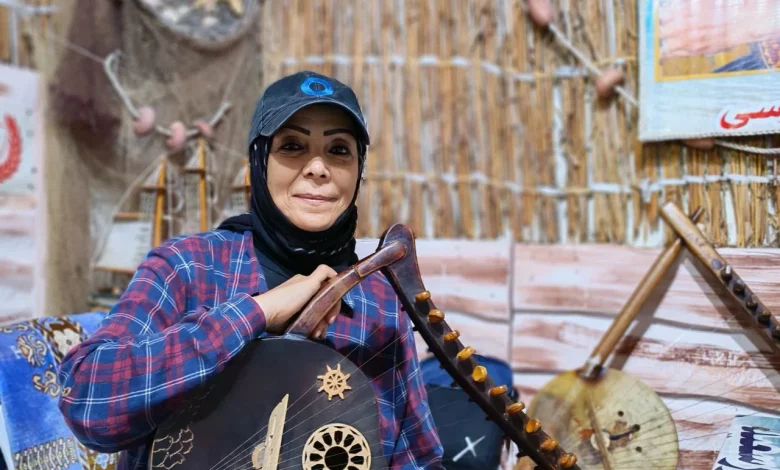
In the port city of Port Said, Egypt, where the Suez Canal meets the Mediterranean, one woman has revolutionised a centuries-old musical tradition. Fatma El-Morsy is the first woman to master the simsimiyya, an ancient Egyptian lyre that has been the voice of Suez Canal communities for generations. This traditional five-stringed instrument, with pharaonic origins, has historically been played only by men in coffeehouses and streets, accompanying songs of the sea, labour, and resistance. Born into a legendary musical family during a tumultuous period of war and displacement, Fatma learned to play at age thirteen when her brothers left for military service, breaking gender barriers and leading the family ensemble “Voice of the Sea” (Sout El-Bahr) through decades of cultural preservation. Her story is one of passion, resilience, and the transformative power of folk music in preserving Egyptian maritime heritage.

First, we’d like to get to know you better. Who is Fatma El-Morsy?
I am Fatma El-Morsy, the first woman to play the traditional Port Said simsimiyya, and leader of the “Voice of the Sea” Folk and Heritage Arts Ensemble. I belong to a distinguished artistic family. My father was El-Reis Morsy, one of the most prominent simsimiyya makers and the lyricist behind the instrument’s most famous songs in the Suez Canal cities.
I grew up immersed in art, and folk music became an inseparable part of my daily life from childhood. I learned to play easily because the simsimiyya was always present at home. One of my sisters played the tabla (drum), another played the spoons rhythmically, and we formed a small household band. I lived in this creative environment that made me the first woman to play the simsimiyya in Egypt, and perhaps in the world.
How did your journey with the simsimiyya begin? When was your first real stage experience?
I started playing at an early age, before the forced evacuation from Port Said. I would join my father and his friends playing in cafes and on the streets. With the evacuation and my brother’s absence due to military service, my father needed musical accompaniment during performances, so he asked me to join him. I was thirteen years old at the time, and he asked me, “Can you play alone? Won’t you be afraid?” I answered enthusiastically: “I won’t be afraid.”
And indeed, I played at a wedding celebration for the first time officially, and sang before an audience, even though the songs were patriotic in nature. That night, my performance surprised everyone, and the audience responded enthusiastically to the playing and singing. That was the beginning of my real launch.

Tell us about your father, El-Reis Morsy. How did he contribute to shaping your career and the family’s artistic journey?
My father was a naturally gifted artist who died young at age 55, but he left an indelible mark on the world of folk art, especially in the Canal cities. He owned a popular café in Port Said that was a meeting place for artists and simsimiyya players, including the great player Ibrahim Khalaf, one of the pioneers in this field.
At that time, the simsimiyya was street art in every sense of the word. There were no sound systems or equipped halls; we played on sidewalks and in squares, surrounded by live, engaged audiences. I was the youngest player and the only girl among men, but it was a fertile environment for honing my talent.
How was the “Voice of the Sea” ensemble founded? Who carried its banner across generations?
My eldest brother, Abdel Qader Morsy, founded the “Voice of the Sea” ensemble as an extension of my father’s artistic project. My brother Hammam Morsy composed and arranged the songs and was also a brilliant player, as was my brother Ibrahim, known as “El-Eitch,” and my brother Gaber Morsy, who took over leadership of the ensemble after Abdel Qader’s death. Leadership passed to me after Gaber’s death two years ago.
The ensemble wasn’t just a family affair; it became part of Port Said’s cultural identity. We continued supporting it with a new generation of children and grandchildren, like my son and my nephew, Ahmed Gaber, who learned to play with us to carry the torch forward.

What role did the simsimiyya play during periods of war and forced evacuation?
The simsimiyya wasn’t just a musical instrument; it was a voice of patriotic resistance. During the forced migration that lasted six years, we carried the simsimiyya with us in our wanderings, and it sang for the homeland, resistance, and the army. We sang during the 1973 war and at the moment of return from displacement.
One of the songs still engraved in my memory goes:
“No matter how long the night lasts for us
No matter how the fire of longing burns
Tomorrow the sun will rise
When we return to Port Said”
My father, El-Reis Morsy, wrote the lyrics of the song “Patriotic Port Said,” which inflamed the feelings of the resistance fighters and made the simsimiyya embrace the weapon, translating the feelings of a people who lived through both victory and defeat, but always sent forth hope.
Tell us about the development of the simsimiyya and what distinguishes it artistically?
The simsimiyya is a stringed instrument of pharaonic origin, traditionally consisting of five strings representing a pentatonic musical scale. It evolved as the number of strings increased to 6, then 7, and even more than 10 strings in some modern models.
My brother Gaber developed a unique musical instrument he called the “Morsiyya,” which blends the strings of the simsimiyya with the oud (Arabic lute), mandolin, and guitar, but retains the simsimiyya’s essence and enchanting sound.
Did you ever go through a period when you stepped away from playing?
Yes, after the evacuation, I practised volleyball and excelled at it until I joined Port Said Club, then Al-Ahly Club, and participated with the national team in international championships in Germany.
Despite being busy with sports, the simsimiyya travelled with me. I would sing and play for my teammates. It remained part of my soul despite the temporary distance.
What about your time living in the city of Rafah? How did it affect your artistic experience?
After participating in a play in North Sinai, I fell in love with the city of Rafah and lived there for 20 years. That period was artistically rich and made me interact with different cultures and communities.
When I returned to Port Said, my brother Gaber had revived the “Voice of the Sea” ensemble after death and travel had separated its members. A new generation joined us, including our youngest player: Amr, who started with us playing rhythm on the tabla at age ten and recently learned the simsimiyya.
What distinguishes the “Voice of the Sea” ensemble from other groups?
What truly distinguishes us is authenticity and diversity. We are an integrated artistic family with our own special heritage and original songs—not limited to traditional material, but creating new works. Having a female simsimiyya player gave the ensemble a unique character and broke the prevailing pattern that the simsimiyya is only for men.
Additionally, our ensemble includes all ages, from young to old, creating a wonderful artistic blend of experience and vitality. This is the secret of our continuity.
Have you faced challenges in continuing as an independent ensemble?
Absolutely. We are a free ensemble not affiliated with the Ministry of Culture, and we receive no financial or moral support. We participate in events and occasions nationwide, appear on satellite channels, and attend important openings, but we haven’t even received an official invitation from the Ministry of Culture to participate in their festivals.
We hope independent ensembles receive more attention because they contain energies and talents capable of representing Egypt in the best light.
What is your dream today?
I dream that love will prevail among all simsimiyya ensembles, because we don’t compete,we complete each other. We represent Port Said and its cultural face, so it’s not appropriate for us to fight one another. I hope we pass the simsimiyya to future generations and teach young and old to love this art, and that we continue the journey begun by those who came before us.
Will you one day lead an all-female simsimiyya ensemble?
Time doesn’t allow me to establish a dedicated women’s ensemble, as the responsibility for “Voice of the Sea” is significant, but I welcome teaching any girl who wants to learn to play. I previously participated in playing with the “Tabla El-Set” (Women’s Drum) ensemble, and we added a simsimiyya segment to their program.
What would you say to young women who dream of learning the simsimiyya?
I advise every girl with genuine passion not to hesitate. Learning the simsimiyya isn’t easy, but it’s possible with determination and practice, and I’m ready to teach any girl with a musical ear and talent. The door is open, the heritage belongs to all of us, and the simsimiyya deserves to be played by hands that are both gentle and strong at the same time.