Alexandria Footnotes Walking Tours: A City That Doesn’t Reveal Its Secrets Easily
By Mirna Gohar
Exploring Alexandria’s hidden layers through footnotes walking tours
If nostalgia were a dish of food, what would it taste like? This simple question, posed by Juan Carlos, co-founder of Footnotes Alexandria walking tours, opens the door to examining the type of nostalgia we feel toward the city. Do we long for a past we actually experienced, or for an imagined version of cosmopolitan Alexandria from the early twentieth century that we never knew firsthand?
The Illusion of Knowing Alexandria
Many people assume they understand Alexandria’s history. We celebrate it as a beautiful city with distinctive character, mourn its decline, and leave the conversation there. Old photographs of neighbourhoods like the Latin Quarter create an illusion of knowledge that prevents us from asking deeper questions or pursuing genuine discovery.
A Methodology Beyond Tourism
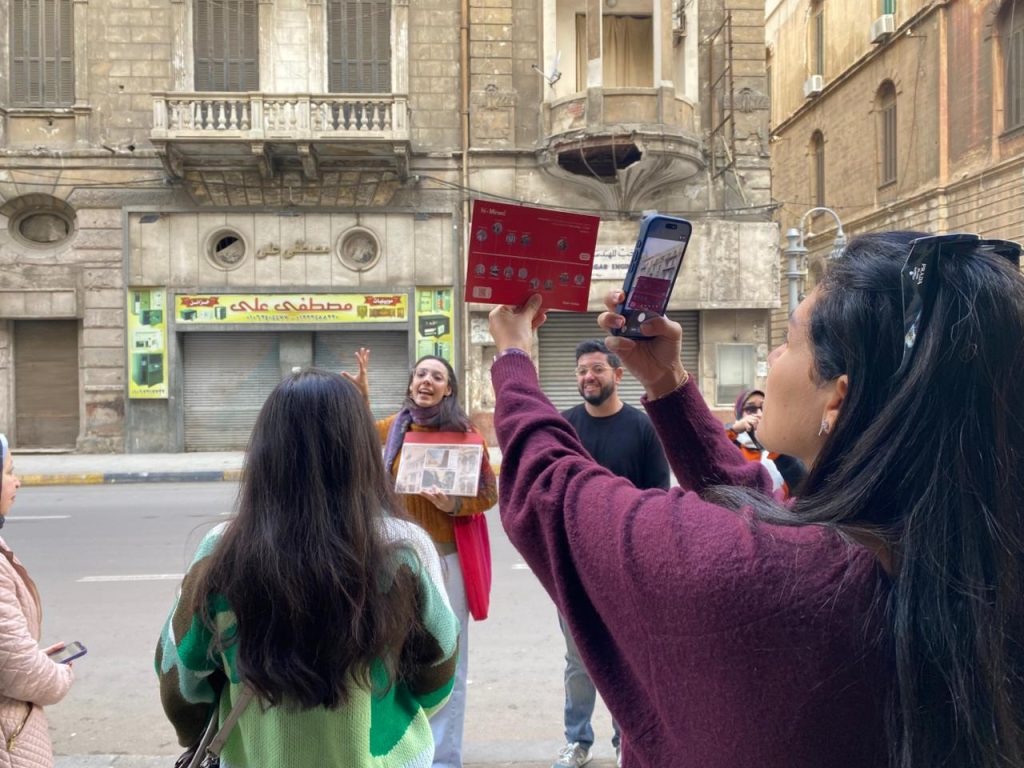
The Footnotes walking tours, founded by Egyptian Egyptologist Wafaa Abdel Aziz and Guatemalan cultural mediator Juan Carlos, challenge this surface-level understanding. On their tour maps, they include a meaningful quote: “Alexandria is a city that does not reveal itself easily. Before it grants you its secrets, it needs time, study, and love.”
This statement represents their core approach to the city. Rather than treating Alexandria as just another tourist destination, they view it as a complex, multilayered text requiring careful analysis. Wafaa brings her academic background in Egyptology and heritage conservation, while Juan contributes his experience as a United Nations cultural mediator. This combination allows their tours to blend scholarly knowledge with human storytelling, connecting official history with lived experience.
Walking as Discovery
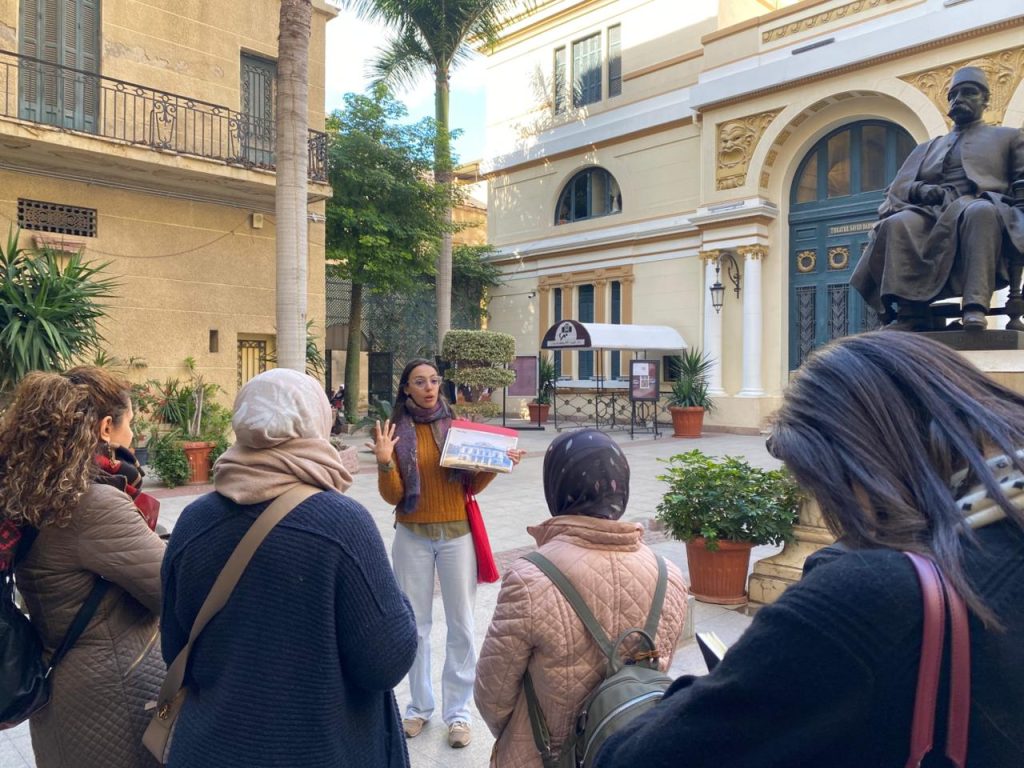
Walking transforms from a casual activity into a tool for understanding. When we walk with the intention to learn, we slow down. Our senses begin to notice what we normally overlook: a square, a building, or an architectural detail that prompts new questions. Throughout the tour, one question persisted: can we call this Alexandria the same city when parts of it change year after year?
Alexandria and the Ship of Theseus Paradox
Alexandria had been burned, with parts destroyed when Julius Caesar arrived. More sections were demolished in 1882 by the British Navy. Yet the city was reborn each time, though in different forms. This continuous transformation echoes the philosophical paradox of the Ship of Theseus, where a ship has its parts replaced one by one until everything has changed. The question becomes: is it still the same ship, or has it become something entirely new?
This same question applies to Alexandria: is it one evolving city, or a succession of different cities sharing the same name?
Sayed Darwish Opera House: Cultural Layers Through Time
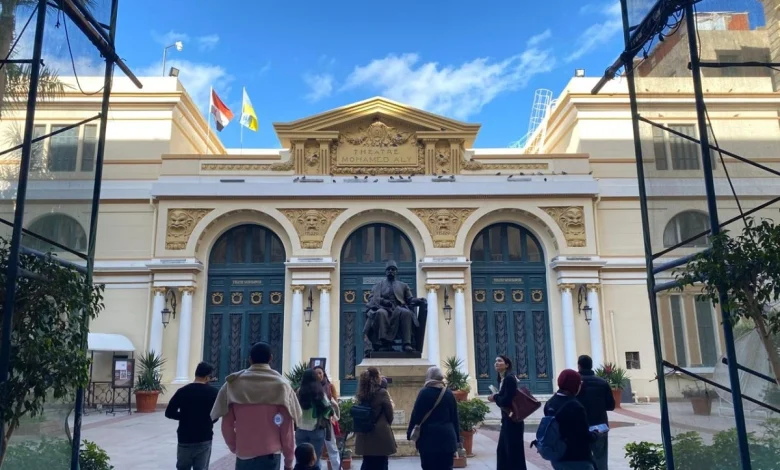
One tour stop highlights this layered history at the Sayed Darwish Opera House on Fouad Street in the Latin Quarter. Wafaa guides visitors through the site’s evolution, revealing that this cultural centre predates the twentieth century by many centuries. Before the current opera house stood the Zizinia Theatre, built in 1864. During its construction, workers discovered a statue of Roman Emperor Marcus Aurelius.
When Function Returns Across Centuries
Marcus Aurelius was both emperor and Stoic philosopher. Wafaa explains that his statue’s presence suggests this location held cultural and intellectual significance long before the theatre’s construction. The fascinating part is not just the archaeological discovery itself, but what it represents. Even though the theatre’s builders likely did not know what lay buried beneath, the site returned to serving the same cultural purpose after centuries.
Culture in Alexandria builds upon itself rather than erasing the past. It reproduces previous functions in new forms. As Gaston Zananiri observed: “Although Alexandria is two thousand years old, it is still Alexandria. There is always something from the past that returns at every moment.”
The Kinetic Memory of Place
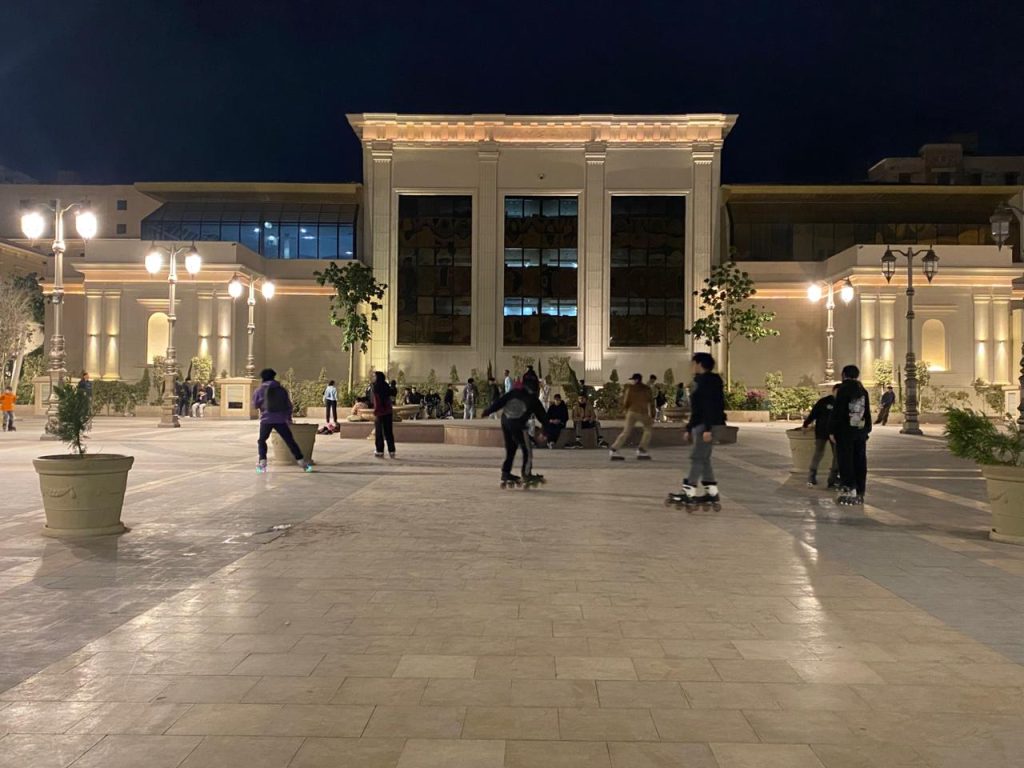
This temporal overlap extends beyond theatres and opera houses into everyday activities. The Greek Roman Museum square, recently renovated and reopened, has become popular for roller skating. This appears to be a modern trend, but it actually continues an older tradition.
Juan and Wafaa explain that the Rosetta Garden Casino once stood across from this square, featuring a large roller skating rink. After the casino’s demolition and replacement with the Paraskivas building, roller skating simply moved to the opposite side, in front of the museum.
This shift demonstrates how use patterns persist even when physical structures disappear. The city’s kinetic memory proves more enduring than its architecture.
Defining Nostalgia
Near the tour’s conclusion, the conversation shifts from places to the feelings they evoke, returning to the question of nostalgia. Juan compares it to coffee, simultaneously bitter and sweet. Wafaa likens it to honey mixed with tahini, where sweetness and bitterness cannot be separated.
Though their metaphors differ, both agree that nostalgia is not a simple emotion. It is a complex experience shaped by culture and memory.
Memory as Fleeting Sensation
Juan shares a story about the Wadi El Nil dairy shop in Manshiya, operating since 1947. The taste of their natural milk transported him back to his childhood in Guatemala. This was not a complete memory recall but rather a brief sensory flash. This small moment illustrates how memory sometimes manifests not as images but as tastes that arrive suddenly and disappear just as quickly.
Why the Name Footnotes?
This attention to small details explains the tour’s name. The couple chose “Footnotes” because it precisely describes their methodology. The stories they share are not full chapters from history books but small details spanning just a few lines or pages. Like actual footnotes in a book, these details often get overlooked or saved for later reading. When finally examined, they prove essential for a deeper understanding. Alexandria is not a straightforward text but rather a book filled with footnotes requiring slow, careful reading.
The Gift of Sight
Footnotes tours may not definitively answer whether Alexandria is one city or many. However, they offer something more valuable: the ability to truly see. They remind us that the city is a living entity resisting superficial observation. Understanding Alexandria requires not mourning what has been lost, but investing time, walking its streets, and having the courage to rediscover what we assumed we already knew.