Farewell to Al-Sayeda and Al-Imam Cemeteries: Scenes of Judgement Day
The end of Cairo’s historic burial grounds: Documenting the Loss of Egypt’s sacred heritage
The Destruction of Cairo’s Historic Burial Grounds
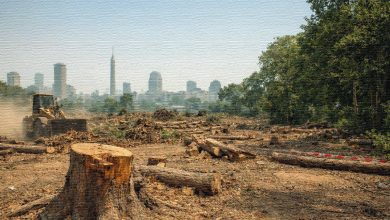
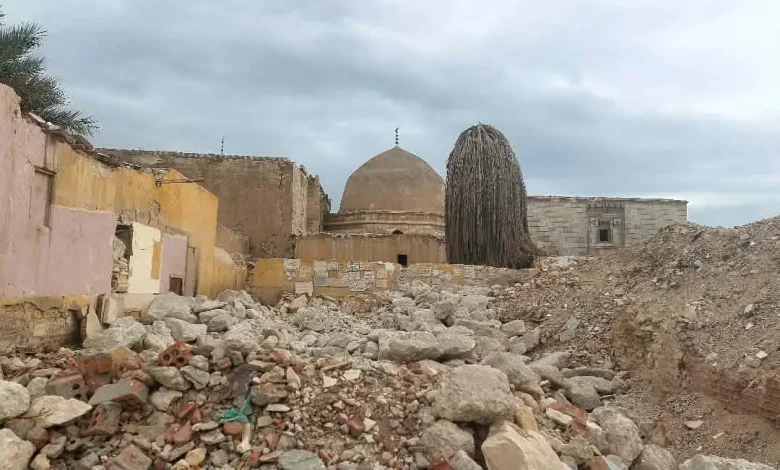
Everyone who built a tomb in Cairo’s cemeteries believed it would remain undisturbed until resurrection day. But government bulldozers had other plans. Throughout 2025, Cairo’s historic burial grounds, particularly the Lesser Qarafa which houses the tombs of Imam Al-Shafi’i and Sayeda Nafisa, witnessed apocalyptic scenes as government bulldozers disturbed the peace of the dead after centuries of rest. For heritage lovers, the year marked the final chapter in the violation of Cairo’s historic cemeteries.
At the end of 2025, I took a tour of the tombs of Sayeda Nafisa and Imam Al-Shafi’i after being away for some time due to life’s demanding pace. It was a Friday, the sacred day when Egyptians visit their deceased relatives. Death holds a special reverence for Egyptians, with rituals passed down through generations. They seek comfort among grave markers bearing the phrase “He is Eternal,” sharing whispered secrets, complaints, and stories between the living and the dead.
A Gray Winter Day of Loss
The weather was distinctly wintry. Clouds gathered in a sky where the sun of hope had vanished. Gray dominated the scene, casting sorrowful curtains that shrouded everything in gloom, as if preparing us for the horror we were about to witness.
Leaving Al-Ashraf Street, where the family of the Prophet rests, toward the square of Sayeda Nafisa Mosque, you move from narrow streets to open space. But memory betrays you. The plaza before the mosque was never this wide, and the horizon was never so open that it merged with the sky’s curve at the edge of the view.
Sayeda Nafisa Mosque Stands Isolated
The Sayeda Nafisa Mosque now stands isolated and alone after the removal of surrounding tombs. Those who chose to be buried near Nafisa the Scholar, seeking blessings in a place Egyptians believe prayers are answered, never imagined that after centuries someone would deprive them of this companionship. Sayeda Nafisa mourned her beloved ones whom the government bulldozer swept away.
Soon the sky’s tears fell on our shoulders, sharing our grief over the random demolition of cemeteries that had lived for ages in peace. They had multiplied in the silence and majesty of death, creating their magnificent urban fabric, before the roar of government bulldozers shattered this oasis of tranquility and tore it apart.
Complete Erasure North of Sayeda Nafisa
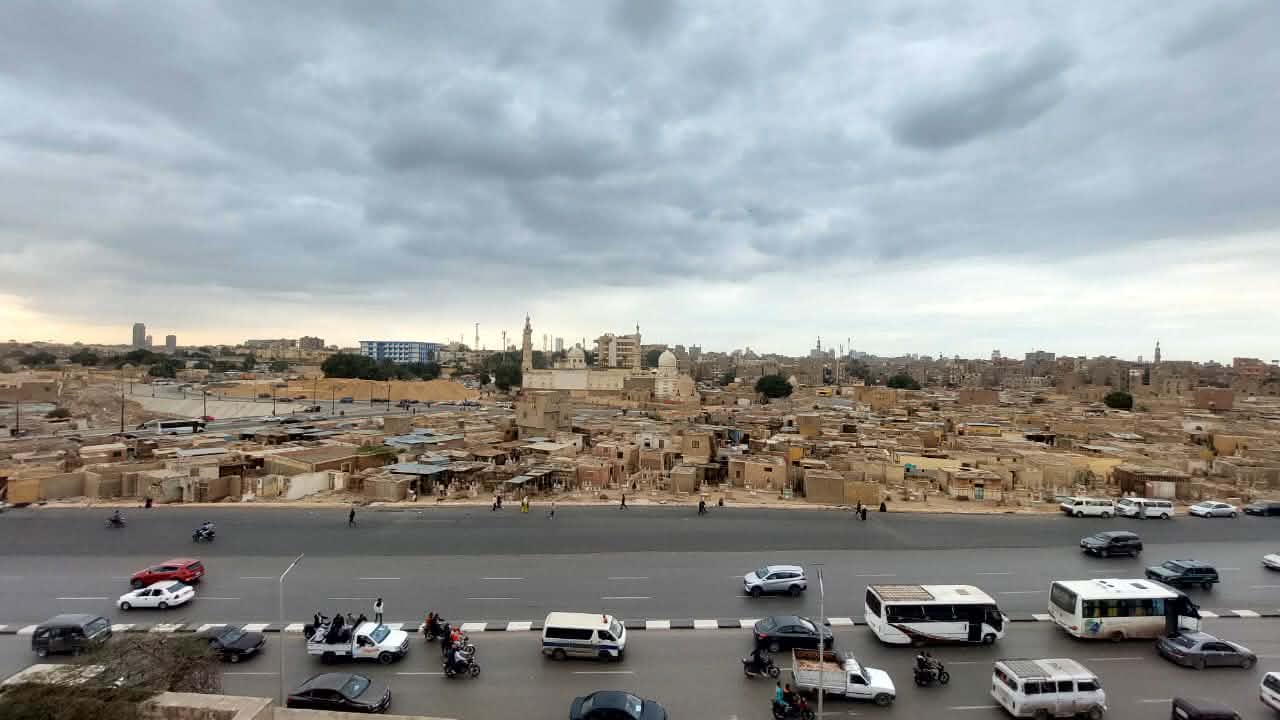
All cemeteries north of Sayeda Nafisa Mosque have been removed, leaving behind a large pit that swallows an entire nation’s history. Only emptiness remains, reminding us of its power to crush both memory and memories together.
Bab Al-Sahara (Desert Gate), located east of Sayeda Nafisa Mosque, now stands exposed and alone, fearing a stray bulldozer might shake its foundation and collapse its structure. Despite its age, it stands tall as a landmark dating back to the Ikhshidid era (10th century CE), forming one of the distinctive features of Cairo’s cemeteries and their unique philosophy.
The tombs and family burial plots vanished as if they never existed, entering the realm of dreams, dissipating under the weight of a new reality imposing its dominance, boasting of erasing memory and besieging remembrance. Here, a network of roads heralds a new consumer invasion headlined by restaurants and cafes, dispersing the majesty the area enjoyed for centuries, deleting the region’s authentic heritage from memory, and creating an unbridgeable gap in the history of this important area that shaped Cairo’s landscape.
The Fate of Ahmed Shawqi’s Tomb
The area between Sayeda Nafisa Mosque and Salah Salem Road now contains only a few remaining tombs. Demolition tools passed through here, severing the cemetery mass and leaving it torn apart. What remains awaits its turn, as the death sentence has been issued for all, including the burial site of Karimat Hussein Pasha Shaheen, which contains the grave of the Prince of Poets, Ahmed Shawqi (1868-1932).
In August 2023, Cairo Governorate issued a statement promising to preserve Shawqi’s tomb, but it was merely a misleading message to public opinion. The execution was carried out, and the tomb was demolished after transferring Shawqi’s grave marker to a place devoid of identity and concept, given a strange, incomprehensible name.
I felt my gaze at Shawqi’s tomb was a farewell. The atmosphere itself created the moment, intensifying my feelings. The clouds gathering on the horizon warned of danger, carrying gray melancholy that cast shadows on the tomb, now standing alone and small after the removal of surrounding graves. It looked astonished at the rubble of what were once tombs, surrounded by roads painted with black asphalt where speeding cars had no time to pause before the ancient history turning its final pages. The tomb was demolished just days after my visit.
A View from Azdamar Minaret
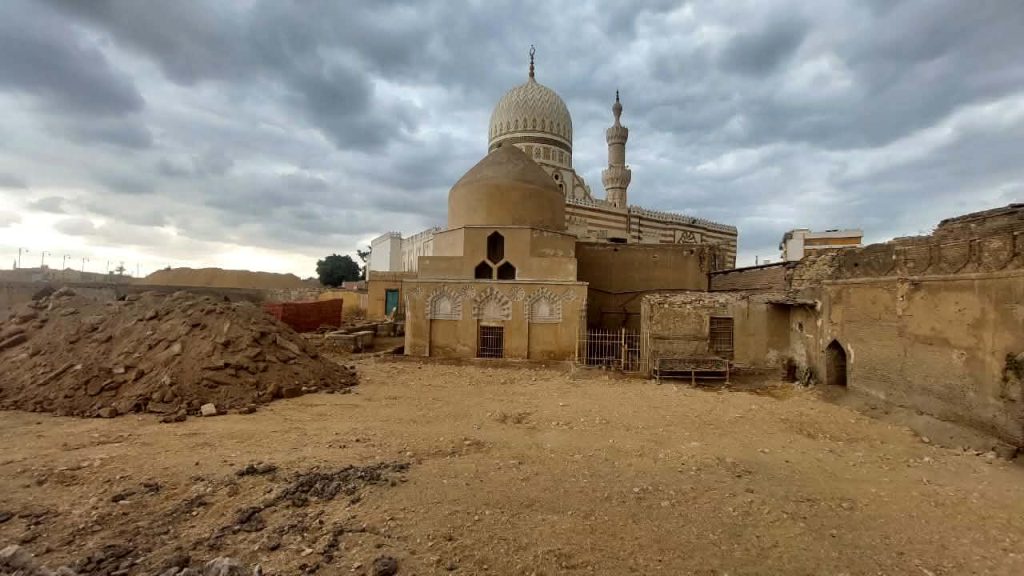
To assess what had happened, an aerial view was necessary to reveal the casualties left by government bulldozers. I climbed Azdamar Minaret with slow steps, my feet heavy with the gloom of the sight and the horror of the loss. My spirit rose as I ascended to emerge from the minaret’s upper balcony onto a horizon no longer the horizon I had known for years. Alienation confronted me, and desolation struck my face.
This place was no longer my place engraved in memory. The government bulldozer crushed both reality and memory. The tombs that were close moved away. An entire row parallel to Salah Salem Road was removed. The cemetery mass around Sayeda Mosque disintegrated due to systematic demolition designed to erase the burial ground.
I descended from the minaret dragging the tail ends of disappointment and defeat. We failed to stop the farce. After confirming the fate of Sayeda Nafisa’s tombs, which is erasure without mercy, keeping only the pieces registered on antiquities lists to serve as distorted reminders stripped of any context about a past that no longer exists and a history we squandered coldly, I had to go to Imam Al-Shafi’i’s tombs, hoping reality would be less harsh and easier to bear. But what happened formed an even greater shock, as if one were before scenes of Judgment Day.
The Destruction of Al-Qarafa Al-Sughra
The front section of Imam Al-Shafi’i Street remains unchanged. Vendors spread their goods on the ground, life appears normal like every Friday, the market is set up and movement is ongoing. But as soon as you advance along the street toward the dome of Imam Al-Shafi’i, the chapters of tragedy unfold without any retouching.
An elevated road cuts through the middle of Al-Qarafa Al-Sughra (Lesser Qarafa), whose heritage dates back more than a thousand years. The road’s design, raised above ground, added a gloomy presence to the center of the Lesser Qarafa. It now obstructs the view of Imam Al-Shafi’i Mosque’s minaret, imposing its crude presence and announcing the death of the Lesser Qarafa as we knew it.
Scenes of destruction replaced the old burial plots and tombs that once adorned memory. Where is Mahmoud Sami Al-Baroudi’s grave? Where is Al-Tahawiya Street and Ibn Al-Farid Street itself? The scene everyone knows as the configuration of Mahmoud Pasha Al-Falaki’s group vanished from existence, leaving us only rubble and ruin.
Lost Landmarks and Shattered Memories
I saw a woman and her son looking at the removal sites, contemplating in silence, perhaps searching for a spot that once had a distinctive marker but is now gone. This is the state of those visiting Imam Al-Shafi’i’s tombs. They search for landmarks and find none. Only a hole in memory exists between what was and what has become, a chaos of memory in which we drown and lie to ourselves: was what we saw reality or tales of imagination?
I thought when I reached the dome of Imam Al-Shafi’i I would find a peaceful square, but demolition spares no stone. The residential buildings in front of Al-Shafi’i were climbed by bulldozers demolishing them from above. The tombs in front of Ahmed Taymur Pasha’s grave were removed, and no better fate befell the tombs facing Hosh Al-Pasha (the burial grounds of Muhammad Ali Pasha’s family).
The Massacre Behind the Dome
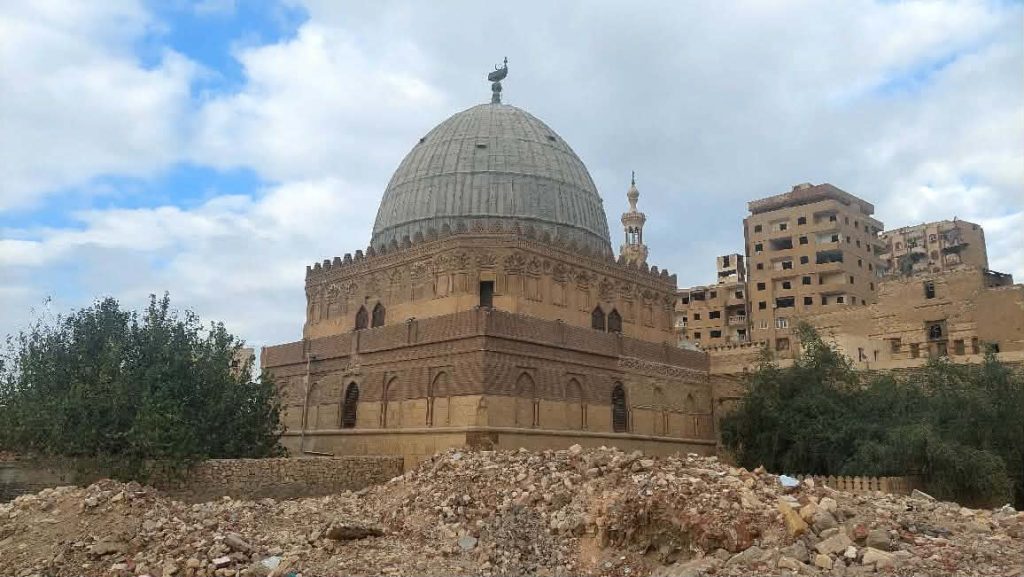
The catastrophe fully reveals itself behind the dome of Imam Al-Shafi’i. Here, a massacre of tombs was carried out, all removed entirely except for the historic Al-Haswati Dome.
Is it possible that this intricate expanse of tombs could transform into an open space of desolation? All were removed. Access to Al-Shafi’i’s dome, which once warmed itself with the comfort of surrounding tombs, became possible from any direction. The dome, dating back to the Ayyubid era, stands for the first time in desolate emptiness after the removal of the graves of loved ones who wanted to shelter under the Imam’s blessing and the place’s fragrance. But the government bulldozer crushed wishes, scattered prayers, and earned us all nothing but regret.
A Final Farewell
I left my visit to the Lesser Qarafa, which dates back more than 1,200 years in history, with mixed feelings of pain over what happened and regret that the demolition was not preceded by excavations and precise documentation operations. Perhaps the question in my mind was: why all this? What puzzles me is that all this systematic and violent destruction occurred without a real purpose. Other solutions could have been sought that were more effective and less costly.
The tour was a farewell in every sense: painful in the magnitude of loss, agonising in the scale of tragedy. Most wretchedly, it confirmed that I will live with a hole in my memory I can never fill. I will live with the reality that I witnessed scenes of Judgment Day in the Lesser Qarafa when destruction and demolition arrived, and the tranquility that the area enjoyed for centuries departed.