The Scent of Castor Fabric: Egypt’s Vanishing Textile Heritage on Al-Qamashin Street
Inside Minya’s historic textile market, where one merchant keeps alive the memory of the cotton blend that once united a nation
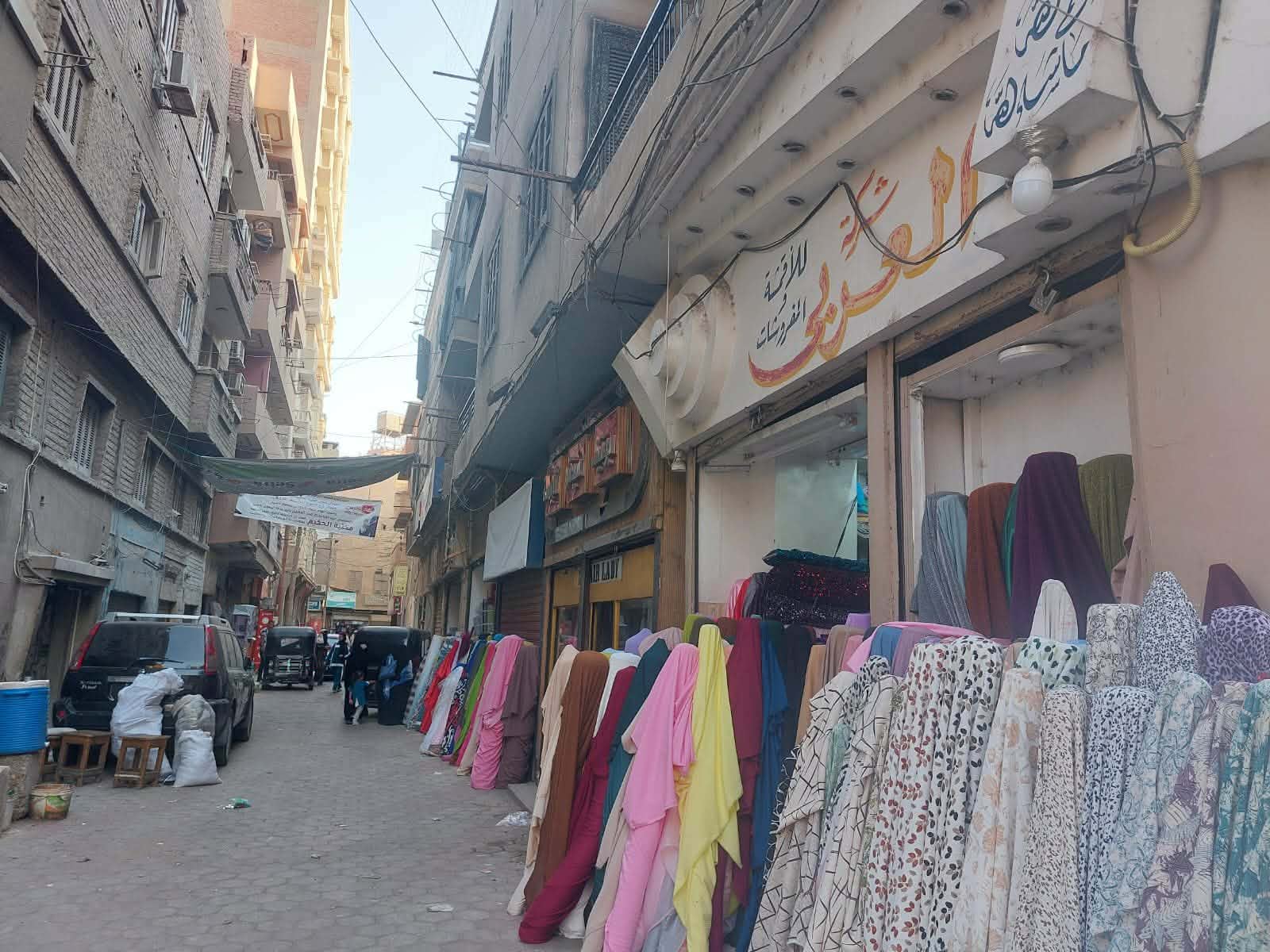
In the heart of southern Egypt, where holiday shoppers crowd narrow lanes and bolts of fabric cascade from storefronts, Al-Qamashin Street in Minya pulses with renewed life. As wedding season approaches and New Year celebrations draw near, this historic textile market in the Al-Fikriya neighborhood awakens to its busiest time of year.
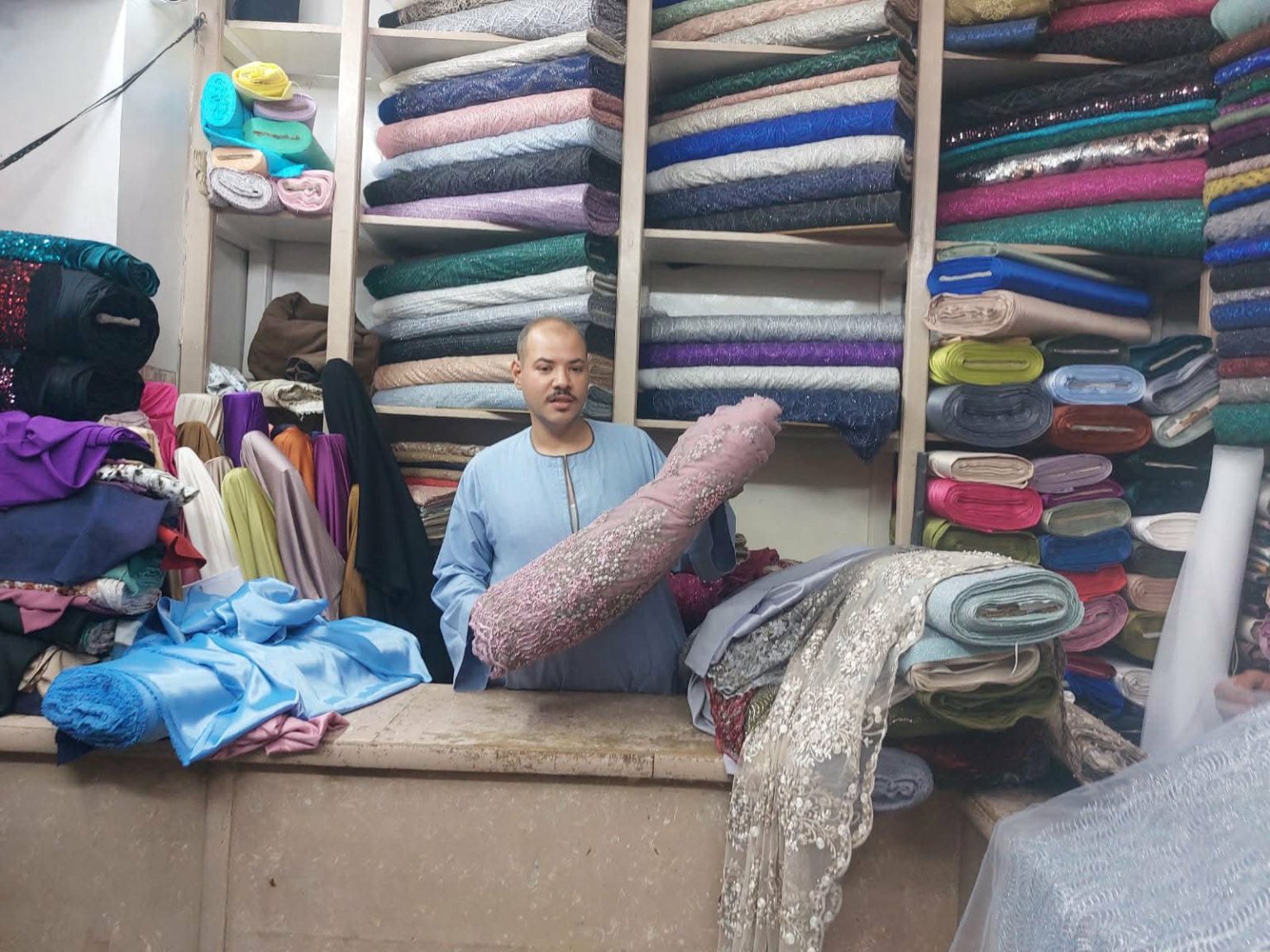
For over six decades, one shop has anchored this street. Here, Hajj Ahmed Al-Arabi tends his colorful wares while humming “Ya Rayheen El-Ghouriya” by Mohamed Kandil, a song that conjures images of Cairo’s medieval market quarter. The melody drifts through the alley, a bridge between past and present, as he shares the story of Egypt’s fading fabric traditions.
Where Ancient Threads Meet Modern Egypt
Al-Qamashin Street tells a story older than memory. Located in Minya, a city 245 kilometers south of Cairo, this marketplace has served as a living museum of Egyptian textile heritage. The street’s name itself evokes the trade: “qamashin” refers to fabrics in Arabic, while merchants here once carried the title “Al-Bazzazin,” the Arabic word for cloth dealers who supplied the ancient world.
Al-Arabi, whose honorific “Hajj” marks him as one who has completed the pilgrimage to Mecca, presides over what may be the street’s oldest continuously operating fabric shop. Despite his degree in Islamic law and jurisprudence from the Faculty of Sharia and Law, he chose scissors over statutes, inheriting a profession he’s loved since age six.
“He who built Egypt was a weaver,” Al-Arabi says with evident pride, referencing Egypt’s millennia-long reputation for producing the world’s finest linen and cotton. In pharaonic times, fabric marked social standing as clearly as any title. Silk and cashmere adorned the wealthy, while linen clothed the masses.
A Childhood Measured in Fabric and Memory
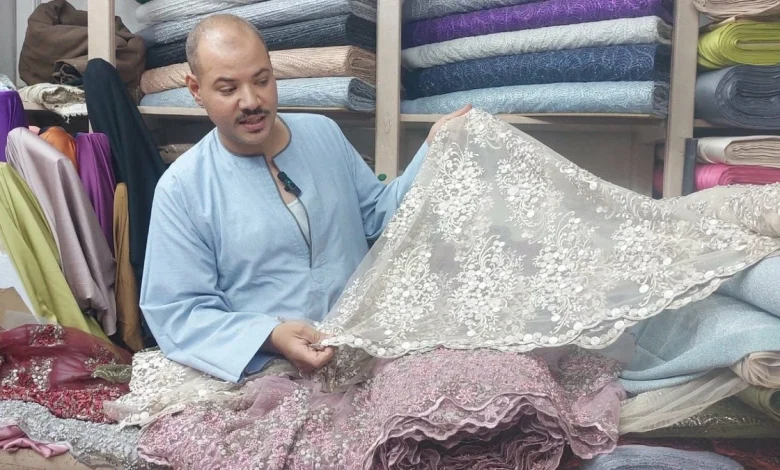
“Not everyone who holds scissors becomes a fabric merchant,” Al-Arabi reflects, his hands moving with practiced ease through layers of embroidered tulle. His father ran this shop before him, catering to village notables and urban dignitaries who traveled from distant towns seeking the finest English wool, Mahalla cotton (from Egypt’s northern textile hub), and the luxurious “Shahi” fabric favored by Ottoman-era pashas.
The shop’s inventory once read like a catalog of mid-century Egyptian life. There was castor, the sturdy cotton blend distributed on government ration cards alongside sugar and cooking oil. There was “Nadia Tiel,” the beige fabric that became synonymous with school uniforms across Egypt, creating a rare moment of equality when farmers’ children and teachers’ children wore identical aprons to class.
“The Nadia Tiel apron equalized everyone,” Al-Arabi recalls. “It dissolved class distinctions, at least within school walls.” Today, he notes with some regret, fashion has fractured along economic lines, each social class claiming its own style.
“Garden City Ladies” and the Return of Vintage Elegance
Walk into Al-Arabi’s shop, and you’ll find fabrics bearing names like poetry: “Garden City Ladies,” his specialty line named for Cairo’s elegant colonial-era neighbourhood where artists and aristocrats once lived. These evening fabrics channel the 1950s and 60s, when puffed dresses, monochrome elegance, and cinched waists defined Egyptian glamour.
“The stars of the good old days are still queens in the world of elegance,” he insists, gesturing toward bolts of satin sequined fabric, guipure lace embedded with glass beads, and chiffon printed with dazzling patterns. Global fashion houses have rediscovered these vintage silhouettes, he notes: the ruffles, pleats, and cloche pockets that once graced Egyptian cinema screens during the golden age of black-and-white films.
His busiest seasons align with Egypt’s social calendar. Wedding season peaks during New Year’s and Christmas holidays, when brides-to-be hunt for that perfect fabric to transform into an unforgettable gown. The shop fills with women debating between tulle and taffeta, between sequins and embroidery, their voices blending with Al-Arabi’s continued humming.
The Castor Chronicles: Egypt’s Beloved Fabric
If any single textile captures Egyptian nostalgia, it’s castor. This durable cotton blend dominated Egyptian wardrobes from the 1940s through the 1990s, its distribution through government ration cards making it accessible to every household. Egyptian cinema immortalised it: Hussein Riyad and Ismail Yassin wore castor galabiyas in countless black-and-white films.
“Castor fabric holds a special place in Egyptian hearts,” Al-Arabi explains. Its practical virtues matched its symbolic importance. The fabric absorbed summer heat while providing winter warmth, making it ideal for Egypt’s climate. Yet castor has nearly vanished from modern markets, a victim of declining cotton cultivation and the flood of cheaper polyester imports.
“Many customers ask for it,” Al-Arabi says, “but it’s become rare and expensive.” The fabric that once united Egyptians across class lines now exists mainly in memory and old film reels.
Forgotten Fabrics with Unforgettable Names
Al-Arabi catalogs the disappeared textiles with the fondness of someone reciting lost friends’ names: Calmando for men’s trousers. Brocade for formal occasions. “Soko Soko” with its distinctive black cording. Damascus, Cazou, Tercal, and Taffeta. Velvet that once lined winter coats.
Then come the whimsically named fabrics that delighted Egyptian women: “Ladies’ Flesh,” “Eyelash,” “Chick’s Eye,” “Sea Wave,” and “Dove’s Neck.” Each name was marketing poetry, designed to capture imagination and open purses.
The dress cuts bore equally charming monikers. “The Effendi’s Bite” featured two open circles at the shoulders, named for the educated middle-class men who set fashion trends. “The Beloved’s Eye” or “The Bulb” described certain necklines. “The Melon” bared the shoulders boldly, while “Ladies’ Coquetry” meant layers of ruffles.
These names have outlived the fabrics themselves, preserved only in the memories of shopkeepers like Al-Arabi and the customers who remember buying them decades ago.
The Galabiya’s Evolving Identity
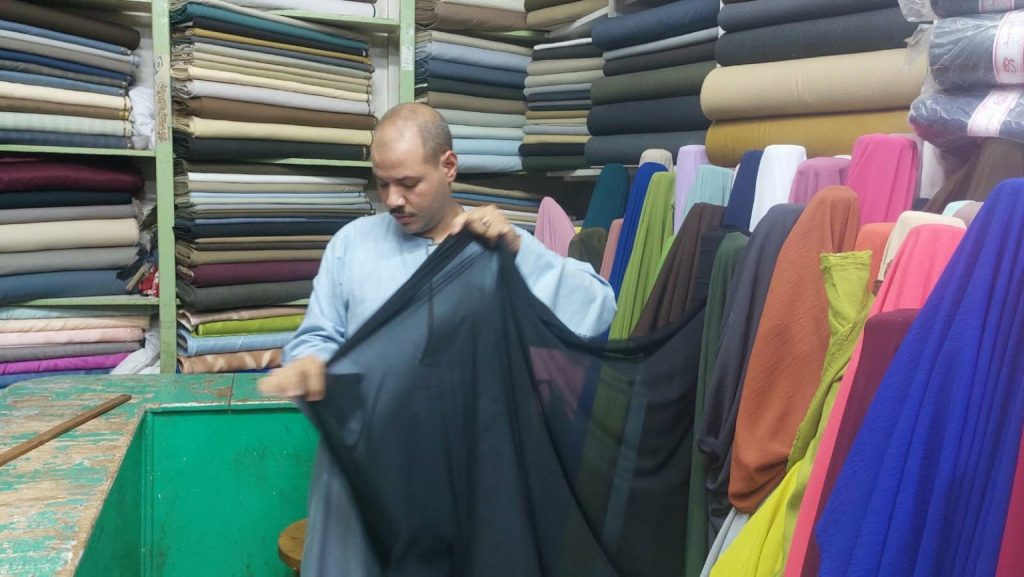
Traditional galabiyas remain central to Al-Arabi’s business, though the fabrics have transformed. Village heads and farmers once wore distinctive galabiyas in English wool, Mahalla cotton, castor, or the luxurious Shahi weave. Today’s options include “Golden Tex,” modern Egyptian manufacturing, and imported gabardine.
“The materials have changed,” Al-Arabi acknowledges, “though Egyptian wool remains the finest quality.” The galabiya persists as daily wear in rural areas and as formal attire for urban Egyptians during religious holidays and special occasions. Its silhouette endures even as its fabrics evolve.
A Call for Cotton’s Return
Al-Arabi’s nostalgia sharpens when discussing Egyptian cotton, once renowned worldwide for its extra-long staples and lustrous finish. The decline of cotton cultivation devastated Egypt’s spinning and weaving industry, transforming a source of national pride into an import-dependent afterthought.
“We hope for cotton to return to its old throne,” he says, “so the spinning and weaving industry returns with it.” He recalls when cotton harvest season meant prosperity for fabric merchants, when wedding bookings surged and customers had money to spend on quality textiles.
An old Egyptian song captures what’s been lost: “You have brightened, O Cotton of the Nile… How sweet you are, O beautiful one.” The lyrics celebrate an agricultural tradition that shaped Egyptian identity for generations.
Threads of Continuity
As afternoon light slants through Al-Qamashin Street, Al-Arabi continues arranging his inventory, preparing for the evening rush of customers. His shop stands as more than a retail space. It’s an archive of Egyptian material culture, a reminder that fabrics carry stories beyond their threads.
The street itself endures as a living connection to Egypt’s artisan past, even as shopping malls and online retailers reshape how Egyptians buy clothing. Here, amid the scent of new fabric and old memories, Al-Arabi keeps singing the songs of good old days while measuring out cloth for tomorrow’s celebrations.