Red Sea Simsimiya vs. Suez Canal: How One Instrument Tells Two Egyptian Stories
For three thousand years, a wooden lyre has travelled the Red Sea, first strung with animal intestines, later with fishing line, then telegraph wire, finally bicycle brake cables. Each adaptation tells the story of the people who played it: enslaved Africans, pearl divers, fishermen on months-long voyages, and eventually, Egyptian resistance fighters. But when these two traditions met at a festival last October, they discovered they were playing the same instrument in completely different languages.
When five dancers from the Halayeb Folk Arts Troupe took the stage at the Ismailia Folk Arts Festival last October, the audience struggled to connect with their performance. The troupe performed the traditional “Hoist” dance, accompanied by the simsimiya—a traditional lyre-like stringed instrument—but the crowd, accustomed to the version played in Egypt’s Suez Canal cities, barely engaged with what they heard.
A Different Musical Tradition
“It’s natural for the audience not to connect with the Shalatin tanboura because the musical rhythm is different, due to the accompanying instruments that drown out the sound of the tanboura,” explains Ali Abdel Rafea, Director of the Halayeb Culture Palace. (Halayeb and Shalatin are remote cities in Egypt’s far southeastern corner, near the Sudanese border along the Red Sea coast.)
The disconnect revealed a broader truth: while Egyptians often associate the simsimiya with the Suez Canal region, the instrument actually belongs to a much wider cultural heritage spanning the entire Red Sea basin. This heritage extends from Jordan in the north to Saudi Arabia’s Jeddah and Yanbu, south to Yemen, and west across the Red Sea to Eritrea, Somalia, and Sudan, as well as Egyptian Red Sea ports.
In the Suez Canal cities: Port Said, Ismailia, and Suez, the simsimiya has become intimately linked with songs of resistance dating back to Egypt’s struggles against foreign occupation. But this represents just one chapter in the instrument’s much longer story.
Evolution of Sound Across Generations
Today’s younger musicians in Halayeb and Shalatin have adapted their approach, explains Abdel Rafea. Rather than relying solely on traditional percussion and drums as older generations did, contemporary players now incorporate electronic organs to accompany the tanboura (another name for the simsimiya). Combined with the use of recorded backing tracks, this creates a sound quite different from what Canal City audiences expect.
Despite these modern innovations, the instrument,locally called “bassankob” in Halayeb and Shalatin, continues to thrive as young people train on it. Meanwhile, older musicians preserve traditional singing styles that younger generations have largely moved away from.
International Recognition
In December 2024, Egypt and Saudi Arabia successfully registered the simsimiya on UNESCO’s Representative List of the Intangible Cultural Heritage of Humanity. Dr Nahla Emam, Cultural Heritage Advisor to Egypt’s Ministry of Culture, noted that the registration came in response to requests from multiple Red Sea basin countries. Jordan has applied to join the registration, while Yemen and Sudan have expressed unofficial interest.
“This confirms that simsimiya heritage is shared among these countries, while each country retains its own specificity and cultural diversity,” Dr Emam stated.

The Sound of the Sea
The simsimiya’s history is deeply intertwined with maritime life. Historically, Red Sea fishermen would spend days or months at sea in small wooden boats called “sanabeq” and “falayek,” explains Amr Raawi, Director of the Red Sea Youth Troupe in Ras Ghareb (a coastal town in Egypt). They carried supplies, including wooden barrels of salt for preserving fish before refrigeration existed, along with flour and fabric for trading at various ports. The simsimiya accompanied them on these long voyages.
Trade and pilgrimage routes facilitated cultural exchange throughout the Nile and Red Sea regions, with the tanboura and simsimiya spreading wherever ships travelled between ports.
According to Raawi, the simsimiya music in Egyptian Red Sea towns like Hurghada, Ras Ghareb, and Al-Qusair was strongly influenced by Jeddawi adwar (musical forms from Jeddah, Saudi Arabia) and maritime rhythms. These differ significantly from standard Egyptian rhythms, relying heavily on a “dumm” beat that mimics the rumbling and undulation of ocean waves. The greatest influence came from Khabayti art originating in Yemen, which uses different musical modes (maqamat) than those familiar in the Canal cities.
From Improvised Materials to Modern Construction
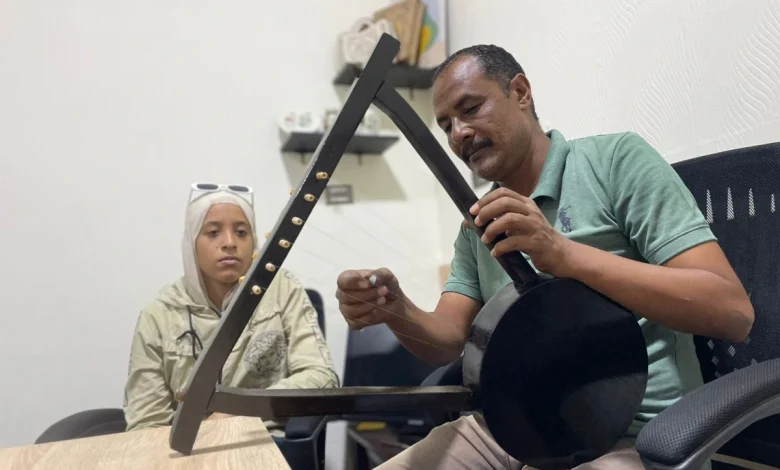
The instrument’s evolution reflects the resourcefulness of seafaring communities. Originally, the simsimiya was crafted from a wooden bowl, with strings made from animal intestines. However, the humid sea air caused these strings to slacken and lose their tone.
Fishermen experimented with alternatives: first net yarn and fishing line, then telegraph wire, and eventually bicycle brake cables as they sought materials that could withstand the maritime environment and compete with the loud sounds of wind and sails. The sound boxes evolved from bowls to wooden constructions, while the body was eventually made from tinplate to amplify the instrument’s volume. Arms and tuning pegs were carved from wood.

Trade Routes and Musical Origins
Raawi proposes that the simsimiya’s spread throughout the Red Sea region can be traced to two primary historical activities: pearl diving expeditions during the era of the legendary Queen of Sheba (approximately 10th century BCE), and extensive trade between the Red Sea’s eastern and western shores, including the tragic history of the slave trade.
Notably, many pioneering simsimiya players in Aqaba (Jordan), Jeddah, Yemen, and even Egypt’s Canal cities were people of African descent. Raawi references a verse from a traditional Khabayti-style song that alludes to this painful history:
“Dallal takes me by the hand in the market, he flatters me,
And if the awazel ask about me, say destiny is upon me.”
In this context, “dallal” refers to a slave auctioneer. Such songs represent a rare and often hidden aspect of simsimiya heritage. Many early master players were dark-skinned individuals, including members of the Beja tribes and their relatives among the Ababda and Bishari peoples. These communities have maintained traditions linking back to an instrument called “bassankob,” which has roots in ancient Egyptian civilisation and continues to be played in Halayeb and Shalatin today.
Many Names, One Family of Instruments
Across the Red Sea basin, this family of lyre-like instruments goes by various names reflecting local languages and cultures. In Jordan, it’s known as the Aqabawi Simsimiya, while in Saudi Arabia, it’s called the simsimiya in Yanbu, Abha, and Jeddah. Southern Yemen also uses the name simsimiya. On the African side of the Red Sea, the Beja tribes of Sudan and southern Egypt call it the tanboura or bassankob, while in Eritrea it’s known as the masanqo or qarar.
Dr Kawkab Tawfiq, a professor at the French Institute of Oriental Archaeology, notes in her 2021 research presented at the Arab Music Conference that German ethnographer Hans Alexander Winkler documented the instrument’s presence in his 1936 book “Egyptian Folklore.” Winkler observed it in the Hamata and Al-Qusair regions of Upper Egypt among fishing communities, where it was called “tanboura” in Hamata and “simsimiya” in Al-Qusair.
Winkler also found the simsimiya being played in cafes at Jeddah’s port, suggesting that this lyre spread across the Red Sea region from Sudan and the Horn of Africa, originally serving as a musical instrument for fishermen and becoming a feature of coastal cafe culture.
Ancient Nubian Roots
In his book “The Music of Egypt and Sudan: Civilizational and Cultural Evidence,” poet and composer Abdullah Saleh traces the tanboura’s lineage back to ancient times. Among the instruments famous in Egyptian civilisation, including the flute, harp, lyre, oud, buzuq, and kinnarah, the tanboura stands out as an ancient stringed instrument with Nubian origins.
Saleh explains that the word “tanboura” in the Nubian language combines “to” (meaning stomach or belly) and “bur” (meaning hollow), creating the meaning “that which has a hollow belly”,an apt description of the instrument’s resonating chamber.
Songs of Resistance Versus Songs of the Sea
A key distinction exists between the simsimiya traditions of the Canal cities and the Red Sea coast, according to Raawi. In the Suez Canal region, simsimiya music emerged from resistance to foreign occupation and war. The instrument became synonymous with Canal city identity during the 1956 Tripartite Aggression (when Britain, France, and Israel invaded Egypt following the nationalization of the Suez Canal), particularly through the powerful poems of Mohamed Youssef, which remain popular today.
By contrast, Red Sea communities, despite experiencing conflict such as the Battle of Shadwan Island (a 1970 military operation that became the Red Sea Governorate’s national day commemoration), did not develop the same intensity of resistance-themed simsimiya songs. Instead, their musical tradition focused on the sea itself,celebrating maritime life, travel, and the pilgrimage to Mecca.
Preserving Tradition Through Education
In Ras Ghareb, Amr Raawi has established a school teaching children to play the simsimiya within a private educational centre. Heba Hamed, the centre’s director, explains their mission: “We are trying to fill a gap in music education in the city, because public schools do not offer music classes, and neither does the official Culture Palace. So we started training courses targeting children to learn the simsimiya.”
She continues: “We know and love the simsimiya, but new generations are not very connected to this heritage, so we began promoting it. We currently have 15 students who are constantly developing their skills. We want to affirm that the simsimiya is not just an instrument for celebrating weddings, but a musical cultural heritage for our city and all of Egypt.”