Art Deco Architecture in Alexandria: Why This 100-Year-Old Style Still Matters Today
A century ago, Alexandria became an unexpected laboratory for Art Deco—the world’s first truly global architectural style. European architects fleeing war found freedom to experiment in this Mediterranean port, leaving behind buildings that still pose a question: can architecture today answer our era’s challenges as boldly as Art Deco answered its own? Mirna Gawhar reports.

The name Alexandria often evokes an image of a city that was once more beautiful—a place we retreat to in memory when the present feels too confining. But nostalgia alone cannot explain our recurring fascination with a specific architectural style like Art Deco. This month, the Bibliotheca Alexandrina celebrated the centenary of Art Deco with a symposium titled “Art Deco Architecture: A Mediterranean Perspective,” aiming to shed new light on this historic style and reinterpret it through contemporary questions.
This event is more than just a celebration of architectural heritage; it raises broader questions: Why are we revisiting this style today? What does it represent? How did it become the first truly global architectural style? And how did it adapt within a Mediterranean city like Alexandria?
What is Art Deco?
Art Deco emerged in France in the 1920s, in the aftermath of World War I. The world was in upheaval, searching for a new artistic language to reflect a reality fundamentally transformed by machinery, industry, speed, and social change. Classical art alone could no longer express this new reality, nor was pure Modernism entirely sufficient. Art Deco emerged as a middle ground,a style that celebrated industrial progress without abandoning beauty.
The name derives from the “Exposition Internationale des Arts Décoratifs et Industriels Modernes” held in Paris in 1925. However, the term “Art Deco” wasn’t widely used until the 1960s, during a wave of rediscovery in the United States and Europe. Before that, it was often referred to simply as “Moderne.”
The philosophy of Art Deco was built on reconciling opposites: industry and craft, ornamentation and simplicity, luxury and function. Its fundamental aim was to answer an essential question: How can humanity preserve beauty in a world ruled by machines and speed?
Why Did It Become a Global Style?
Art Deco became a global phenomenon not just because of its wide geographical reach through international exhibitions,like the Paris Expo, which showcased an elite selection of global artists, but because it relied on a set of visual principles that transcended borders. These included geometric simplification, a celebration of the industrial age, and a balance between beauty and utility.
Art Deco drew inspiration for some of its ornamentation from ancient civilisations, such as Egypt and the Aztecs. Yet it didn’t impose a rigid template; instead, it allowed for diverse interpretations within a shared visual language.
As a result, it manifested differently around the world: in Paris with its elegant ornamentation, in New York with its bold vertical emphasis, and in Mediterranean cities with entirely distinct characteristics. In this sense, it can be considered the first global architectural style,not through uniformity, but through its remarkable capacity for adaptation.
Alexandria as a Mediterranean Model
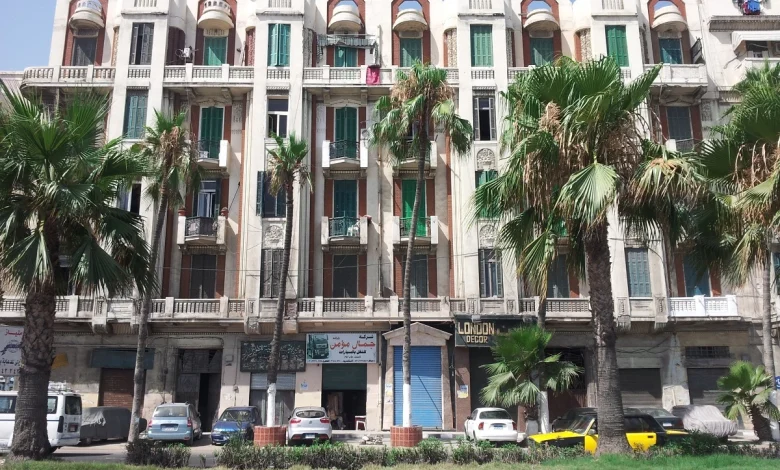
It was natural for Art Deco to take root in Alexandria, a city that had attracted artists and architects of various nationalities since the 19th century. By the first half of the 20th century, especially after the World Wars, the city became a haven for those fleeing Europe’s devastation. They found in Alexandria a space to experiment with new architectural trends that weren’t yet accepted in their home countries,Art Deco among them.
During the symposium, architects Amani Mohamed and Reem Abdel Azim, presenting their research on “The Influence of Globalism on Art Deco,” noted that the area between Al-Mansheya Square and the Al-Morsi Abul Abbas Mosque along the Corniche, the parallel street (the tram street known as Mohamed Karim), and the connecting streets contain about 48 Art Deco buildings out of a total of 160 in the area.
This concentration coincided with the expansion of the Alexandria Corniche during the reign of King Fouad I. This urban development created new spaces that were used to implement some of the latest global architectural trends, foremost among them Art Deco.

Varieties of Art Deco in Alexandria
According to architect Mohamed El-Awad, a heritage conservation specialist and deputy director of the Alex-Med research center, Art Deco in Alexandria didn’t appear in a single, fixed form. It took on multiple expressions reflecting the city’s diversity and the varied backgrounds of its working architects.
El-Awad identified four main expressions of Art Deco in Alexandria. The first is early Art Deco, characterized by simplicity and clear vertical lines. The second is an eclectic style with classical influences, as seen in the Rio Cinema. The third blends Art Deco with local ornamentation or Pharaonic and Islamic motifs, such as the Heikel building next to the Cecil Hotel. The fourth expression is modern Art Deco, which moved toward greater simplification, streamlining, and reduced ornamentation, as seen in the insurance company building in the Sporting district.
This diversity reflects the style’s ability to blend with the local environment, both in terms of materials used and cultural references. It makes Alexandria’s experience a clear example of the Mediterranean perspective addressed by the symposium.
Cinemas and Art Deco: The Language of the Modern Age
One of the most prominent venues for Art Deco in Alexandria was cinema buildings. According to Rawaa Sameh, an assistant professor of Modern Sciences and Arts at October University, in her presentation “Tracing the Architectural Heritage of Art Deco Cinemas in Alexandria and Cairo,” there is a connection between the birth of cinema and the spread of this style.
Cinema, as a modern art form at the dawn of the 20th century, required dedicated buildings for film screenings, which coincided with Art Deco’s rise. As cinema evolved from temporary shows to permanent institutions, Art Deco was among the first architectural styles used to design theaters, thanks to its capacity to express the machine- and technology-driven spirit of the age.
Light and Movement
The splendour of Art Deco was evident in clean geometric façades and carefully designed entrances that created a visual experience for audiences, along with an emphasis on lighting and movement within the building. This is why cinemas like the Rialto and Rio were built in this style.
However, this legacy hasn’t remained entirely intact. The Rialto Cinema, which Rawaa noted was the first cinema built in this style, was demolished in 2013. Meanwhile, the Rio Cinema still stands today on Fouad Street, serving as a living example through which its features can be studied.

Why Do We Celebrate?
We don’t celebrate Art Deco to reuse it in contemporary construction, nor because we seek to resurrect a century-old style. We celebrate it because it reminds us how architecture once managed to clearly answer the questions of its era, reflecting a historical moment after which the world changed fundamentally.
Art Deco was a conscious attempt to reconcile beauty and machine, the global and the local, modernity and humanity. Celebrating it is an attempt to understand how that answer emerged, not to replicate it. This leads us to pause and ask ourselves: Do we possess the intellectual and cultural climate today that would allow a new architectural style to emerge, one capable of answering our contemporary questions as Art Deco did for its time?