After 27 Years, Amenhotep III’s Alabaster Colossi Restored to Egyptian Temple
In a triumph of modern archaeology over the ravages of time, the colossal statues of a pharaoh have risen again. After nearly 27 years of painstaking restoration, the twin alabaster figures of King Amenhotep III have been returned to their rightful place in his Luxor temple.

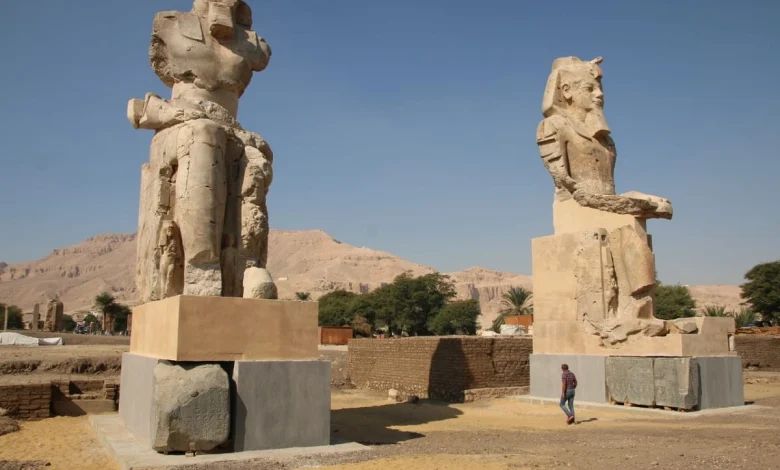
Life has returned once more to the colossal statues of King Amenhotep III in his memorial temple on the West Bank of Luxor. Following nearly 27 years of painstaking restoration and reassembly, the two monumental figures have been returned to their original positions, standing guard after millennia buried and broken. They are powerful, if poignant, symbols of survival; one statue is missing an arm and a foot, while the other stands headless, armless, and without its feet.

The Temple of Millions of Years
The Temple of Amenhotep III, often called a “Temple of Millions of Years” (a term for royal mortuary temples), recently unveiled its two reassembled alabaster colossi. They were reinstalled at the temple’s third pylon, marking a major milestone in the ongoing conservation of the site. This achievement is the result of decades of work by the Egyptian-European archaeological mission under the leadership of Dr. Hourig Sourouzian.
The Grandest Mortuary Temple: A Legacy of Amenhotep III
The site commemorates King Amenhotep III (c. 1386-1349 BCE), a pharaoh of the prosperous 18th Dynasty whose long reign is considered a golden age of art, diplomacy, and monumental building. His mortuary temple was originally the largest of its kind on the Theban west bank, the necropolis for ancient Egypt’s capital.
Dr Mohamed Abdel-Badea, Head of the Central Administration for Egyptian Antiquities, noted that the temple complex originally covered a vast area of approximately 450 by 700 meters. Amenhotep III established his administrative capital, palace, and extensive estates on the West Bank, making his temple the focal point of a royal city.
The newly erected statues join other restored colossi at the temple’s first and second pylons, gradually restoring the site’s awe-inspiring ancient processional way.


Temples of “Millions of Years”: Ensuring Eternal Life
As Dr. Abdel-Badea explained, the name “Temple of Millions of Years” reflects its core religious function. In ancient Egyptian belief, such a temple was not just a tomb but a perpetual cult centre designed to sustain the king’s spirit (or ka) for eternity. Through ongoing rituals and offerings performed here, the deceased pharaoh would maintain his divine connection, particularly with the supreme god Amun-Ra, and thus achieve immortality.
A Rare Masterpiece: Colossal Alabaster Statues Weighing 300 Tons
The two statues are exceptional artistic and technical achievements. Carved from precious Egyptian alabaster (calcite) quarried at Hatnub in Middle Egypt, they were assembled from hundreds of fragments. The statues rest on bases of black granite from Aswan, while the brilliantly white alabaster bodies and features were carved with remarkable skill. They are the largest known alabaster statues from ancient Egypt. Each complete figure, including its base, throne, and (when present) head, weighs over 300 tons, with some individual blocks weighing up to 100 tons.
The Rescue Epic: From Ruin to the World Monuments Watch
Dr Hourig Sourouzian’s conservation project began in 1998, but the mission was born from urgent necessity. By the 1990s, the temple was in critical condition, a flooded field of shattered stone, overgrown with vegetation, its remains damaged by centuries of Nile floods and the great earthquake that struck the area around 1200 BCE.
The catalyst for action was a fire in the temple’s Hypostyle Hall in 1996. Following an appeal from archaeologist Sabri Abdel Aziz, Dr Sourouzian took on the challenge. The temple’s perilous state earned it a spot on the World Monuments Watch’s list of 100 Most Endangered Sites in 1997, highlighting the international importance of the rescue effort. The mission’s goal became to conserve every last fragment of the temple in situ, stabilising and re-erecting the fallen monuments where they originally stood.
On-the-Ground Heroics: Testimony from Mohamed Ali Al-Ghassab
Mohamed Ali Ahmed Al-Ghassab, a veteran Egyptian foreman who has worked at the site for 25 years, praised the dedication of the local Egyptian teams working alongside the international experts. He cited controlling the high groundwater as one of the project’s biggest challenges, a task made possible by Dr Sourouzian’s provision of advanced equipment, including a 400-ton crane to move the massive stone blocks.
Al-Ghassab emphasised the incredible precision of the restoration, describing how the team spent four months carefully assembling nearly 500 fragments to reconstruct just these two statues. In a moving tribute, he dedicated this hard-won achievement to all his colleagues over the past quarter-century, including those, like Al-Nubi and Hamdi, who are no longer here to see the final result. Their collective effort has breathed new life into a monument meant to last for millions of years.