Hibiscus Harvest in Upper Egypt: A Nubian Legacy Empowering Women
In the dry, sun-baked fields of Upper Egypt, the hibiscus harvest represents a powerful convergence of heritage and economic resilience. It’s a story of a community preserving its Nubian roots while cultivating a future where tradition fuels opportunity, empowering the hands that harvest and peel this ruby red treasure. Bab Masr reports.

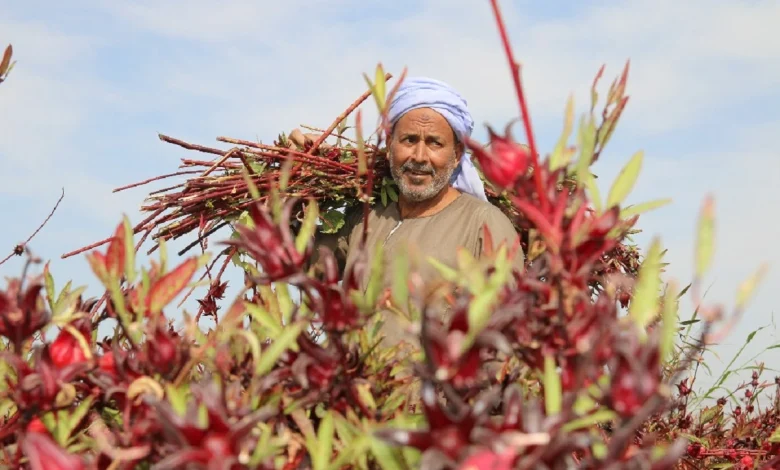
Among the vibrant, ruby red hibiscus calyces dangling from their stems, farmer Ali Fouad moves through his fields in the village of Tomas in Esna. A smile breaks across his weathered face,the reward after more than six months of careful cultivation. Here in the heart of Egypt’s south, the annual hibiscus harvest is more than an agricultural event; it’s a cultural tradition and a vital economic lifeline, particularly for the women of this community.
Fouad cuts the stems with a sharp blade and loads them onto a simple wooden cart, known locally as a karro. His destination is not a factory, but the homes of the village women, who are renowned masters of the delicate, skilled work of peeling the valuable flower pods.

Roots in Nubian Heritage
Tomas village in the Esna district has been defined by hibiscus for generations,” explains Fouad. The crop’s history here is intertwined with Egypt’s own. Following the construction of the Aswan High Dam in the 1960s, which flooded historic Nubian lands, President Gamal Abdel Nasser established this village to resettle displaced Nubian communities. They brought with them agricultural expertise, including the cultivation of karkadeh (hibiscus), which they had long grown in Aswan. The village’s location, with its reclaimed desert foothills, proved ideal for the drought-resistant plant, which thrives in well-drained, sandy soil.
A Community’s Mainstay
Hibiscus cultivation dominates the local economy. The village dedicates hundreds of acres (a feddan is roughly an acre) to the crop annually. For many families, their entire year revolves around this season.
There are two primary varieties: a prized dark-red “Saudi” type, known for its large flowers and high yield, which can fetch up to 200 Egyptian Pounds (approx. $6.50 USD) per kilogram, and a lighter red “Egyptian” type, priced around 120 EGP (approx. $3.90 USD) per kilo. A successful feddan can generate revenue of 60,000 EGP (approx. $1,950 USD) or more.


Economic Engine for Women
“This is our season,” says Umm Mohamed, a veteran of the peeling work. The process is a finely organised community operation. Before harvest, farmers designate a specific street for unloading. A coordinator then distributes sacks of fresh hibiscus to households. The women gather, often in courtyards or shaded areas, to carefully separate the fleshy red calyx from the seed pod inside.
“We earn 75 pounds for peeling one sack, which holds five trays,” Umm Mohamed explains. “That means 15 pounds per tray.” While the work is seasonal, lasting from December to February, it provides crucial income. A diligent woman can earn up to 4,000 EGP (approx. $130 USD) per month—a significant sum in this region, directly empowering them to support their households and children’s education.
From Local Staple to Global Commodity
According to Ali Qenawy, former head of the Luxor Farmers’ Syndicate, hibiscus has evolved from a local crop to a strategic agricultural export. “While exact figures are elusive, we estimate over 250 acres are dedicated to hibiscus in the Esna area alone,” he notes.
The crop’s journey is remarkable. “It originated in regions like Sudan and was perfected in Nubia. Today, Egyptian hibiscus, especially from Luxor and Aswan, is sought after worldwide,” Qenawy adds. It’s sold in local spice markets (souqs), exported internationally for herbal teas and supplements. It has become a symbolic souvenir, a “Gift from the South “for tourists visiting the ancient temples of the Nile.

The Cycle from Field to Cup
The harvest begins in late autumn. After manual cutting, the fresh calyces are peeled and spread on rooftops to dry under the intense, dry sun of Upper Egypt—a natural drying process that takes about five days. This sun-drying method is key to developing the tea’s signature tangy flavour and deep colour.

Challenges and Future Hopes
Despite its importance, farmers face mounting pressures. Global price volatility, rising costs for fertilizers, and increased labor expenses squeeze profits. This year alone, market prices jumped by nearly 100 EGP per kilo.
Looking ahead, farmers and community leaders see greater potential.Many advocate for establishing local processing and packaging facilities within Tomas itself. “Just as we’ve seen with sun-dried tomatoes, adding value here at home is the future,” one farmer argues. A local factory for grading, drying, and packaging could capture more revenue, provide year-round jobs for youth, and transform Tomas 3 from a supplier of raw materials into a recognised centre for premium hibiscus products.